Sadar Festival History and Meaning: The Story of Hyderabad's Dunnapothula Panduga
Sadar, or Dunnapothula Panduga, is the buffalo carnival of Hyderabad's Yadav community. Here is what it means, how the Narayanguda Pedda Sadar began, and why it is now a state festival.
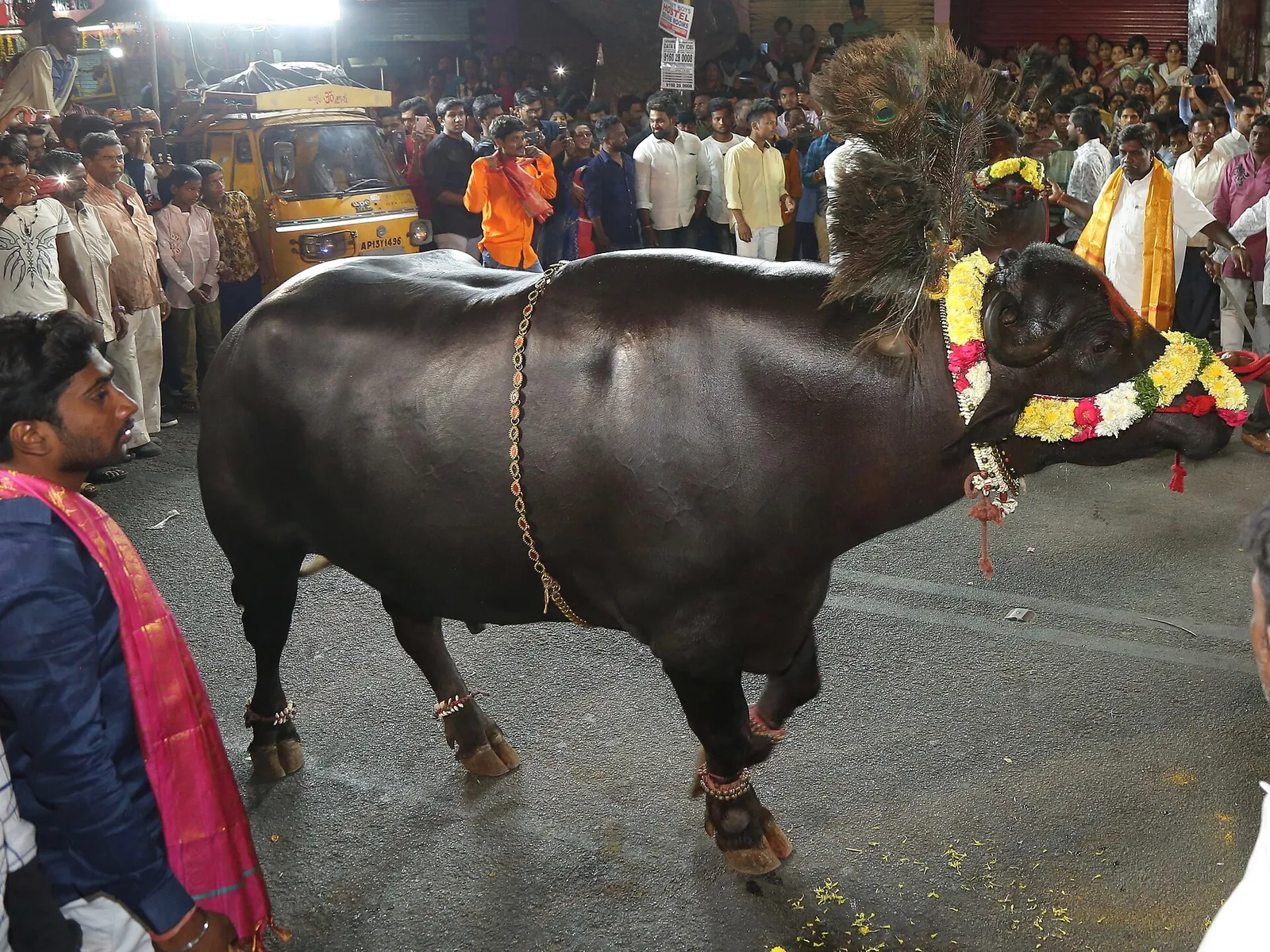
Every year around Diwali, the streets of Hyderabad fill with the sound of dappu drums and the sight of enormous, gleaming buffalo bulls. This is Sadar, also called Dunnapothula Panduga, the buffalo carnival of the city's Yadav community. It is loud, joyful and deeply rooted in faith, and it is unlike any other Diwali custom in India. This guide explains what the festival means, where it came from and why it matters to the people who keep it alive.
If you are looking for this year's dates, venues and practical advice, see our Sadar 2026 guide for Hyderabad. This page is about the story and meaning behind the celebration.
Sadar 2026 at a glance
- Diwali (Lakshmi Puja) falls on Sunday 8 November 2026.
- The Sri Krishna Sadar Sammelan was held on Wednesday 4 November 2026 at NTR Stadium, Hyderabad, as the official state-level event. It began with Go Puja and Sri Krishna puja.
- Chief Minister A. Revanth Reddy attended, announced Rs 5 crore for the Sadar celebrations and said the government will conduct the Sammelan officially every year.
- The Narayanguda Pedda Sadar is traditionally held two days after Diwali, which points to Tuesday 10 November 2026. As of 5 November the date had not been officially announced, so check the Hyderabad Traffic Police advisory (@HYDTP on X) before you go.
What Sadar and Dunnapothula Panduga mean
The festival goes by two names. Sadar (సదర్) is the name most Hyderabadis use, and it has become the familiar label for the parades and gatherings held across the city. Dunnapothula Panduga (దున్నపోతుల పండుగ) is the Telugu name, and it says exactly what the festival is: the "festival of the buffaloes". In Telugu, panduga means festival and dunnapothulu are buffalo bulls.
Both names point to the same idea. Sadar is a celebration of the buffalo, the animal on which the livelihood of the Yadav community has long depended. Decorated buffalo bulls, often of the Murrah breed, are worshipped and then paraded through the streets with dappu and teen maar drums, music and dancing. It is held as part of Diwali, so it shares the season of lamps and thanksgiving with the rest of the country, but it gives that season a character that is entirely Hyderabad's own. For the wider festival, see our Diwali 2026 guide.
The Yadav pastoral heritage behind Sadar
Sadar belongs to Hyderabad's Yadav (Golla-Kuruma) community, a community with a pastoral heritage centred on cattle. For families whose work and prosperity are tied to their animals, a healthy, strong herd is not just an asset; it is a blessing. Sadar is the moment when that blessing is publicly honoured.
This is why the festival feels both devotional and celebratory. The buffalo is not simply shown off as a prize animal. It is worshipped first, and only then paraded. The pride that owners take in their bulls sits alongside gratitude for what the animals give to the household and the community.
Underneath the spectacle, the festival remains a family and community occasion, carried forward from one generation to the next.
The origin story of Sadar
Like many living traditions, Sadar has a story that is told and retold. The modern Narayanguda Sadar is credited to the late Sri Salandri Nyayam Chowdhary Mallaiah Yadav.
According to most accounts, including Telangana Today and Wikipedia, he organised the first major gathering at Narayanguda YMCA in 1946. One report places the beginning in 1942 instead. Since the sources differ, it is fair to say that the modern Sadar took shape in the 1940s, with 1946 being the year most often cited.
Telangana Today describes how it began. Mallaiah Yadav travelled to Ujjain to seek blessings for the buffaloes, and on his return began an annual thanksgiving. That thanksgiving grew, year by year, into the Sadar carnival that Hyderabad knows today.
What is remarkable is the continuity. His family has run the Narayanguda Sadar every year since. A celebration that began as one man's act of gratitude has been kept alive by his descendants, and it has become one of the defining sights of Hyderabad's festive calendar.
Narayanguda and the Pedda Sadar
Sadar is celebrated in many neighbourhoods, but one gathering stands above the rest. The Narayanguda Sadar is known as the Pedda Sadar, or Grand Sadar, and it is the biggest of them all. It is held at Narayanguda YMCA, the same place where the modern festival is said to have begun.
The Pedda Sadar is traditionally held through the night two days after Diwali. In recent years it has run from about 7 pm to 3–4 am. In 2023, for example, it took place on 14 November, two days after Diwali on 12 November. The all-night format is part of its charm: the drums, the crowds and the parade of bulls continue long after most of the city has gone to sleep.
Sadar is also held in other localities across Hyderabad. Each has its own crowd and its own atmosphere, and together they turn the festival into a citywide celebration.
| Locality | Note |
|---|---|
| Narayanguda | Pedda Sadar (Grand Sadar), the biggest gathering, at Narayanguda YMCA |
| Shaikpet | Local Sadar celebration |
| Deepak Talkies area | Local Sadar celebration |
| Saidabad | Local Sadar celebration |
| Ameerpet | Local Sadar celebration |
| Khairatabad | Local Sadar celebration |
| Karwan | Local Sadar celebration |
| Langer Houz | Local Sadar celebration |
| Madhapur | Local Sadar celebration |
Go Puja and the Krishna and Govardhan connection
Sadar does not begin with a parade. It begins with Go Puja, the worship of cattle. At Narayanguda, the Chowdhary family performs the Go Puja that opens the festival, continuing the role their family has held since the beginning.
This opening ritual connects Sadar to one of the most beloved images in Hindu devotion: Lord Krishna as the cowherd. For a pastoral community, Krishna is not a distant figure. He is the divine herdsman who lived among cattle and cowherds, and honouring him alongside the herd is natural. Sadar is also linked with Govardhan traditions, which are observed in the same Diwali season. To learn more about that festival, read our Govardhan Puja and Annakut 2026 guide.
This devotional thread is visible even at the state level. The Sri Krishna Sadar Sammelan held on 4 November 2026 began with Go Puja and Sri Krishna puja, showing that worship remains at the centre of the festival however large it grows.
Why the buffaloes are decorated
The decorated buffalo bull is the symbol of Sadar. The decoration is an act of honour. Before the animals are paraded, they are worshipped, and dressing them up is a way of showing the respect and affection their owners feel for them. A well-presented bull reflects the care of the family that raised it.
The parade then turns that devotion into celebration. Accompanied by dappu and teen maar drums, music and dancing, the bulls move through the crowd, and some are made to rear up on their hind legs. These moments draw the loudest cheers of the night and display the strength of the animals and the skill of their handlers.
For spectators, the bulls are the stars of the show, and the arrival of star bulls from Haryana and other states adds to the excitement. But for the community, each decorated animal also carries the older meaning of the festival: thanksgiving for the herd that sustains the family.
From community festival to state festival
For much of its history, Sadar was a community celebration, organised by Yadav families and neighbourhood groups and watched by an ever-growing public. Its scale and popularity eventually earned it official recognition. The Telangana government issued a GO recognising Sadar as a state festival, placing it among the celebrations the state formally honours.
That recognition has continued to grow. In 2026, the Sri Krishna Sadar Sammelan was held at NTR Stadium as the official state-level event. Chief Minister A. Revanth Reddy attended, announced Rs 5 crore for the Sadar celebrations and said the government will conduct the Sammelan officially every year.
Even so, the heart of Sadar remains where it began: the Pedda Sadar at Narayanguda is still run by the family of its founder.
If you would like to share the spirit of the season, browse our Sadar wishes for 2026.
Frequently asked questions about Sadar
What does Dunnapothula Panduga mean?
Dunnapothula Panduga (దున్నపోతుల పండుగ) is the Telugu name for Sadar and means "festival of the buffaloes". It is the buffalo carnival of Hyderabad's Yadav (Golla-Kuruma) community, celebrated as part of Diwali.
Who started the Sadar festival in Hyderabad?
The modern Narayanguda Sadar is credited to the late Sri Salandri Nyayam Chowdhary Mallaiah Yadav. Most accounts, including Telangana Today and Wikipedia, say he organised the first major gathering at Narayanguda YMCA in 1946, while one report gives 1942. His family has run it every year since.
What is Pedda Sadar?
Pedda Sadar, or Grand Sadar, is the name for the Narayanguda Sadar, the biggest of Hyderabad's Sadar gatherings. It is traditionally held through the night two days after Diwali at Narayanguda YMCA.
How is Sadar connected to Lord Krishna?
The festival begins with Go Puja, the worship of cattle, and is linked with Lord Krishna as the divine cowherd and with Govardhan traditions. For a pastoral community whose life revolves around cattle, this connection gives the celebration its devotional heart.
Is Sadar an official Telangana festival?
Yes. The Telangana government issued a GO recognising Sadar as a state festival. In 2026 the Sri Krishna Sadar Sammelan was held at NTR Stadium on 4 November as the official state-level event.
Why are the buffaloes made to rear up?
Some decorated bulls are made to rear up on their hind legs during the parade. It is one of the most watched moments of Sadar and shows off the strength of the animal and the skill of the people who raise and handle it.
Photo credit: decorated buffalo bull at Hyderabad's Sadar, by Yadav.sadarhyd, via Wikimedia Commons, licensed CC BY-SA 4.0.

Share this with family and friends
Send it on WhatsApp, post it, or copy the link.
More from Festivals
- Mantras to Chant While Buying Gold on Dhanteras: Lakshmi and Kubera Mantras for Prosperity
- Hanumad Vratam 2026 in the UK and USA: Date, Margashirsha Hanuman Jayanti and Temple Observances
- Hindu Festival Dates That Differ Abroad in 2026: Kalabhairav Jayanti, Vivah Panchami, Utpanna Ekadashi and Arudra Darshan (UK and USA)
- Hindu Temple Events in the USA, December 2026: Vaikunta Ekadasi on December 19 or 20, Dhanurmasa and Ardra Darshan at Official Temple Calendars
- Hindu Temple Events in the UK, December 2026: Vaikunta Ekadasi, Gita Jayanti and Dhanurmasam at Official Temple Calendars
You might also like
Sadar Celebrations in Hyderabad 2026: Complete Guide to the Yadav Community's Vibrant Buffalo Carnival
Sadar 2026 Wishes: Happy Sadar Messages and Greetings for Dunnapothula Panduga
Diwali Crackers: History, Types and the Meaning Behind Fireworks, and What Every Hindu Should Know