Why Vishnu Offered His Eye to Shiva: The Thousand-Lotus Story Behind Vaikuntha Chaturdashi
Quick answer: On Vaikuntha Chaturdashi, Hindus remember how Vishnu worshipped Shiva with 1,000 lotuses, one for each of Shiva's thousand names. Shiva hid one lotus to test him. Vishnu, the "lotus-eyed", offered his own eye in its place, and Shiva gave him the Sudarshana Chakra. The Shiva Purana (Kot
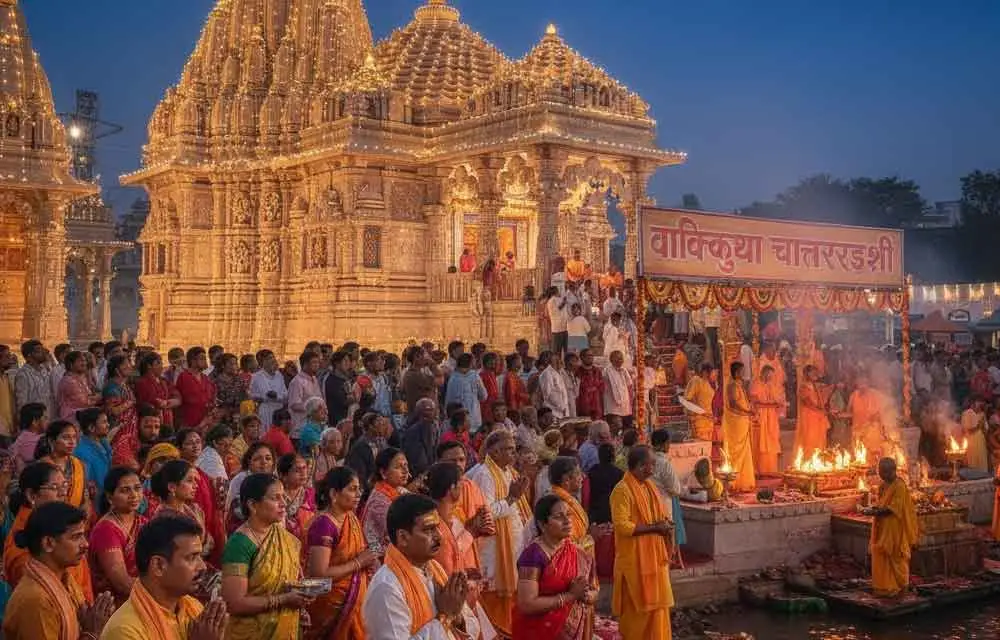
Quick answer: On Vaikuntha Chaturdashi, Hindus remember how Vishnu worshipped Shiva with 1,000 lotuses, one for each of Shiva's thousand names. Shiva hid one lotus to test him. Vishnu, the "lotus-eyed", offered his own eye in its place, and Shiva gave him the Sudarshana Chakra. The Shiva Purana (Kotirudra Samhita, chapters 34 to 36) and the Linga Purana (chapter 98) both tell the story, and the Linga Purana adds that Vishnu was called Padmaksha from then on. In 2026 the day falls on Monday 23 November in India and Sunday 22 November in the USA, Canada and the UK. On this one night, tulasi goes to Shiva and bilva goes to Vishnu.
Most of us know the outline of this story. Fewer know that two Puranas tell it in detail, that both set it in the Himalayas rather than in Kashi, or that the Shiva Mahimna Stotram turns it into one of its finest verses. This guide stays with the story: what the texts say, where they differ, why two sacred leaves change places for one night, and how to honour it at home on 23 November.
The thousand-lotus story, as the Puranas tell it
Two Puranas tell this story in full, and they agree on almost every step. Here is the Shiva Purana's version (Kotirudra Samhita, chapters 34 to 36).
- The crisis. Powerful daityas overrun the worlds and trample dharma. The devas bring their suffering to Vishnu, and he decides to win Shiva's help (34.5–10).
- The vow. Vishnu goes near Mount Kailasa, kindles a sacred fire and worships Shiva in the earthen-linga rite, with lotuses from Lake Manasa. He resolves not to move until Shiva is pleased (34.12–15).
- A lotus for every name. When Shiva still does not appear, Vishnu praises him with a thousand names, offering one lotus with each name (34.18–19). The Purana then lists those thousand names in the next chapter.
- The test. To test Vishnu's devotion, Shiva quietly hides one lotus (34.20; 36.2).
- "Is my own eye not a lotus?" At the last name, Sarvasattvavalambana ("the support of all beings"), the count is one short. Vishnu searches for the missing lotus, then reasons that his own eye is a lotus. He plucks it out and offers it with that last name (34.21–22; 36.4–5).
- Shiva appears. Shiva rises from the earthen linga Vishnu had worshipped and stops him (36.6–7).
- The gift. Shiva gives Vishnu the Sudarshana discus, bright as ten thousand suns and born from Shiva's own foot. Vishnu accepts it facing north and goes on to defeat the daityas (34.25–32; 36.15–16).
The linga at the centre of the story is remembered as Harishvara, "the Lord worshipped by Hari" (34.2–4).
"Where has the lotus gone? If it is gone, let it go. Is my own eye not a lotus?" Vishnu's thought in the Shiva Purana, Kotirudra Samhita 36.4 (HinduTone's translation).
What the Linga Purana adds
The Linga Purana tells the same episode in chapter 98, alongside the thousand names Vishnu recited. Three details stand out:
- The setting: Vishnu installs a linga on a Himalayan summit and offers a lotus with every name (98.20–26).
- The fire: When Vishnu offers his eye with the last name, Shiva comes down from the sacred fire (98.162–163).
- A new name: Shiva gives Vishnu the discus, bright as ten thousand suns, and an eye like a lotus. From then on, the Purana says, Vishnu is called Padmaksha, the lotus-eyed (98.170–177). Every time you chant Padmaksha or Kamalanayana, you are, in the Linga Purana's telling, remembering this night.
The Kashi version behind Vaikuntha Chaturdashi
Popular calendars and Kashi tradition set the story in Varanasi on Kartika Shukla Chaturdashi itself. Drik Panchang credits this telling to the Shiva Purana; in the Kotirudra chapters above, though, the setting is Kailasa and no date is given. Retellings that cite the Kartika Mahatmya of the Skanda Purana fill in the Kashi details:
- Vishnu bathes at Manikarnika Ghat and brings a thousand golden lotuses to the Vishveshvara linga.
- When the thousandth lotus is missing, he offers his eye, and Shiva gives him the Sudarshana.
- Shiva declares that the day will be famous as Vaikuntha Chaturdashi, and that on it Vishnu should be worshipped first and Shiva after.
HinduTone could not trace the exact chapter for this Kashi telling, so we present it as living tradition rather than a quoted text.
Three tellings at a glance
| Shiva Purana (Kotirudra 34–36) | Linga Purana (98) | Kashi and Kartika tradition | |
|---|---|---|---|
| Where | Near Mount Kailasa, at a sacred fire | A Himalayan summit | Varanasi: Manikarnika Ghat and the Vishveshvara linga |
| When | Not stated | Not stated | Kartika Shukla Chaturdashi |
| The lotuses | 1,000, from Lake Manasa | One with each name | 1,000 golden lotuses |
| The eye | Offered with the last name | Offered with the last name | Offered as the 1,000th lotus |
| Shiva's gift | The Sudarshana, born from his foot | The Sudarshana, a lotus-like eye and the name Padmaksha | The Sudarshana, and the day named Vaikuntha Chaturdashi |
Who gave Vishnu the Sudarshana Chakra? Three different answers
Ask around and you will hear several answers. That is because the texts themselves differ, and each answer says something about the text that gives it.
| Text | Who gives the discus | How it happens |
|---|---|---|
| Shiva Purana and Linga Purana | Shiva | As the reward for the thousand-lotus worship. The Linga Purana adds that Shiva first made the discus to kill the demon Jalandhara (98.11–19). |
| Vishnu Purana (3.2) and Markandeya Purana (105) | Vishvakarma | The Sun is too bright for his wife Sanjna, Vishvakarma's daughter, so Vishvakarma trims his radiance. From the trimmed light he makes Vishnu's discus, Shiva's trident and other divine weapons. |
| Mahabharata (Adi Parva, the burning of the Khandava forest) | Agni | Agni, who obtains it from Varuna, gives Krishna a fiery discus before the forest is burned. Varuna also gives Krishna the mace Kaumodaki. |
The answers need not cancel each other out. In the Shaiva Puranas the discus is the fruit of Vishnu's devotion. The Vishnu Purana calls the Sun's radiance Vishnu's own splendour, so its discus is made from Vishnu's own light. In the Mahabharata it arms Krishna for his work on earth.
The hymn that sings it: Shiva Mahimna Stotram, verse 19
The Shiva Mahimna Stotram, attributed to Pushpadanta and dated to around 850 CE, fits the whole story into four lines and adds a beautiful turn: the discus is Vishnu's devotion itself.
Devanagari
हरिस्ते साहस्रं कमलबलिमाधाय पदयोः
यदेकोने तस्मिन् निजमुदहरन्नेत्रकमलम् ।
गतो भक्त्युद्रेकः परिणतिमसौ चक्रवपुषा
त्रयाणां रक्षायै त्रिपुरहर जागर्ति जगताम् ॥
IAST
haris te sāhasraṃ kamala-balim ādhāya padayoḥ
yad ekone tasmin nijam udaharan netra-kamalam |
gato bhakty-udrekaḥ pariṇatim asau cakra-vapuṣā
trayāṇāṃ rakṣāyai tripura-hara jāgarti jagatām ||
Telugu
హరిస్తే సాహస్రం కమలబలిమాధాయ పదయోః
యదేకోనే తస్మిన్ నిజముదహరన్నేత్రకమలమ్ ।
గతో భక్త్యుద్రేకః పరిణతిమసౌ చక్రవపుషా
త్రయాణాం రక్షాయై త్రిపురహర జాగర్తి జగతామ్ ॥
Meaning: O destroyer of the three cities, Hari laid a thousand lotuses at your feet, and when one was missing he plucked out his own lotus-eye to complete the offering. That surge of devotion took the shape of the discus, which stays awake to guard the three worlds.
Why tulasi and bilva trade places on this one night
On any other day the rule is simple: tulasi goes to Vishnu and bilva goes to Shiva. Tulasi is so closely tied to Vishnu that she is married to him in the Tulasi Vivah, which falls just two days earlier this year, on Saturday 21 November. Bilva is the leaf Shiva devotees offer every Karthika Monday.
On Vaikuntha Chaturdashi the two leaves change hands:
- At Kashi Vishwanath, Vishnu offers tulasi to Shiva, and Shiva offers bilva to Vishnu.
- In Ujjain, Mahakal's bilva garland is placed on Lord Gopal, and Gopal's tulasi garland is placed on Mahakal.
Read next to the story, the swap makes sense. Vishnu gave Shiva the most precious thing he had, his own eye. On this night each god gives the other the leaf he loves most. The rule is not broken so much as shared.
The Skanda Upanishad puts the idea in a single verse (verse 8):
Devanagari
शिवाय विष्णुरूपाय शिवरूपाय विष्णवे ।
शिवस्य हृदयं विष्णुर्विष्णोश्च हृदयं शिवः ॥
IAST
śivāya viṣṇurūpāya śivarūpāya viṣṇave |
śivasya hṛdayaṃ viṣṇur viṣṇoś ca hṛdayaṃ śivaḥ ||
Telugu
శివాయ విష్ణురూపాయ శివరూపాయ విష్ణవే ।
శివస్య హృదయం విష్ణుర్విష్ణోశ్చ హృదయం శివః ॥
Meaning: Salutations to Shiva, whose form is Vishnu, and to Vishnu, whose form is Shiva. Vishnu is the heart of Shiva, and Shiva is the heart of Vishnu.
The next verse goes on: just as Vishnu is full of Shiva, so Shiva is full of Vishnu, and the one who sees no difference between them prays for a life of well-being (verse 9).
A small surprise about bilva
Bilva is no stranger in Vishnu's house. The Shri Suktam, recited in Lakshmi puja, says the bilva tree was born of Lakshmi's own tapas (verse 6):
Devanagari
आदित्यवर्णे तपसोऽधिजातो वनस्पतिस्तव वृक्षोऽथ बिल्वः ।
IAST
ādityavarṇe tapaso'dhijāto vanaspatis tava vṛkṣo'tha bilvaḥ |
Telugu
ఆదిత్యవర్ణే తపసోఽధిజాతో వనస్పతిస్తవ వృక్షోఽథ బిల్వః ।
Meaning: O Lakshmi, bright as the sun, born of your tapas is the king of trees, your own tree, the bilva.
On other days, keep to your family custom. Most homes do not offer tulasi to Shiva outside this night, and the exchange is what makes Vaikuntha Chaturdashi special.
Where the story is still lived: Kashi, Ujjain and Thiruveezhimizhalai
Kashi (Varanasi).This is the one day in the year when Vishnu is given a special place of honour inside the sanctum of Kashi Vishwanath, and the temple is said to become as holy as Vaikuntha itself. Shiva devotees take a pre-dawn dip at Manikarnika Ghat, the Manikarnika Snan. The next evening the ghats light up for Dev Deepawali. Planning a visit? See our Kashi Vishwanath temple guide.
Ujjain (Madhya Pradesh).Hari-Har Milan is the story played out in the streets. Around 11 PM, Lord Mahakal leaves the Mahakaleshwar temple in a silver palanquin, passes Gudri Chauraha and Patni Bazaar, and reaches Gopal Mandir, the Dwarkadhish temple. There the garlands are exchanged, and Mahakal is said to hand the care of creation back to Hari. In 2026 it is expected on the night of Monday 23 November; check the temple's notice for the time, and keep children close in the crowd. More in how Ujjain celebrates Karthika Masam 2026.
Thiruveezhimizhalai (Tamil Nadu).In Tiruvarur district stands the Veezhinathar temple, whose Shiva is also called Netrarpaneswarar, "the Lord to whom an eye was offered". Its temple tradition says this is where Vishnu made his offering. The image shows the offered eye at the Lord's feet, with the discus below it, and devotees offer small eye symbols of silver, gold or copper. The nearby temples of Thirumalpur and Thiruppaigneeli tell the same episode.
Maharashtra.Maharashtrian tradition credits Shivaji and his mother Jijabai with setting the custom there. Jijabai wished to offer a thousand white lotuses at the Jagadishwar temple, untouched by any other hand. A courtier, Vikram Dalvi, is said to have cut the stems with arrows and gathered the flowers with tongs from a boat.
Rishikesh.The day is kept as a festival of lamps on the Ganga, and the lamps are made of flour so that they dissolve in the water. It is a good model for any family floating lamps this Karthika.
Vaikuntha Chaturdashi 2026: date and the midnight window
| India | USA, Canada and UK | |
|---|---|---|
| Date | Monday 23 November 2026 | Sunday 22 November 2026 |
| Chaturdashi tithi | 2:36 AM to 11:42 PM IST on 23 November | New York: Sun 4:06 PM to Mon 1:12 PM EST. London: Sun 9:06 PM to Mon 6:12 PM GMT |
| Shiva puja at Arunodaya (before sunrise) | Monday 23 November. In Hyderabad, from about 4:49 AM until sunrise at 6:25 AM | Monday 23 November before sunrise, while Chaturdashi is still running |
| Vishnu puja at Nishita (midnight) | Night of Monday 23 November (city times below) | Night of Sunday 22 November (city times below) |
Karthika Pournami follows on Tuesday 24 November in India.
The 2026 twist.This year Chaturdashi ends at 11:42 PM IST, just as the midnight window opens. On India's east coast the window opens early enough to catch some Chaturdashi; in the west it opens after the tithi has changed.
| City | Nishita window, night of Monday 23 November | Chaturdashi inside the window |
|---|---|---|
| New Delhi | 11:41 PM to 12:35 AM | About 1 minute |
| Hyderabad | 11:37 PM to 12:28 AM | About 5 minutes |
| Vijayawada | 11:28 PM to 12:19 AM | About 14 minutes |
| Visakhapatnam | 11:18 PM to 12:09 AM | About 24 minutes |
| Chennai | 11:30 PM to 12:21 AM | About 12 minutes |
| Bengaluru | 11:41 PM to 12:31 AM | About 1 minute |
| Varanasi | 11:18 PM to 12:11 AM | About 24 minutes |
| Ujjain | 11:47 PM to 12:40 AM | None |
| Mumbai | 11:59 PM to 12:51 AM | None |
Abroad, on the night of Sunday 22 November, Chaturdashi covers the whole window (local time): New York 11:14 PM to 12:11 AM, Toronto 11:35 PM to 12:33 AM, Dallas 11:46 PM to 12:41 AM, San Francisco 11:28 PM to 12:24 AM, London 11:16 PM to 12:18 AM.
What this means in India: if you want the Vishnu puja to fall within Chaturdashi, begin around 11:00 to 11:15 PM and make the main offering before 11:42 PM, then continue into the midnight window. Otherwise follow your family's custom or your temple's timing; temples publish their own schedules.
How we worked these out: Nishita is the 8th of the 15 muhurtas between sunset and the next sunrise. HinduTone's calculation matches Drik Panchang's New Delhi window to the minute; other cities may differ from your local panchang by a minute or two.
For Telugu families: Monday 23 November is also the second Karthika Somavaram, so many homes will already keep a Shiva fast that day, and the night Vishnu puja makes it a complete Hari-Hara day. See Karthika Somavaram 2026. For every country's date, see our Vaikuntha Chaturdashi 2026 date guide.
A thousand-lotus puja at home, scaled for a flat
You do not need a temple tank full of lotuses. What the story asks for is one offering with each name.
- Set up a Hari-Hara corner. Place a small Shivalinga or a picture of Shiva beside a Vishnu or Krishna image on a clean cloth, with a ghee lamp on a metal plate. If open flames are not allowed in your building, use an LED diya.
- Pick the leaves in daylight. Many families avoid plucking tulasi after sunset, so pick a few tulasi leaves and a few whole bilva sets on Sunday afternoon and keep them in water.
- Dawn on Monday: Shiva first, with tulasi. Before sunrise, offer water to Shiva, then a few tulasi leaves for this once-a-year exchange, and chant Om Namah Shivaya 108 times.
- Through the day. Fast if your health allows (fruit and milk are common), or simply keep to sattvic food. Elders, pregnant women and anyone with diabetes should not fast strictly.
- Evening: tell the story. Read the story above aloud. Children can count out the flowers. When you tell it to them, describe the eye as a picture of giving your very best.
- Night: Vishnu's thousand names, with bilva. In the Nishita window, recite the Vishnu Sahasranama and offer one flower, one petal or a few grains of akshata with each name, as devotees do with lotuses on this night. Place a few bilva leaves before Vishnu. If time is short, use the 108 names of the Ashtottara.
- Close with the Hari-Hara verses. Recite Mahimna Stotram verse 19 and Skanda Upanishad verse 8 from above. If you like, offer your last flower with the name at which Vishnu's lotuses ran out: ॐ सर्वसत्त्वावलम्बनाय नमः · oṃ sarvasattvāvalambanāya namaḥ · ఓం సర్వసత్త్వావలంబనాయ నమః ("salutations to the support of all beings").
- Arati and prasad. Wave the lamp, share the prasad, and put out every flame before you sleep.
For the full list of slokas, see our pooja slokas and mantras page.
Do's and don'ts
| Do | Don't |
|---|---|
| Take a few tulasi leaves from the top shoots | Strip a tulasi plant bare |
| Use whole bilva sets with all three leaflets | Offer torn or wilted leaves |
| Buy lotuses from a florist or a temple stall | Pick lotuses from temple tanks or protected ponds |
| Keep lamps on a metal plate, away from curtains | Leave a lamp burning unattended or near sleeping children |
| At Manikarnika or the Shipra, go with others and stay within the marked bathing areas | Take a cold pre-dawn dip if you are unwell, elderly or alone |
| At Hari-Har Milan, hold children's hands and stay at the edges of the crowd | Push toward the palanquin or stand close to fireworks |
| Compost used flowers or use the temple's nirmalya bin | Throw flowers into rivers in plastic bags |
For NRI families: dates, substitutes and smoke alarms
- Your date is Sunday 22 November in the USA, Canada and the UK. Do the Vishnu puja on Sunday night (times above) and the Shiva puja before sunrise on Monday, while Chaturdashi is still running.
- Australia, New Zealand, Singapore and the Gulf: check the country table in our date guide. In Sydney the tithi at sunrise on 23 November is still Trayodashi, so local temples may choose a different day.
- No lotuses? Any fresh flowers, petals or akshata will do. One offering with each name keeps the spirit of the story.
- No bilva? Indian grocery stores and temple shops sometimes stock fresh or dried bael leaves. If you cannot find any, offer akshata in their place.
- Tulasi in winter: keep the pot by your brightest window and pick only a few leaves.
- Smoke alarms: incense and camphor smoke can set them off. Open a window, keep lamps away from detectors, or use an LED diya. Never disable a smoke alarm.
- Watch from afar: check the official websites of Kashi Vishwanath and Mahakaleshwar for live darshan on the day.
Frequently asked questions
Why did Vishnu offer his eye to Shiva?
Vishnu had vowed to worship Shiva with a thousand lotuses, one for each of Shiva's thousand names. Shiva hid one lotus to test him. Rather than leave the vow incomplete, Vishnu, whose eyes are compared to lotuses, offered one of his own eyes. Shiva appeared at once and rewarded him with the Sudarshana Chakra.
Which Purana tells the story of Vishnu's thousand lotuses?
The Shiva Purana tells it in the Kotirudra Samhita (chapters 34 to 36), and the Linga Purana tells it in chapter 98, alongside the thousand names Vishnu recited. The Shiva Mahimna Stotram sums it up in verse 19. Kashi tradition and Kartika Mahatmya retellings set it in Varanasi on Kartika Shukla Chaturdashi.
Did the thousand-lotus worship happen in Kashi or near Kailasa?
It depends on the telling. The Shiva Purana places it near Mount Kailasa, with lotuses from Lake Manasa, and the Linga Purana places it on a Himalayan summit. Neither names a date. The Varanasi setting on Kartika Shukla Chaturdashi comes from Kashi tradition and Kartika Mahatmya retellings, and it is the version behind Vaikuntha Chaturdashi.
Who gave Vishnu the Sudarshana Chakra?
The texts differ. In the Shiva Purana and the Linga Purana, Shiva gives it to Vishnu after the thousand-lotus worship, and the Linga Purana says Shiva first made it to kill the demon Jalandhara. In the Vishnu Purana, Vishvakarma forges it from the Sun's trimmed radiance. In the Mahabharata, Agni gives Krishna a fiery discus before the burning of the Khandava forest.
Why is Vishnu called Padmaksha, the lotus-eyed?
Padmaksha and Kamalanayana both mean lotus-eyed. The Linga Purana ties the name to this story: after Vishnu offered his eye, Shiva gave him an eye resembling a lotus, and from then on he was called Padmaksha.
What was the last name Vishnu chanted before offering his eye?
Sarvasattvavalambana, meaning the support of all beings. In both the Shiva Purana and the Linga Purana it is the last of the thousand names, so Vishnu reached it with no lotus left and offered his eye instead.
Why are tulasi and bilva exchanged on Vaikuntha Chaturdashi?
On ordinary days tulasi belongs to Vishnu's worship and bilva to Shiva's. On this one day each is offered to the other: at Kashi Vishwanath, Vishnu offers tulasi to Shiva and Shiva offers bilva to Vishnu, and in Ujjain the two deities exchange bilva and tulasi garlands. The swap shows Hari and Hara as one.
Can tulasi be offered to Shiva on other days?
Most families keep tulasi for Vishnu and Krishna and do not offer it to Shiva on ordinary days. The exchange on Vaikuntha Chaturdashi is the well-known exception. If your family or temple follows a different custom, follow it.
Which temple remembers Vishnu offering his eye?
The Veezhinathar (Netrarpaneswarar) temple at Thiruveezhimizhalai in Tiruvarur district, Tamil Nadu. Its temple tradition says this is where Vishnu offered his eye, and the name Netrarpaneswarar means the Lord to whom an eye was offered. The image shows the offered eye at the Lord's feet, with the discus.
When is Vaikuntha Chaturdashi 2026, and when is the midnight puja?
In India it is Monday 23 November 2026, and Chaturdashi tithi runs from 2:36 AM to 11:42 PM IST. The Nishita window is 11:41 PM to 12:35 AM in New Delhi and about 11:37 PM to 12:28 AM in Hyderabad. In the USA, Canada and the UK it is Sunday 22 November.
Can I do a thousand-lotus puja at home without lotuses?
Yes. Offer one flower, one petal or a few grains of akshata with each name of the Vishnu Sahasranama during the night puja. If time is short, the 108 names of the Ashtottara are a shorter, widely used alternative. The heart of the story is one offering with each name, and any flower keeps that.
Conclusion
The thousand-lotus story is short, but it carries a whole way of seeing. Vishnu searches the earth for one lotus and then offers his own eye; Shiva, who hid the lotus, gives back far more than he took. That is why, for one night a year, tulasi goes to Shiva and bilva goes to Vishnu. On Monday 23 November (Sunday 22 November abroad), tell the story at home, offer one flower with each name, and let the two leaves change places.
Related reads on HinduTone
- Vaikuntha Chaturdashi 2026: date, Nishita time and Hari-Hara Milan
- Panchangam for Monday 23 November 2026
- Ksheerabdi Dwadasi and Tulasi Vivah 2026
- Karthika Somavaram 2026 dates
- Karthika Pournami 2026
- Dev Deepawali 2026
- How Ujjain celebrates Karthika Masam 2026
- Kashi Vishwanath Temple, Varanasi
- Karthika Masam 2026 guide
- November 2026 Hindu festival calendar
- Why Hindus avoid non-veg in Karthika Masam
- Nagula Chavithi: do snakes really drink milk?
- Why 365 wicks on Karthika Pournami
- Bhakta Kannappa, the devotee who offered his eyes to Shiva
More Karthika Masam reads
Share this with family and friends
Send it on WhatsApp, post it, or copy the link.
More from Festivals
- 12 Jyotirlingas in Karthika Masam 2026: State-Wise List, Karthika Specialities, Somavaram and Pournami Visits, Darshan and Travel Guide
- First Governor-Hosted Diwali in Idaho: Senator Jim Risch Welcomes Boise's Growing Indian Community
- Why Hindus Should Not Eat Non-Veg in Karthika Masam: 7 Reasons from Scripture, Sadhana and Season
- Today in Margasira Masam 2026, Day 30 (7 Jan): Tithi and Sunrise Time
- Today in Margasira Masam 2026, Day 29 (6 Jan): Tithi and Sunrise Time
You might also like
Anant Chaturdashi 2026 — Date (September 5), 14-Knot Vishnu Thread Puja Vidhi, Mantras & NRI Guide
Narayana Suktam: Full Sanskrit Text with IAST, Meaning and How to Chant

Nagula Chavithi 2026: Why Milk Is Offered at the Snake Mound, and Do Snakes Really Drink It?