
Kaviyoor Mahadeva Temple (Thrikkaviyoor)
Shiva with Parvati (Thrikkaviyoorappan); famous Hanuman shrine temple · Kaviyoor, Pathanamthitta, Kerala, India
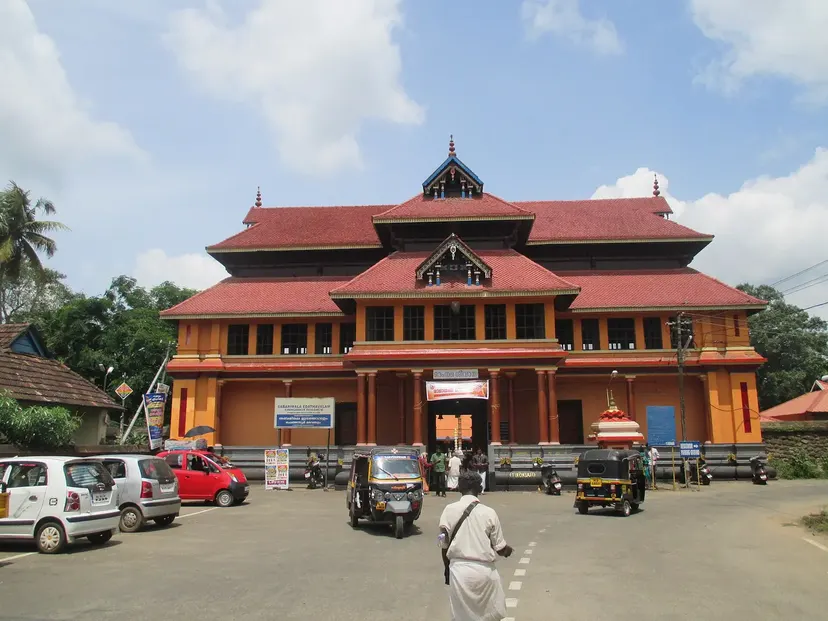
The Kaviyoor Mahadeva Temple, also called the Thrikkaviyoor Mahadeva Temple, is an ancient Shiva temple at Kaviyoor in Pathanamthitta district, Kerala, about 6 km east of Thiruvalla town. The main deity, called Thrikkaviyoorappan, is Shiva seated with Parvati. A shrine to Hanuman within the temple draws devotees from across Kerala.
The temple is under the Travancore Devaswom Board, which lists Kaviyoor as a Special Grade sub-group in its Thiruvalla group. Two stone inscriptions on the base of its round sanctum date from the mid-10th century CE, making them among the oldest temple records in Kerala.
Faith & Tradition
Religious Significance of Kaviyoor Mahadeva Temple (Thrikkaviyoor)
According to the temple's account, Shiva is worshipped here in a gentle, joyful form, seated on a lotus and embracing Parvati, so that both are present in a single image. The linga is described as earthen and about two and a half feet tall. Dakshinamurthy and Ganapathi are installed on the south side of the sanctum, and on the west side the goddess Parvati is worshipped as Sreemoolarajeswari. A Mahavishnu temple known as Keezhthrikkovil stands at a lower level outside the compound, and serpent deities are worshipped in the outer courtyard.
The temple's origin story links it to the Ramayana. According to legend, Rama and Sita stopped here on their way back to Ayodhya after defeating Ravana, and Rama sent Hanuman to the Himalayas for a suitable Shiva linga. When the auspicious hour drew near and Hanuman had not returned, Rama shaped a linga from the local earth and darbha grass and installed it. Hanuman returned and could not move the linga, so he begged to remain near it forever. Devotees believe this is why Kaviyoor is a home of Hanuman. Tradition also holds that one of the lingas Hanuman brought is the one installed at the nearby Thrikkakudi cave temple.
A second tradition tells that the sage Vilwamangalam saw Hanuman in an ilanji tree in the courtyard and asked him to come inside. Hanuman is said to have settled in the north-western corner of the inner courtyard. The temple describes the Hanuman shrine as one of the best-known in Kerala, and his annual festival draws very large crowds. The temple also notes that many songs of Padayani, the ritual art of central Travancore, praise Thrikkaviyoorappan.
Heritage
History of Kaviyoor Mahadeva Temple (Thrikkaviyoor)
The temple's oldest records are two Vattezhuthu inscriptions on the granite base of the sanctum, dated Kali era 4051 and 4052 (about 950–951 CE). According to the temple, the first records a land grant by Makizhancheri Thevan Chennan to pay for a perpetual lamp, sandal paste and incense. The second records a gift of paddy fields by two men of the Mangalathu household to meet the cost of worship. The donated lands lay in Kuttanad, at places such as Kidangara, Kumarankari, Kottankari and Eera. The temple notes that the inscriptions show the full daily round of five poojas was already established, and that historians count them among the oldest inscriptions found in Kerala.
According to the temple, it was controlled for centuries by ten families of Kaviyoor village, and a record of 1530 CE lists them. The Travancore government took over the temple in 1900 and ranked it among the major devaswoms of the state. Its lands passed to the government under the Travancore land settlement of 1921, and ownership later passed to the Travancore Devaswom Board when the Board was formed. The Sreemoolarajeswari image was installed in the early 1890s on the orders of Maharaja Sri Moolam Thirunal. In the early 1930s, after a dream of Maharaja Chithira Thirunal, the Hanuman shrine was rebuilt and given full daily worship. A copper flagmast was installed in the 1930s and was replaced with a gold-covered one in 2006.
Architecture and sacred features
The temple stands on a small rise and is reached by about 21 broad steps leading to the eastern gopuram, which opens into a long elephant hall (anakkottil). According to the temple, the large circular sanctum has 44 rafters and a sandhara plan (with an inner passage). Its granite base is divided into 21 courses, and the inscriptions are carved on its moulding. The sanctum, the namaskara mandapam, the Hanuman shrine, the nalambalam and the lamp gallery are all roofed in copper.
The temple notes that the architectural historians Stella Kramrisch and H. Sarkar placed the sanctum in the early phase of Kerala temple architecture, a view supported by the 10th-century inscriptions. Hundreds of wood carvings decorate the sanctum walls and the ceilings of the namaskara mandapam, gate hall and bali-stone pavilion. Wikipedia records a laterite outer wall enclosing about two acres, gopurams on the south and west, and the Polachira lake to the west.
Plan Your Visit
Darshan and Visitor Information
Kaviyoor is an active Travancore Devaswom Board temple with traditional Kerala temple customs. The busiest times are the Hanuman Jayanti and Thiruvutsavam seasons in Dhanu (December–January). Confirm current timings, dress rules and offering arrangements with the Kaviyoor Devaswom sub-group office before visiting.
Timings and arrangements change with seasons and festivals. Confirm current details with Travancore Devaswom Board (Kaviyoor sub-group) before travelling. Last reviewed 1 November 2026.
Sacred Calendar
Festivals at Kaviyoor Mahadeva Temple (Thrikkaviyoor)
Hanuman Jayanti
A seven-day festival begun in the 1950s after the Hanuman shrine was restored, ending with a kalabham (sandal paste) abhishekam at noon and a flower abhishekam in the evening; the temple says it draws tens of thousands of devotees.
Thiruvutsavam
A ten-day festival that begins with the flag-hoisting on the Thiruvathira asterism, with processions to the surrounding villages, the Pallivetta on the ninth day and the Arattu in the Manimala river on the tenth.
Sahasrakalasam
Ten days of tantric kalasa rites, begun in 1907, ending with a kalabhabhishekam on the eleventh day.
Maha Shivaratri
Special poojas and processions, with the temple's lamps lit at midnight by the surrounding villages.
Uthrattathi (Sreemoolarajeswari festival)
Marks the installation of Sreemoolarajeswari on the western side, with special poojas and a procession on elephant.
Location
How to Reach Kaviyoor Mahadeva Temple (Thrikkaviyoor)
The temple says Kaviyoor is about 6 km east of Thiruvalla. It can be reached by travelling about 2 km from the Manakkachira or Thottabhagam junctions on the Thiruvalla–Pathanamthitta road, or about 11 km from Changanassery along the Kaviyoor road to the eastern gate.
Kerala Tourism's festival data sheet gives Thiruvalla railway station as about 6.5 km away, Kizhakkanethu Junction bus stop as about 500 m and Cochin International Airport as about 110 km.
Location: Kaviyoor, Pathanamthitta, Kerala, India
Nearest airport: Cochin International Airport (about 110 km, per Kerala Tourism)
Nearest railway station: Thiruvalla (about 6.5 km, per Kerala Tourism)
More in Hindu temples in Kerala · Shiva with Parvati (Thrikkaviyoorappan); famous Hanuman shrine temples · Temples in Kaviyoor · Temples in Thiruvalla Taluk · Temples in Pathanamthitta District
Questions
Kaviyoor Mahadeva Temple (Thrikkaviyoor): Frequently Asked Questions
Which deity is worshipped at Kaviyoor Mahadeva Temple?
The main deity is Shiva seated with Parvati, known as Thrikkaviyoorappan. The temple is also famous for its Hanuman shrine.
Why is Kaviyoor associated with Hanuman?
According to legend, Rama installed the Shiva linga here, and Hanuman, unable to move it, asked to stay near the shrine forever. The temple describes its Hanuman shrine as one of the best-known in Kerala.
How old is Kaviyoor Mahadeva Temple?
Its oldest records are two inscriptions on the sanctum base, dated Kali era 4051 and 4052 (about 950–951 CE), so the sanctum is at least that old.
Is this the same as the Kaviyoor rock-cut cave temple?
No. The rock-cut cave temple (Thrikkakudi) is a separate site about 1 km away. Tradition links the two, holding that a linga brought by Hanuman was installed in the cave temple.
When is Hanuman Jayanti celebrated at Kaviyoor?
On the Moolam asterism in the month of Dhanu (December–January), at the end of a seven-day festival.
Who manages Kaviyoor Mahadeva Temple?
The Travancore Devaswom Board, which lists Kaviyoor as a Special Grade sub-group in its Thiruvalla group.
How do I reach Kaviyoor Mahadeva Temple?
Kaviyoor is about 6 km east of Thiruvalla. Thiruvalla railway station is about 6.5 km away, and the temple is about 2 km from the Manakkachira or Thottabhagam junctions on the Thiruvalla–Pathanamthitta road.
Sources and attribution
- Kaviyoor Devaswom (archived temple website) — Thrikkaviyoor Mahadeva Temple – overview, administration and architecture (Malayalam; Wayback Machine copy, 2015)
- Kaviyoor Devaswom (archived temple website) — Charithrasakshyam – inscriptions and history (Malayalam; Wayback Machine copy, 2015)
- Kaviyoor Devaswom (archived temple website) — Prathishta mahatmyam – deities (Malayalam; Wayback Machine copy, 2015)
- Kaviyoor Devaswom (archived temple website) — Aithihyangal – legends (Malayalam; Wayback Machine copy, 2015)
- Kaviyoor Devaswom (archived temple website) — Aattaviseshangal – festivals (Malayalam; Wayback Machine copy, 2015)
- Travancore Devaswom Board — Revised grade of sub groups, ROC No. 1169/15/Est-I dated 09/02/2015 (Wayback Machine copy)
- Department of Tourism, Government of Kerala — Kaviyoor Hanuman temple festival – data sheet (1000 Festivals of Kerala)
- Wikipedia — Kaviyoor Mahadevar Temple
Further reading: Kaviyoor Mahadeva Temple (Thrikkaviyoor) on Wikipedia (CC BY-SA 4.0).
Spotted an error? Write to info@hindutone.com — see our editorial policy.
Pilgrim Circuit