Baijnath Temple Complex
Shiva as Vaidyanath (Baijnath), with a celebrated standing image of Parvati temple · Baijnath (Garur), Bageshwar, Uttarakhand, India
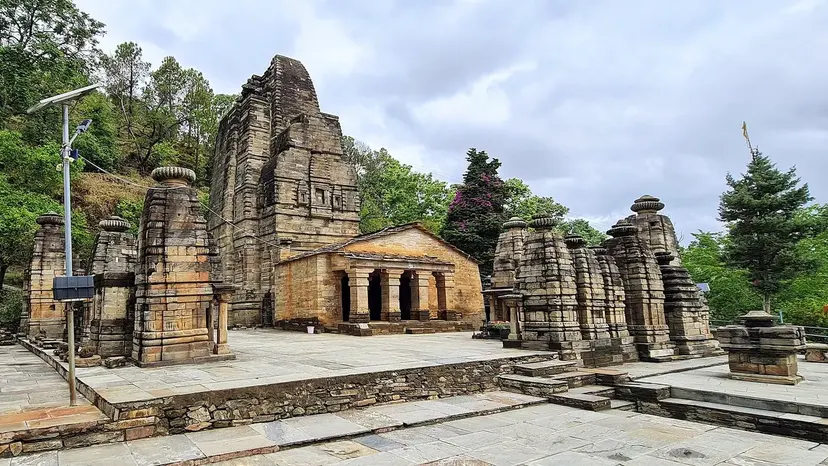
The Baijnath Temple Complex is a group of ancient stone temples on the left bank of the Gomti river at Baijnath, in the Garur area of Bageshwar district, Uttarakhand. The Archaeological Survey of India (ASI) protects it as a group consisting of a main shrine of Shiva, known as Baijnath or Vaidyanath, and seventeen subsidiary shrines.
Baijnath lies in the Katyuri valley and is identified with Kartikeyapura, the old capital of the Katyuri kings, the earliest ruling dynasty of the central Himalayan region. The complex is best known for its standing image of the goddess Parvati, carved in grey schist, which the Bageshwar district administration calls ancient and magnificent. Pilgrims gather here especially at Shivaratri and Makar Sankranti.
Faith & Tradition
Religious Significance of Baijnath Temple Complex
The main shrine is dedicated to Shiva as Vaidyanath, worshipped in the form of a linga; according to Wikipedia, the name Baijnath is a later form of Vaidyanath. Many other deities are represented in the complex. Incredible India, the Ministry of Tourism's portal, lists images of Parvati, Nritya Ganapati (dancing Ganesha), Kartikeya, Narasimha, Brahma, Mahishasuramardini, the Sapta Matrikas, Surya, Garuda and Kubera. Wikipedia counts 102 stone images at the site, some still in worship and others kept by the ASI.
The image of Parvati is the complex's most celebrated work of art. Incredible India describes it as a standing figure of grey schist wearing a crown of 26 miniature images. Outside the Vaidyanath shrine sits a life-size image of Kal Bhairava, according to both Incredible India and Wikipedia.
Local traditions add to the site's sacred standing. According to folklore recorded by Incredible India, Shiva and Parvati were married here, and another story holds that the temples were built in a single night, with two left unfinished. These are matters of belief rather than history.
Heritage
History of Baijnath Temple Complex
According to the ASI, Baijnath is identified with ancient Kartikeyapura and is believed to have become the seat of the Katyuris when they moved their capital here from Joshimath, in present-day Chamoli district, sometime in the eighth century AD. The Bageshwar district administration likewise describes Baijnath as the former Katyuri capital. Incredible India dates the temples to the 9th–12th centuries AD and attributes them to the Katyuri rulers.
Wikipedia records that inscriptions dating to 1202 CE have been found in the complex, that the temples were restored and rebuilt in the reign of King Gyan Chand, and that the complex was plundered by the Rohillas in 1743–44, when the spire of the main shrine was destroyed. This fits the ASI's observation that the original shikhara of the main temple is lost. The flight of stone steps leading up from the river is traditionally said to have been built on the orders of a Katyuri queen.
Immediately to the west, in the village of Tallihat, the ASI protects three more temples: the Lakshmi Narayan temple, which bears an inscription of Saka 1214 (AD 1292) near its doorway, the massive Rakshas Deval, and the ruined Satyanarayan temple.
Architecture and sacred features
The ASI describes the main Baijnath temple as pancharatha in plan (with five projections on each side), consisting of a sanctum with a projecting portico. Its plinth has five base mouldings, but the rest of the wall is plain. The original shikhara has been lost, and the present roof is a later clerestoried tin shed supported on a wooden frame. The other shrines in the group are similar in plan and elevation; among the important ones the ASI names the Kedareswar, Lakshmi-narayan and Brahmani Devi temples. Incredible India describes the shrines as examples of the Nagara style.
According to the ASI, the nearby Lakshmi Narayan temple at Tallihat has a sanctum in the rekha style with a pyramidal-roofed mandapa, triratha in plan with balconied transepts, and the ASI compares it with Odishan temples. Wikipedia gives the elevation of the Baijnath complex as 1,125 m.
Plan Your Visit
Darshan and Visitor Information
The Baijnath complex is both a place of worship and an ASI-protected monument. Respect any restrictions on photography and on touching sculptures, and do not climb on the old structures. The site is busiest at Shivaratri and Makar Sankranti. Confirm current timings and arrangements locally or with the ASI Dehradun Circle before visiting.
Timings and arrangements change with seasons and festivals. Confirm current details with Monument protected by the Archaeological Survey of India (Dehradun Circle) before travelling. Last reviewed 1 November 2026.
Sacred Calendar
Festivals at Baijnath Temple Complex
Maha Shivaratri
Incredible India and Wikipedia record pilgrims gathering at the complex on Shivaratri.
Makar Sankranti
Devotees gather at Baijnath on Makar Sankranti, according to Incredible India and Wikipedia.
Location
How to Reach Baijnath Temple Complex
According to the Bageshwar district administration, Baijnath is 19 km from Kausani and 26 km from Bageshwar. Wikipedia places the temples in the eastern part of the town, by the Gomti river. Incredible India notes the Kot Bhramari Devi temple about 3 km away, and the district administration mentions the Kotkimai temple about 8 km away on the Gwaldam road.
Location: Baijnath (Garur), Bageshwar, Uttarakhand, India
More in Hindu temples in Uttarakhand · Shiva as Vaidyanath (Baijnath), with a celebrated standing image of Parvati temples · Temples in Bimola · Temples in Garud Tehsil · Temples in Bageshwar District
Questions
Baijnath Temple Complex: Frequently Asked Questions
How many temples are in the Baijnath complex?
The ASI lists a main shrine of Shiva and 17 subsidiary shrines, so 18 temples in all. Three more ASI-protected temples stand in nearby Tallihat village.
Who built the Baijnath temples?
They are attributed to the Katyuri kings, whose capital Kartikeyapura is identified with Baijnath. Incredible India dates the temples to the 9th–12th centuries AD.
What is the Baijnath Parvati idol?
A standing image of Parvati carved in grey schist, wearing a crown of 26 miniature images, according to Incredible India. It is the best-known sculpture of the complex.
Why is the main temple roofed with a tin shed?
The ASI notes that the original shikhara was lost and replaced by a later clerestoried tin roof on a wooden frame. Wikipedia records that the spire was destroyed when the Rohillas plundered the complex in 1743–44.
How far is Baijnath from Kausani and Bageshwar?
According to the Bageshwar district administration, Baijnath is 19 km from Kausani and 26 km from Bageshwar.
Sources and attribution
- Archaeological Survey of India, Dehradun Circle — Monuments of Bageshwar district: Group of ancient temples (Baijnath or Vaidyanath) and Tallihat temples
- Ministry of Tourism, Government of India (Incredible India) — Baijnath Temple
- District Administration Bageshwar, Government of Uttarakhand — Baijnath
- Wikipedia — Baijnath Temple Complex
Further reading: Baijnath Temple Complex on Wikipedia (CC BY-SA 4.0).
Spotted an error? Write to info@hindutone.com — see our editorial policy.