
Firecracker Safety for Children in Europe: A Parent's Guide to a Safe Diwali
A parent's guide to a safer Diwali in Europe: 12 firework and sparkler safety tips, the EU age limits, what the rules say in Germany, the Netherlands, Ireland, Austria and France, burn first aid and a family checklist.

Last updated: 25 October 2026.
Quick answer: children should watch fireworks, not handle them. Across most of Europe, Diwali night (Sunday 8 November 2026 on HinduTone's Drik-aligned calendar) is not a legal fireworks night for families: Germany limits private F2 fireworks to 31 December and 1 January, the Netherlands and Ireland allow the public only the smallest F1 items, and Austria bans F2 in built-up areas. Plan a sparkler-only or firework-free celebration, or go to a permitted community display.
Diwali is the festival of lights, and many Indian families in Europe want to share the sparkle of fireworks with their children. Europe is different from India: fireworks are tightly controlled, and in many countries the main legal fireworks night is New Year. This guide gives parents safety tips, a country overview from official sources, burn first aid and family ideas for a safe, happy Diwali.
Sources checked on 25 October 2026: Directive 2013/29/EU, the City of Heidelberg (Baden-Württemberg service portal), Rijksoverheid.nl, the Irish Department of Justice on gov.ie, an Austrian Interior Ministry reply published by the Austrian Parliament, sante.fr (DGCCRF information), the NHS and the EU Your Europe portal.
Why firework safety matters for children
Fireworks are explosives, and even small ones get extremely hot. Children are curious and quick, may pick up a firework that seems to have gone out, and often wear festive clothes such as lehengas, dupattas and long sleeves that catch sparks easily. In Europe there is one more risk: fireworks bought in one country may be illegal in the next, and unlabelled or illegal products are more dangerous.
No firework is completely safe for children. The aim is to cut the risk: adults handle everything, children watch from a distance, and water is ready before anything is lit.
Fireworks rules country by country
EU law sets the categories and minimum sale ages, but each country decides how and when fireworks may be used. We checked the official sources below on 25 October 2026. Where we could not confirm the current rule from an official source, the table tells you who to ask.
| Country | What the official source says | Diwali night for families |
|---|---|---|
| EU (all member states) | Directive 2013/29/EU: categories F1 to F4; minimum sale age 12 (F1), 16 (F2), 18 (F3); countries may raise these | Depends on national and local law |
| Germany | Private persons over 18 may use F2 ("Silvesterfeuerwerk") without a permit only on 31 December and 1 January; other days need a municipal exception permit, with no right to one | No F2 without a municipal permit; ask your Gemeinde or Stadtverwaltung |
| Netherlands | Consumers may only use F1 fireworks, such as cap pops, small fountains and sparklers, with F1 and a Dutch manual on the packaging | Only F1 items |
| Ireland | Only Category 1 (very low hazard) is on sale to the public; other categories only for organised displays by professional operators under licence | Only Category 1 items such as sparklers and party poppers |
| Austria | F2 use in built-up areas (Ortsgebiet) is banned in principle (PyroTG 2010 § 38(1)); a mayor may make local exceptions by ordinance | Check with your Gemeinde whether any exception applies |
| France | F1 from 12 years; F2 and F3 from 18; municipal or prefectoral orders can restrict sale, transport and carrying of fireworks at certain times | Check with your mairie or préfecture |
| Italy | Not verified from an official source for this guide | Check with your comune |
| Belgium | Not verified from an official source for this guide | Check with your commune or gemeente |
| Switzerland | Not verified from an official source for this guide | Check with your canton and Gemeinde or commune |
| Spain | Not verified from an official source for this guide | Check with your ayuntamiento |
| Sweden and the Nordics | Not verified from an official source for this guide | Check with your local police and municipality |
Rules can change quickly, and local bans often apply near hospitals, care homes, churches and in old town centres. Always confirm with your local authority before buying anything.
12 firecracker safety tips for parents in Europe
1. Check the law where you live first
Diwali falls in early November, which is outside the usual fireworks window in many European countries. Use the table above, then confirm with your town hall or local authority.
2. Choose a community display
Temples and Indian community groups sometimes organise Diwali events with permitted displays. Check the organiser's own website for dates and safety rules, and watch from the spectator area.
3. Only adults light fireworks
Even where a child may legally buy F1 items, an adult should light every firework and sparkler. Choose one sober adult to light and another to watch the children.
4. Buy only legal, labelled products
Look for the category (F1, F2 or F3), the CE marking, the age limit and instructions in your language; sante.fr advises reading the label carefully and following its safety distance. Never bring fireworks from India or from another country where the rules are different, and never buy unlabelled products.
5. Read the label and keep the distance
Every firework label gives a minimum age and safety distance. Read it in daylight, before the celebration, and keep children behind that distance.
6. Treat sparklers as real fireworks
- Keep sparklers away from toddlers and babies.
- An adult lights each sparkler, one at a time.
- Children hold a sparkler only with an adult right beside them, and never in a crowd.
- Drop each finished sparkler into a bucket of water; the wire stays hot after the sparks stop.
7. Keep water ready
Put a bucket of water or a garden hose next to the lighting area before you start, and a second bucket just for used sparklers.
8. Never go back to a dud
Do not relight or pick up a firework that did not go off. Keep children well away from it, wait, then soak it in water before disposing of it.
9. No fireworks in hands or pockets
sante.fr warns parents to talk to children about the danger of holding lit firecrackers: every year fingers are lost in games where someone holds a lit banger as long as possible. Never put fireworks in pockets and never throw them.
10. Watch the weather
Strong wind can carry burning debris into dry grass or onto balconies. If it is windy, postpone or skip fireworks altogether, and never use them on a balcony.
11. Make diyas and winter clothing part of the plan
Place oil diyas and candles where children and pets cannot reach them, away from curtains and coats. Scarves, winter jackets and dupattas can brush flames, so tie back long hair and tuck in loose ends. LED diyas are a good choice for children's rooms.
12. Think about neighbours and pets
Many neighbours will not expect fireworks in November. Let them know about your celebration, keep pets indoors, and give babies and noise-sensitive children a quiet room.
Burn first aid: 5 steps
This is general first aid based on the NHS burns and scalds page, not medical advice for your child. If in doubt, call 112.
- Move the child away from the heat. Remove clothing or jewellery near the burn, but not anything stuck to the skin.
- Hold the burn under cool running water for 20 minutes, as soon as possible. If there is no running water, use cool bottled water or a wet towel.
- Do not put creams, oils or butter on the burn, do not cover it with plasters or sticky dressings, and do not burst blisters.
- When the burn has cooled, lay cling film over it if you can, without wrapping it around a limb.
- Call 112 or go to the emergency department for a very large or deep burn, a burn on the face, genitals or bottom, or a chemical or electrical burn.
Fun and safer ways to celebrate Diwali with children
- Go to a temple or community Diwali event with a permitted display.
- Light LED diyas and fairy lights with the children, and let them choose where each one goes.
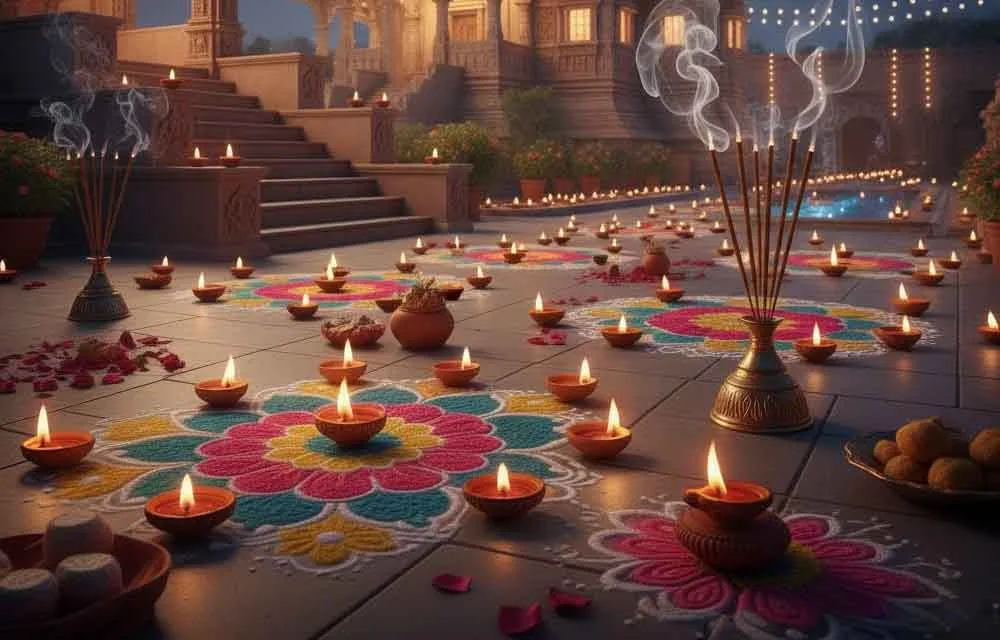
- Make a rangoli together with coloured rice, flower petals or chalk.
- Paint clay diyas earlier in the week, then let an adult light the oil lamps.
- Tell the story of Rama and Sita returning to Ayodhya, or of Goddess Lakshmi, at bedtime.
- Use glow sticks and glow bracelets instead of sparklers for younger children.
- Make Diwali sweets together and share them with neighbours, with a note explaining the festival.
- Join the family Lakshmi Puja and let children ring the bell or offer flowers.
- Video-call grandparents in India so the children can share their celebration.
For events and traditions near you, see Diwali 2026 celebrations in European countries and Diwali celebrations in Germany 2026. For more ideas, read our guide to an eco-friendly, cracker-free Diwali.
Parents' Diwali night safety checklist
- I have checked the fireworks rules for my country and town.
- Any fireworks are legal, labelled with the category and CE marking, and suitable for the date.
- Fireworks are stored in a closed box, out of children's reach.
- One adult is in charge of lighting and another is watching the children.
- Children will stay behind the safety distance on the label.
- A bucket of water or a hose is ready, plus a bucket of water for sparklers.
- No toddler will hold a sparkler, and no child will be left alone with one.
- Long hair is tied back and scarves, dupattas and loose sleeves are tucked away.
- Diyas and candles are out of reach and away from curtains and coats.
- I know the burn first aid steps, and 112 is the number to call.
Frequently asked questions
Can we set off fireworks in Europe on Diwali night?
Usually not, apart from the smallest F1 items such as sparklers. Germany allows private F2 fireworks without a permit only on 31 December and 1 January; the Netherlands now allows consumers only F1; Ireland sells only Category 1 to the public; and Austria bans F2 in built-up areas unless the mayor makes an exception. Diwali 2026 is Sunday 8 November on HinduTone's Drik-aligned calendar, so for most families a community display is the realistic option.
What do the F1, F2, F3 and F4 labels mean?
They are the EU fireworks categories in Directive 2013/29/EU. F1 fireworks present a very low hazard and negligible noise and can include indoor items; F2 are low hazard for outdoor use in confined areas; F3 are medium hazard for large open areas; and F4 are high-hazard fireworks for people with specialist knowledge only.
How old does my child have to be to buy fireworks in the EU?
The Directive sets minimum ages for sale: 12 for F1, 16 for F2 and 18 for F3, and lets countries raise them. Some do: France lists 18 for F2 and F3. Even where a child may legally buy F1 items, an adult should still supervise every use.
Are sparklers safe for young children?
No firework is completely safe. Sparklers burn very hot, so keep them away from toddlers, never leave a child alone with one, have an adult light it, and drop the finished wire into a bucket of water. Many parents choose glow sticks or LED lights for younger children instead.
What number do I call in an emergency in Europe?
Call 112. The EU Your Europe portal describes 112 as the European emergency number, and it works across the EU alongside national numbers. For a burn, start cooling it under cool running water while you or someone else makes the call.
Final thoughts
Diwali is about light, family and the victory of good over evil, and none of that depends on fireworks. In Europe, a family celebration with LED diyas, rangoli, sweets and stories, or a visit to a permitted community display, is often the safest and most legal choice. Wherever you live, keep an adult in charge, children at a distance and water close by.
Editor's note (25 October 2026): Country rules in this guide were checked on 25 October 2026 against the official sources listed below. We could not open the German federal regulation text (1. SprengV) or the Austrian legal database directly, so the German rule is taken from a municipal service page and the Austrian rule from an Interior Ministry reply published by the Austrian Parliament. We could not verify current rules for Italy, Belgium, Switzerland, Spain or the Nordic countries from official sources, so we tell you who to ask instead.
Official sources: Directive 2013/29/EU, Article 6 (categories); Directive 2013/29/EU, Article 7 (age limits); Stadt Heidelberg: Private Feuerwerke, Ausnahmegenehmigung; Rijksoverheid: Welk vuurwerk mag ik nog afsteken?; Rijksoverheid: Vuurwerk; gov.ie Department of Justice: Fireworks; Austrian Parliament: Interior Ministry reply on F2 fireworks in built-up areas (2019); sante.fr: Pétards et feux d'artifice, quels sont les risques ?; NHS: Burns and scalds; Your Europe: Single emergency number 112.
Disclaimer: This article is general safety information for parents, not legal or medical advice. It does not replace advice from your doctor, the emergency services, your town hall or the police. In an emergency, call 112.
Related guides
- Also read: Diwali cracker safety: precautions to prevent accidents and protect street dogs and birds
- Also read: Firecracker safety for children in the UK: a parent's guide
- Also read: Firecracker safety for children in Canada: a parent's guide
- Also read: Firecracker safety for children in the USA: a parent's guide
Share this with family and friends
Send it on WhatsApp, post it, or copy the link.
More from Festivals
- How Indian Americans Celebrate Diwali: A Complete Guide
- Diwali Celebrations Around the World 2026: 30 Countries
- Akshaya Tritiya 2027 (Akha Teej): Date, Tritiya Tithi, Puja Muhurat and Gold Buying Time by City, Vidhi and Significance
- Diwali in Bangladesh 2026: Kali Puja Date & Traditions
- Firecracker Safety for Children in South Africa: A Parent's Guide to a Safe Diwali
You might also like
Firecracker Safety for Children in the UK: A Parent's Guide to a Safe Diwali

Firecracker Safety for Children in Canada: A Parent's Guide to a Safe Diwali
Firecracker Safety for Children in Australia: A Parent's Guide to a Safe Diwali (2026)
