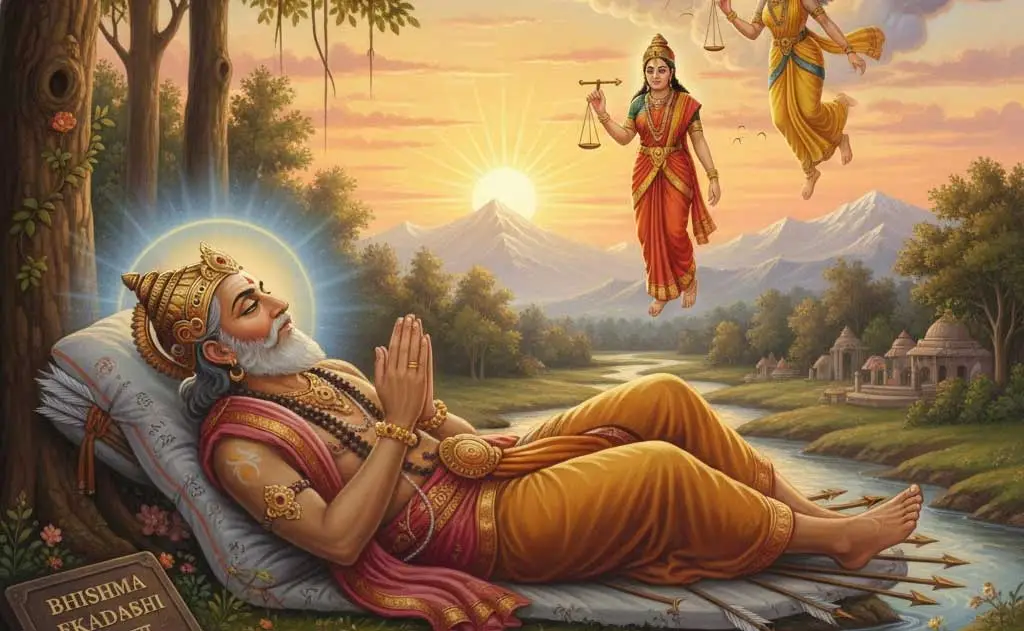
Masik Shivaratri Vrat Katha: The Hunter and the Bilva Tree, and How the Versions Differ
Quick answer: the story most families read on Masik Shivaratri is the story of the hunter who spent a night in a bilva tree. Without knowing it was Shivaratri, he stayed awake and fasting, and water and bilva leaves fell from the tree onto a Shiva linga below, so his night became a Shivaratri puja.
Quick answer: the story most families read on Masik Shivaratri is the story of the hunter who spent a night in a bilva tree. Without knowing it was Shivaratri, he stayed awake and fasting, and water and bilva leaves fell from the tree onto a Shiva linga below, so his night became a Shivaratri puja. The story appears in more than one Purana, and the details differ: in the Shiva Purana the hunter is Gurudruha and the night turns on his meeting with a family of deer; in the Skanda Purana he is Canda, waiting for a wild boar; in the Garuda Purana he is Sundarasena, a Nishada king of Arbuda who hunts with his dogs. A popular modern retelling, King Chitrabhanu's memory of a past life as the hunter Suswara, is also widely read.
There is no single fixed "Masik Shivaratri katha". The texts that tell the hunter's story tell it about Shivaratri in general. The Garuda Purana version says the vow may be kept on the same night every month, and that is how the story came to be read each month. Below, each version is told as its source tells it, followed by how tradition reads it and our own short comment, kept separate.
The story in the Shiva Purana: Gurudruha and the deer
Source: Shiva Purana, Koti Rudra Samhita, chapter 40, "The glory of Shivaratri" (English translation edited by J. L. Shastri, on wisdomlib.org).
The story. Gurudruha was a Bhilla, a forest hunter, strong and harsh, with a large family. He killed deer every day and also stole. He had done no good deed in his life, and he did not know that the day was Shivaratri. That day his hungry parents, wife and children asked him for food. He went into the forest, found nothing to hunt by sunset, and was afraid to go home empty-handed. He climbed a bilva tree beside a pond where animals came to drink, carrying water with him, and waited.
Under the tree, unknown to him, stood a Shiva linga.
In the first part of the night a doe came to drink. As he drew his bow, some of his water spilled and bilva leaves fell onto the linga. The text counts this as the puja of the first watch of the night. The doe pleaded to be allowed to leave her young with her sister or her mate first, and swore a solemn oath that she would come back. He let her go.
Her sister came searching for her. Again he took aim, again water and leaves fell on the linga: the puja of the second watch. The second doe made the same promise with an oath, and he let her go too.
In the third part of the night the stag came looking for them. The same thing happened: the puja of the third watch. The stag asked to tell his family first. By now, the text says, the hunter's mind had begun to change, but he answered that none of the others had come back. The stag swore an oath, and the hunter released him.
The three deer met, comforted their young, and decided to keep their word. Each offered to go alone; in the end they all came together, with the fawns following. In the fourth watch, as the hunter saw them, water and leaves fell on the linga once more, and the text says his sins were burned away. The deer asked him to make use of their bodies.
Through that night's unknowing worship, the text says, knowledge he had never had arose in him. He praised the deer, blamed his own life, put away his arrow and let them go. Shiva appeared before him and named him Guha. Shiva told him he would live at Shringaverapura, his family would prosper, and Rama would one day come to his house as a friend. The deer, at the sight of Shiva, were freed from their animal birth and rose to heaven. Shiva, the text adds, became known there as Vyadheshvara on Mount Arbuda. The chapter ends by praising the Shivaratri vow above other vows.
The story in the Skanda Purana: Canda and his wife
Source: Skanda Purana, Maheshvara Khanda, Kedara Khanda, chapter 33, "The greatness of Shivaratri vrata" (G. V. Tagare translation, on wisdomlib.org).
Canda was a hunter who netted fish and killed deer, birds and other animals; the text adds that he even killed Brahmanas. On the fourteenth night of the dark half of Magha he sat in a bilva tree, bow in hand, waiting for a wild boar, with water kept in his quiver. Watching without sleep, he broke off bilva leaves that fell onto a linga at the root of the tree, and water he rinsed his mouth with fell on it too. The text calls this worship done "by sheer good luck".
His wife, Ghanodari, went looking for him and also went without food and sleep that night. At dawn she found him by the river with food she had brought; while they bathed, a dog ate all of it. She was angry and wanted to drive the dog away, but Canda said he was content that the dog had eaten, and reflected that the body does not last. Shiva's attendants came for them in celestial chariots, and Virabhadra told Canda that Shiva was pleased with his keeping awake on Shivaratri. Both were taken to Shiva's presence. There are no deer in this version, and no promises.
The story in the Garuda Purana: Sundarasena and his dog
Source: Garuda Purana, chapter 124, "The Siva Ratra Vratam" (M. N. Dutt translation, on wisdomlib.org).
Here Shiva himself tells the story to Gauri. Sundarasena, a cruel Nishada king of the Arbuda country, went hunting with his dogs. Tired and hungry, he rested through the night in a bower by a pool on a hilltop, where there was a linga and a bilva tree. As he moved, the tree shook and its leaves fell on the linga. He sprinkled water from the pool to settle the dust, and drops fell on the linga. Bending to pick up a fallen arrow, he touched it. He sat awake all night. He did all this, the text says, unknowingly and for another purpose.
Years later, when he died, the messengers of Death came to take him, but Shiva's attendants overpowered them and took him, with his faithful dog, to Shiva's world. The chapter then describes the vow itself: self-control on the thirteenth day, a fast on the fourteenth, worship in each quarter of the night, hearing the story told, and breaking the fast the next day. It says the vow may be kept for twelve years, or on this same night in each month.
The popular retelling: King Chitrabhanu and the hunter Suswara
Source: Swami Sivananda, "Shivaratri", a chapter of Hindu Fasts and Festivals (Divine Life Society, dlshq.org).
In this telling, King Chitrabhanu of the Ikshvaku line was keeping a Shivaratri fast with his queen when the sage Ashtavakra asked him why. The king remembered his past life as Suswara, a hunter of Varanasi. Caught by night in the forest with a deer he had killed, Suswara climbed a bilva tree, stayed awake, hungry and thirsty, and dropped leaves while he wept for his waiting family. Leaves and tears fell on a linga at the foot of the tree. The next day he sold the deer, and before eating he gave food to a stranger who asked. At his death, Shiva's messengers took him to Shiva's abode; after long ages there he was born as Chitrabhanu.
Swami Sivananda says that Bhishma refers to this story in the Shanti Parva of the Mahabharata. We have not been able to check that reference against a translation of the Mahabharata, so we give the story as Swami Sivananda's retelling. Some modern katha booklets add other details, such as the hunter being locked in a temple over a debt; we have not found these in the Purana texts above.
The versions side by side
| Shiva Purana | Skanda Purana | Garuda Purana | Sivananda's retelling | |
|---|---|---|---|---|
| Hunter | Gurudruha, a Bhilla | Canda, a forest hunter | Sundarasena, Nishada king of Arbuda | Suswara of Varanasi (later King Chitrabhanu) |
| Why he was in the tree | Waiting for deer at a pond | Waiting for a wild boar | Resting in a bower by a pool | Shelter from the night |
| What fell on the linga | Water and bilva leaves, once in each watch | Bilva leaves and water | Bilva leaves, water, and his touch | Bilva leaves and tears |
| Deer | A doe, her sister and the stag, who keep their word | None | None named | One already killed |
| Others in the story | The deer and their fawns | His wife Ghanodari | His dog | His family; a stranger he feeds |
| Outcome | Named Guha; Rama's future friend; the deer freed | Taken to Shiva's presence with his wife | Taken to Shiva's world with his dog | Shiva's abode, then rebirth as a king |
The other Shivaratri story, of Brahma and Vishnu and the endless pillar of light (Lingodbhava), explains why the midnight hour is kept. It is told briefly in our Masik Shivaratri city guide and in our Nishita Kaal puja guide.
How tradition reads the story
Across all the versions, the texts make the same points, and devotees usually draw these lessons from them:
- the elements of a Shivaratri vrat are a fast, a night awake, water, and bilva offered to the linga;
- even worship done without knowing is counted by Shiva;
- the night is divided into watches, which is why many families offer an abhishekam in each quarter of the night on Maha Shivaratri;
- in the Shiva Purana, the hunter's change of heart, letting the deer go, is what comes right before Shiva appears.
Editorial comment
These are sacred stories, and we have tried to tell them as the sources do. Two things are worth saying plainly. First, the stories praise the night's devotion; they are not about the hunting. In the fullest version, the turning point is mercy: a man who could not feed his family lets the deer live because they kept their word. Second, the texts describe rewards in their own terms. We repeat what they say, but this page does not promise any result from keeping the vrat.
How to read the katha on Masik Shivaratri
- When: in the evening before the puja, or at Nishita Kaal itself. For December 2026 the night is Monday 7 December in India and Sunday 6 December in the USA, Canada and the UK; see Masik Shivaratri December 2026 for every city.
- How: one person reads, others listen. Children usually follow the deer story easily.
- With the puja: offer water and bilva while the story is read, if you like, as in the story. How to do abhishekam at home gives the order of offerings, and the Bilvashtakam is commonly recited with the bilva offering. For mantras and stotras, use the texts on our pages or your own family prayer book.
- At home abroad: our apartment Shivling puja guide covers setup and safe lamps.
Health note: if you fast while keeping the vigil, do it as your health allows. Children, older people, pregnant or breastfeeding women and anyone with a medical condition or on regular medication should speak to a doctor first, and can listen to the katha and do the puja without fasting.
Frequently asked questions
Which story is read on Masik Shivaratri?
Most commonly the hunter and the bilva tree. Families may read the Shiva Purana version (Gurudruha and the deer), a shorter retelling, or the Chitrabhanu story. There is no single required text.
Which Purana has the hunter story?
The Shiva Purana (Koti Rudra Samhita, chapter 40), the Skanda Purana (Kedara Khanda, chapter 33) and the Garuda Purana (chapter 124 in M. N. Dutt's translation) all tell a version, with different names and details.
What was the hunter's name?
It depends on the version: Gurudruha in the Shiva Purana, Canda in the Skanda Purana, Sundarasena in the Garuda Purana, and Suswara in Swami Sivananda's retelling of the Chitrabhanu story. "Lubdhaka", heard in many retellings, is a Sanskrit word for a hunter.
Is the Shivaratri katha only for Maha Shivaratri?
The texts tell it about Shivaratri in general. The Garuda Purana says the vow may be kept on this night every month, so many families read the same story on each Masik Shivaratri. See Masik Shivaratri vs Maha Shivaratri.
Sources
Shiva Purana, Koti Rudra Samhita, ch. 40, ed. J. L. Shastri (wisdomlib.org); Skanda Purana, Maheshvara Khanda, Kedara Khanda, ch. 33, tr. G. V. Tagare (wisdomlib.org); Garuda Purana, ch. 124, tr. M. N. Dutt (wisdomlib.org); Swami Sivananda, "Shivaratri", Hindu Fasts and Festivals (dlshq.org). Dates computed with HinduTone's panchang engine (Drik Panchang method).
Share this with family and friends
Send it on WhatsApp, post it, or copy the link.
More from Festivals
- Karthika Masam 2026 in Qatar, Oman, Bahrain, Kuwait and Saudi Arabia: Dates, Somavarams and a Home Worship Guide
- Karthika Masam 2026 in South Africa: Dates, Somavarams and Pournami Times for Durban, Pietermaritzburg, Johannesburg, Pretoria and Cape Town
- Kanakadasa Jayanti 2026: Date (27 November), the Life of the Haridasa Saint-Poet and How Karnataka Observes It
- Dattatreya's 24 Gurus: Spiritual Lessons from Nature, from the Bhagavata Purana
- Kalashtami December 2026: Date, Ashtami Time, and Why It Is 30 December, Not 31
You might also like
Masik Shivaratri 2027 Dates: Monthly Shivaratri List, Nishita Kaal Times and Dates Abroad
Masik Shivaratri vs Maha Shivaratri: What Is the Difference?
Masik Shivaratri December 2026: Date, Nishita Kaal by City and Why the Day Differs Abroad