Masik Shivaratri vs Maha Shivaratri: What Is the Difference?
Quick answer: both are Shivaratris, "nights of Shiva", kept on Krishna Chaturdashi, the 14th day of the waning moon, and both are fixed by the same rule: the night on which Chaturdashi covers Nishita Kaal, the midnight window, in your city. Masik Shivaratri comes every lunar month, twelve or thirtee
Quick answer: both are Shivaratris, "nights of Shiva", kept on Krishna Chaturdashi, the 14th day of the waning moon, and both are fixed by the same rule: the night on which Chaturdashi covers Nishita Kaal, the midnight window, in your city. Masik Shivaratri comes every lunar month, twelve or thirteen times a year. Maha Shivaratri is one of them: the Shivaratri of Magha in the South Indian (amanta) calendar, which is Phalguna in the North Indian (purnimanta) calendar. It is the year's great Shiva festival, kept on a larger scale. In 2027 Maha Shivaratri is on Saturday 6 March in India.
The two are not separate traditions. Maha Shivaratri is the monthly Shivaratri of one particular month, raised to a festival. That is the whole difference, and everything else below follows from it.
Comparison table
| Masik Shivaratri | Maha Shivaratri | |
|---|---|---|
| Meaning of the name | Monthly night of Shiva (masa = month) | Great night of Shiva |
| Tithi | Krishna Chaturdashi of every lunar month | Krishna Chaturdashi of Magha (amanta) / Phalguna (purnimanta) |
| How often | 12 or 13 times a year (13 in 2027, counting Maha Shivaratri) | Once a year |
| Date rule | The night on which Chaturdashi covers local Nishita Kaal | The same rule |
| Main puja time | Nishita Kaal | Nishita Kaal; many also worship in each of the four prahars (quarters) of the night |
| Typical observance | Day fast as health allows, evening lamp, abhishekam and japa at midnight | Fuller fast, four-prahar puja, all-night jagaran, temple festivals |
| Temples | Many hold an evening abhishekam | Major festival at most Shiva temples |
| Date abroad | Can be a day earlier or later than India | Same: can differ by a day |
| 2027 dates (India) | 5 Jan, 4 Feb, 6 Mar, 5 Apr, 4 May, 3 Jun, 2 Jul, 31 Jul, 30 Aug, 28 Sep, 27 Oct, 26 Nov, 25 Dec | Saturday 6 March 2027 |
The 2027 dates come from our own Masik Shivaratri 2027 dates list and Maha Shivaratri 2027 guide.
What is the same
The tithi. Every Shivaratri, monthly or great, is a Krishna Chaturdashi: the fourteenth day of the dark fortnight, the night before Amavasya (new moon).
The time. The heart of the night is Nishita Kaal, the eighth of the fifteen muhurtas between sunset and the next sunrise. Shaiva tradition links this hour with Shiva's manifestation as the endless pillar of light (Lingodbhava). Our Nishita Kaal puja guide explains it in detail.
The date rule. Because the rule is local, both the monthly and the great Shivaratri can fall on different calendar dates in different countries. In December 2026, for example, Masik Shivaratri is on Monday 7 December in India and on Sunday 6 December in the USA, Canada and the UK; the full city table is in Masik Shivaratri December 2026. In 2027 Maha Shivaratri is on the night of Saturday 6 March in India and most of the world, but, according to our Maha Shivaratri 2027 guide, on the night of Friday 5 March in Los Angeles, the Bay Area, Seattle and Vancouver.
The worship. Water or milk abhishekam, bilva leaves, white flowers, a lamp and the Panchakshari "Om Namah Shivaya" are the core in both. The same stotras are read, such as the Bilvashtakam and the 108 names of Shiva.
The story. The hunter who kept a night's vigil in a bilva tree is told for both. One of the Purana versions, in the Garuda Purana, describes the Shivaratri vow for the fourteenth night of the waning moon between Magha and Phalguna, and then adds that it may be kept on the same night in each month. Our Masik Shivaratri vrat katha page gives the versions side by side.
What is different
The month. Only one Krishna Chaturdashi in the year is Maha Shivaratri. The month has two names because India uses two ways of counting months. In the amanta system (Telugu, Kannada, Marathi, Gujarati calendars) a month ends at the new moon, so the Chaturdashi before the Phalguna new moon falls in Magha. In the purnimanta system (most of North India) a month ends at the full moon, so the same night is already in Phalguna. It is the same night either way; only the label differs.
The scale. Maha Shivaratri is a festival: temples stay open late or all night, many families keep jagaran, and the four-prahar puja (an abhishekam in each quarter of the night) is widely done. The Masik Shivaratri is a quieter monthly vrat, often a single puja at home.
The fast. On Maha Shivaratri many devotees keep a stricter, full-day fast and break it the next morning. On Masik Shivaratri, many keep a lighter fast or one meal, especially on a working day. Customs vary by family and region on both nights.
Special Shivaratris during the year. Some monthly Shivaratris carry their own names: the Shravana (Sawan) Shivaratri in North India (Saturday 31 July 2027 in India, per our 2027 list), and the Karthika Masa Shivaratri in the Telugu calendar, which in 2026 is Monday 7 December and falls on the last Karthika Somavaram (Karthika Masa Shivaratri 2026). These are still Masik Shivaratris, kept with extra devotion because of the month.
Does keeping Masik Shivaratri replace Maha Shivaratri?
No, and there is no rule that you must keep one to keep the other. Many families keep only Maha Shivaratri. Others keep the monthly vrat as a regular practice and give Maha Shivaratri the full night. Some begin the monthly vrat on Maha Shivaratri and continue for a year; the customs for starting and ending such a vow vary, so follow your family priest.
A practical way for families abroad:
- Monthly: a short puja at the local Nishita Kaal, or an evening lamp and japa if the window is very late on a work night.
- Maha Shivaratri: a fuller night, with the four-prahar puja if you can, or a temple visit. Our Maha Shivaratri 2027 guide has the prahar times by city.
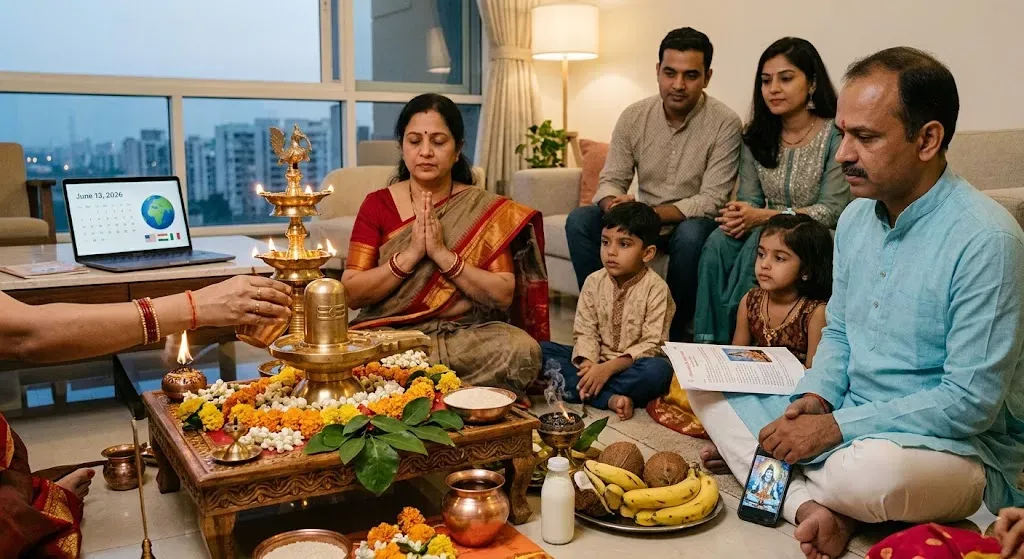
For the step-by-step home puja, use how to do abhishekam at home and the apartment Shivling puja guide. If you also keep Pradosham, the Trayodashi just before, see our Pradosham guide.
Health note: on either night, fasting is a personal discipline, not a test of endurance. Children, older people, pregnant or breastfeeding women and anyone with diabetes, low blood pressure, an eating disorder or regular medication should talk to a doctor first, and can keep a fruit-and-milk fast or simply do the puja. Drink water unless your doctor is happy with a waterless fast. Neither vrat comes with a promised result; it is an offering of attention and devotion.
Frequently asked questions
Is Maha Shivaratri a Masik Shivaratri?
Yes. It is the Masik Shivaratri of Magha (amanta) or Phalguna (purnimanta), the most important of the year. That is why our 2027 list counts 13 Shivaratris including Maha Shivaratri.
How many Masik Shivaratris are there in a year?
Usually twelve. Because a lunar month is about 29.5 days, twelve of them are about 11 days shorter than the calendar year, so some years hold thirteen. In 2027 there are 13 in India, from 5 January to 25 December.
When is Maha Shivaratri 2027?
Saturday 6 March 2027 in India, with Nishita Kaal from 12:07 to 12:56 AM in Delhi (night of 6 to 7 March), according to our Maha Shivaratri 2027 and 2027 Masik Shivaratri pages. On the US West Coast and in Vancouver it is the night of Friday 5 March.
Is the puja different?
The core is the same: abhishekam, bilva, lamp, Panchakshari at Nishita Kaal. Maha Shivaratri adds the four-prahar puja and the night vigil that many families keep only once a year.
What is Sawan Shivaratri?
The Masik Shivaratri of the Shravana month in the North Indian calendar, when many devotees offer Ganga jal to Shiva. In 2027 it is on Saturday 31 July in India.
Sources
Dates: HinduTone's Masik Shivaratri 2027 dates list and Maha Shivaratri 2027 guide (Drik Panchang method; Delhi times). December 2026 times computed with HinduTone's panchang engine (Drik Panchang method). The monthly option of the Shivaratri vow: Garuda Purana, chapter 124 ("The Siva Ratra Vratam"), M. N. Dutt translation, on wisdomlib.org.
Share this with family and friends
Send it on WhatsApp, post it, or copy the link.
More from Festivals
- Kanakadasa Jayanti 2026: Date (27 November), the Life of the Haridasa Saint-Poet and How Karnataka Observes It
- Dattatreya's 24 Gurus: Spiritual Lessons from Nature, from the Bhagavata Purana
- Kalashtami December 2026: Date, Ashtami Time, and Why It Is 30 December, Not 31
- Mokshada Ekadashi 2026: Vrat Vidhi, King Vaikhanasa Katha and Parana Time by City
- The Birth of Dattatreya: Atri, Anasuya and the Trimurti, in the Puranas and in Popular Tradition
You might also like
Masik Shivaratri 2027 Dates: Monthly Shivaratri List, Nishita Kaal Times and Dates Abroad
Masik Shivaratri Vrat Katha: The Hunter and the Bilva Tree, and How the Versions Differ
Masik Shivaratri December 2026: Date, Nishita Kaal by City and Why the Day Differs Abroad