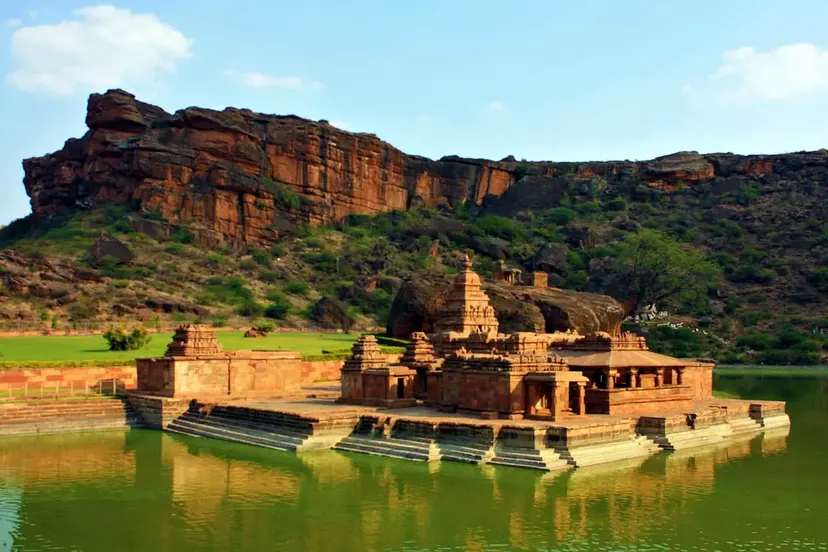
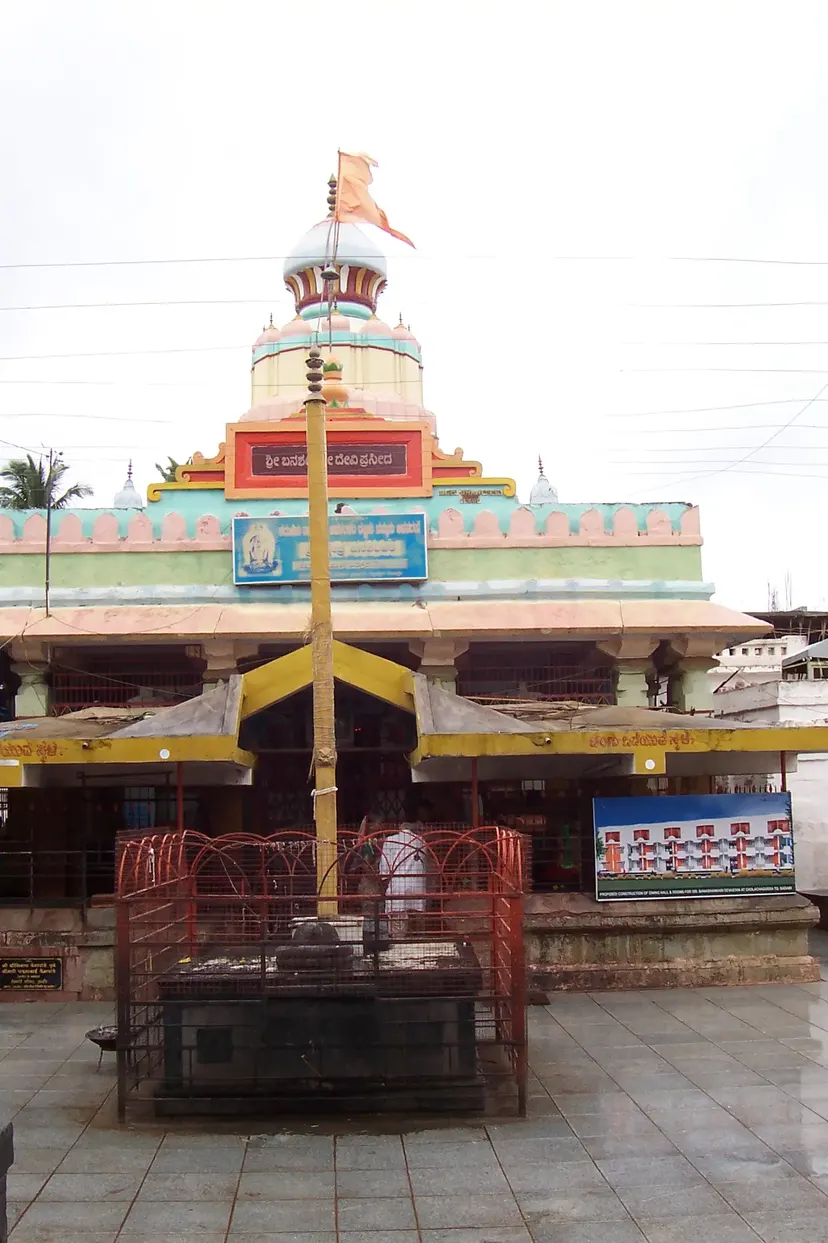
Trikuteshwara Temple, Gadag
Shiva (as Trikuteshwara, three lingas on one pedestal) temple · Gadag, Karnataka, India
The Trikuteshwara Temple stands in the old part of Gadag city in north-central Karnataka. It is a Shiva temple from the Kalyani (Later) Chalukya period, and its name comes from its unusual sanctum, where three Shiva lingas are set in a row on a single stone pedestal.
Karnataka Tourism describes it as a protected monument of the Chalukya era, known for its decorative pillars and carved stone screens. Within the same complex stands a Saraswati temple whose pillars are often singled out as some of the finest Chalukyan carving in the region.
Faith & Tradition
Religious Significance of Trikuteshwara Temple, Gadag
The three lingas give the temple its name, Trikuteshwara, 'lord of the three peaks'. According to Wikipedia and Swarajya, the three lingas are understood to represent Brahma, Vishnu and Shiva (Maheshwara). The Puratattva study notes a local tradition linking them to three sacred peaks.
Historians associate the temple with the Kalamukha school of Shaivism, a Shaiva monastic order; the Puratattva study cites the historians David Lorenzen and S. N. Sen in identifying Gadag as a Kalamukha centre. Writing in Swarajya, the art historian R. H. Kulkarni notes that Kalamukha teachers ran temples as centres of learning, and describes the adjoining Saraswati temple as having served as a place of study. Inscriptions summarised by Saurabh Saxena record grants made after honouring the temple's acharyas, including Kriyashakti Pandita and Siddhanti Chandrabhushana Pandita.
The temple remains in worship as a Shiva shrine, while the sanctum of the Saraswati temple holds a large but damaged image of the goddess.
Heritage
History of Trikuteshwara Temple, Gadag
Gadag was an important centre under the Kalyani Chalukyas, and Swarajya places the city's temples, including Trikuteshwara, in roughly 1050–1150 CE. Saxena's study, drawing on earlier scholars such as Henry Cousens, dates the main shrine to around 1000–1050 CE and suggests that the complex grew in three phases: first the main sanctum with its closed hall, then a second west-facing shrine with an open hall, and finally the north-facing Saraswati shrine.
Numerous inscriptions in and around the temple record donations to the god Trikuteshvara. As summarised by Saxena, these include a gift under the Chalukya king Vikramaditya VI (1102 CE), land grants by the Seuna king Bhillama V (1191 CE) and the Hoysala king Vira Ballala II (1192 CE), and a grant by the mahajanas of Gadag under the Seuna king Singhana II (1213 CE). The succession of royal patrons reflects the changing control of the region in that period.
Some popular accounts, including Wikipedia, credit the legendary sculptor Jakanachari with the temple, but this is a traditional attribution without supporting evidence; other sources give earlier dates, and dating of the complex varies between authors.
Architecture and sacred features
According to Swarajya, the main temple has a single sanctum with a vestibule (sukanasi), a large hall (navaranga) and an entrance porch, with doors on the east and south and a Dravida-style tower. Its most noted feature is a set of perforated stone screens that fill the space between the parapet and the beam below the eaves. Door lintels show Gaja-Lakshmi and the trinity of Brahma, Vishnu and Shiva, and the walls carry figures including apsaras, a dancing Ganesha, the twelve Adityas and Ravana lifting Mount Kailasa. A stone-lined well of the same period stands on the premises.
The Saraswati temple faces north and consists of a vestibule and an open pillared hall. Saxena records four full pillars and fourteen half-pillars, a ribbed ceiling with lotus pendants, and entrance pillars carved with miniature shrines, tiny deities and lions; Cousens regarded this work as among the best of the Chalukyan school. Karnataka Tourism also highlights the temple's life-sized carvings.
Plan Your Visit
Darshan and Visitor Information
Trikuteshwara is both a heritage monument and a place of worship, so visitors should dress modestly, follow the instructions of temple staff, and avoid climbing on or touching carved surfaces. Photography rules may differ inside the sanctum. Confirm current visiting hours and any restrictions locally or with Karnataka Tourism before travelling.
Timings and arrangements change with seasons and festivals. Confirm current details with the temple administration before travelling. Last reviewed 1 November 2026.
Location
How to Reach Trikuteshwara Temple, Gadag
Karnataka Tourism notes that Gadag Junction is a major railway station with direct trains to Bengaluru, Mumbai, Hyderabad and Vijayapura. The nearest airport is Hubballi, about 60 km away, and national highways link Gadag with Hubballi, Hosapete and Bagalkot.
The temple is inside the city, among residential streets of old Gadag. Karnataka Tourism lists the Chalukya temples of Lakkundi (12 km) and Dambal (20 km) among nearby places.
Location: Gadag, Karnataka, India
Nearest airport: Hubballi (about 60 km, per Karnataka Tourism)
Nearest railway station: Gadag Junction
More in Hindu temples in Karnataka · Shiva (as Trikuteshwara, three lingas on one pedestal) temples · Temples in Gadag (Rural) · Temples in Gadag Taluk · Temples in Gadag District
Questions
Trikuteshwara Temple, Gadag: Frequently Asked Questions
Why is it called Trikuteshwara Temple?
The sanctum holds three Shiva lingas on one stone pedestal, and the name means 'lord of the three peaks'. The lingas are commonly understood to represent Brahma, Vishnu and Shiva.
How old is the Trikuteshwara Temple?
It belongs to the Kalyani Chalukya period. Saurabh Saxena dates the main shrine to about 1000–1050 CE, while Swarajya places Gadag's temples in about 1050–1150 CE. Inscriptions record grants to the temple between the 12th and 13th centuries.
What is the Saraswati temple at Trikuteshwara?
It is a north-facing shrine within the same complex with an open pillared hall. Its carved pillars are regarded as some of the finest Chalukyan work, and its sanctum holds a damaged image of Saraswati.
Who were the Kalamukhas?
They were a Shaiva monastic order. Historians associate the Trikuteshwara temple with Kalamukha teachers, and inscriptions record grants made in honour of its acharyas.
Is Trikuteshwara Temple a protected monument?
Karnataka Tourism describes it as a protected monument from the Chalukya era.
How do I reach the Trikuteshwara Temple?
The temple is in Gadag city. Gadag Junction railway station has direct trains to several major cities, and Hubballi airport is about 60 km away, according to Karnataka Tourism.
Sources and attribution
- Karnataka Tourism (Government of Karnataka) — Gadag
- Swarajya — Gadag, home to fascinating temples of Kalyani Chalukyas (R. H. Kulkarni, 2018)
- Puratattva (Saurabh Saxena) — Gadag – Reverberation of the Kalamukhas (2013)
- Wikipedia — Trikuteshwara Temple, Gadag
Further reading: Trikuteshwara Temple, Gadag on Wikipedia (CC BY-SA 4.0).
Spotted an error? Write to info@hindutone.com — see our editorial policy.