Ashtabujakaram (Adi Kesava Perumal) Temple, Kanchipuram
Vishnu (as Ashtabhuja Perumal / Adi Kesava Perumal, with eight arms) temple · Kanchipuram (Chinna Kanchipuram), Kanchipuram, Tamil Nadu, India
The Ashtabujakaram Temple in Kanchipuram is dedicated to Vishnu in a rare eight-armed form, worshipped as Ashtabhuja Perumal ('the Lord with eight arms'). The deity is also known as Adi Kesava Perumal, and The Hindu lists further names including Chakradhar and Gajendra Varadan. His consort is worshipped as Alarmel Mangai, also called Pushpavalli Thayar and Padmasini.
The temple is one of the 108 Divya Desams of the Sri Vaishnava tradition and one of the group of Divya Desams in Kanchipuram. It stands in Chinna (Vishnu) Kanchipuram, and according to Wikipedia it is maintained by the Hindu Religious and Charitable Endowments Department of the Government of Tamil Nadu.
Faith & Tradition
Religious Significance of Ashtabujakaram (Adi Kesava Perumal) Temple, Kanchipuram
The eight-armed form is the temple's defining feature. The Hindu describes the main image as holding a bow, arrow, sword, shield, mace, lotus, conch and discus, with Mahalakshmi on his chest and a large garland of saligrama stones around his neck. Dinamalar describes this as the only Perumal temple where the Lord appears with eight arms; the Kancheepuram district administration likewise identifies the deity by his eight arms.
The temple's legend belongs to the story of Brahma's sacrifice at Kanchipuram. According to The Hindu, Saraswati, angered that Brahma performed the yajna without her, created the goddess Kali and sent demons to disrupt it; Brahma prayed to Vishnu, who took the eight-armed form to protect the sacrifice. Wikipedia gives a version in which the last attacker was a serpent. Both The Hindu and Dinamalar say the Lord was enshrined here as Adi Kesava Perumal before he appeared as Ashtabhujakaran. The Hindu counts this as one of at least four Kanchipuram temples linked to the legend, with Yathothkari, Deepaprakasar and Varadaraja Perumal.
A second legend, told by Dinamalar, concerns a yogi who was reborn as an elephant and worshipped the Lord here daily with lotus flowers from the tank. When a crocodile seized him, he cried out to Vishnu as Gajendra once had, and the Lord came on Garuda and released him; hence the names Gajendra Varadan and Gajendra Pushkarini. Dinamalar also records a belief that the Lord rescued Bhoomadevi here, so that people buying land or building houses pray at this temple.
Heritage
History of Ashtabujakaram (Adi Kesava Perumal) Temple, Kanchipuram
Wikipedia states that the temple is believed to have been built in the Pallava period, with later contributions from the Cholas and the Vijayanagara kings. It cites inscriptions of Kulothunga Chola I (1070-1120 CE) recording gifts of land, contributions by local people for perpetual lamps, and a sale of lands to meet the temple kitchen's expenses. The Kancheepuram district website gives a traditional attribution of the building to Thondaiman Chakravarthy, also called Vayiramoghan.
The temple has a large body of devotional literature. Dinamalar and The Hindu say that Peyalvar and Thirumangai Alvar sang its praise in the Nalayira Divya Prabandham, and Dinamalar notes that this is the only Divya Desam where an Alvar addressed a separate verse to the goddess. Later teachers including Manavala Mamunigal, Vedanta Desika and Pillai Perumal Iyengar also wrote in its praise, according to The Hindu; Wikipedia records that Desika composed the Ashtabhujashtakam on the deity.
In November 2003 The Hindu reported that the temple's Maha Samprokshanam (reconsecration) was being held after a renovation funded by donors.
Architecture and sacred features
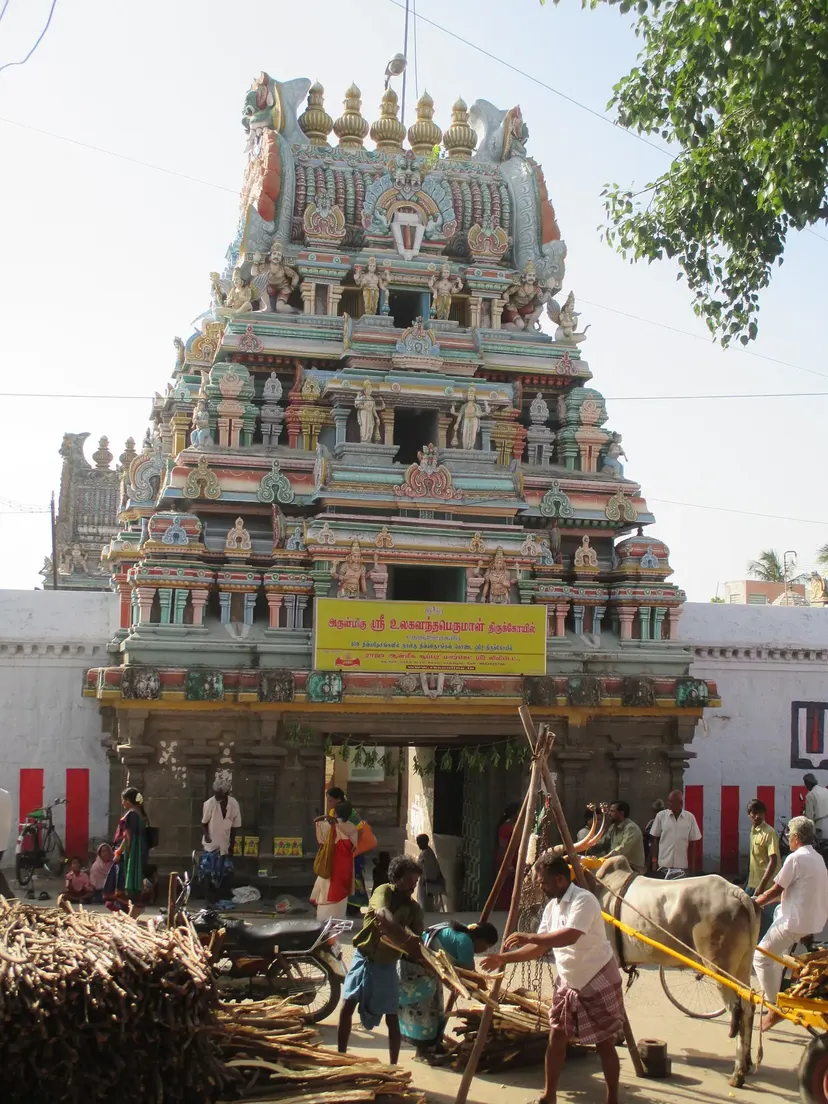
The Hindu and the district administration describe a compact temple with a three-tiered rajagopuram and a single prakara (enclosure); the district website gives the enclosure as about an acre with the tower at the north entrance. The deity faces west, and Dinamalar names the sanctum tower the Chakrakuthi Vimana. Dinamalar notes an unusual feature: both the main entrance and the Sorgavasal (the 'gate of heaven' opened on Vaikunta Ekadasi) face north, whereas in most Vishnu temples they face different directions.
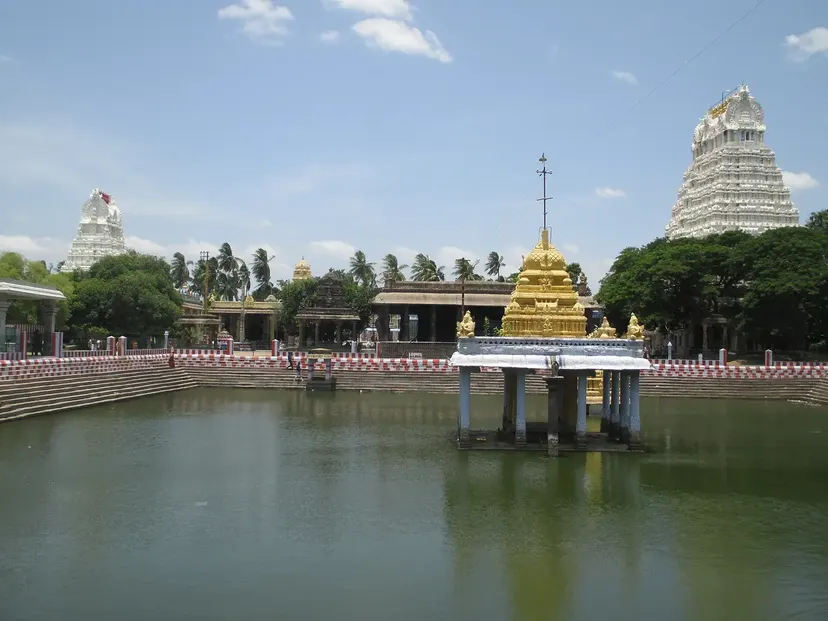
According to The Hindu, there are separate shrines for Andal, Hanuman, Bhuvaraha and Peyalvar, along with bronze festival images of the Lord, his consort and of Rama, Sita, Lakshmana and Hanuman. Wikipedia adds shrines for the Sudarshana Chakra and Sharabha, and a four-pillared 'Friday mandapam' before the goddess's shrine. The temple tank, Gajendra Pushkarini, lies outside the entrance tower.
Plan Your Visit
Darshan and Visitor Information
This is an active temple with fixed morning and evening darshan periods; Wikipedia notes the custom of worshipping the goddess before the Lord. Dress modestly, remove footwear before entering, and follow the instructions of the temple staff on photography. Confirm current timings and festival dates locally with the temple administration (HR&CE) before visiting.
Timings and arrangements change with seasons and festivals. Confirm current details with Tamil Nadu HR&CE Department (per Wikipedia) before travelling. Last reviewed 1 November 2026.
Sacred Calendar
Festivals at Ashtabujakaram (Adi Kesava Perumal) Temple, Kanchipuram
Vaikunta Ekadasi
Named by Dinamalar and Wikipedia as a main festival; Wikipedia describes a ten-day celebration and calls it the temple's most prominent festival.
Navaratri
Celebrated at the temple according to Dinamalar and Wikipedia.
Sri Rama Navami
Celebrated at the temple according to Dinamalar and Wikipedia.
Gajendra Moksha festival
Commemorates the rescue of the elephant devotee, according to Wikipedia.
Location
How to Reach Ashtabujakaram (Adi Kesava Perumal) Temple, Kanchipuram
The Kancheepuram district website and Dinamalar both give the temple as about 2 km from the Kancheepuram bus stand; Dinamalar places it on Tirukachi Nambigal Street in Chinna Kancheepuram. Kancheepuram is the nearest railway station and Chennai the nearest airport, according to Dinamalar.
Location: Kanchipuram (Chinna Kanchipuram), Kanchipuram, Tamil Nadu, India
Nearest airport: Chennai (per Dinamalar)
Nearest railway station: Kancheepuram (per Dinamalar)
More in Hindu temples in Tamil Nadu · Vishnu (as Ashtabhuja Perumal / Adi Kesava Perumal, with eight arms) temples · Temples in Kanchipuram Taluk · Temples in Kanchipuram District
Questions
Ashtabujakaram (Adi Kesava Perumal) Temple, Kanchipuram: Frequently Asked Questions
Why is the temple called Ashtabujakaram?
Because Vishnu is worshipped here with eight arms (ashta bhuja), holding a bow, arrow, sword, shield, mace, lotus, conch and discus.
What is the legend of Ashtabhuja Perumal?
Tradition says Vishnu took the eight-armed form to protect Brahma's sacrifice from Kali and the demons sent by Saraswati. He had earlier been enshrined here as Adi Kesava Perumal.
Which Alvars sang about Ashtabujakaram?
Peyalvar and Thirumangai Alvar. Dinamalar notes that an Alvar addressed a separate verse to the goddess here, which is unique among the Divya Desams.
What is the Gajendra Pushkarini?
The temple tank, named after the legend of an elephant devotee who was seized by a crocodile while gathering lotuses and was rescued by Vishnu.
When is Vaikunta Ekadasi celebrated here?
In Margazhi (December-January). The temple's entrance and Sorgavasal both face north, which Dinamalar describes as unusual.
How far is Ashtabujakaram from Kanchipuram bus stand?
About 2 km, according to the Kancheepuram district website and Dinamalar.
Sources and attribution
- Kancheepuram District Administration, Government of Tamil Nadu — Places of Interest
- The Hindu (K. Subramaniam, 21 November 2003) — Samprokshanam at Kanchi
- Dinamalar — Sri Ashtabhuja Perumal temple, Kanchipuram
- Wikipedia — Ashtabujakaram
Further reading: Ashtabujakaram (Adi Kesava Perumal) Temple, Kanchipuram on Wikipedia (CC BY-SA 4.0).
Spotted an error? Write to info@hindutone.com — see our editorial policy.