
Famous Hanuman Temples in India: 12 Temples Every Devotee Should Visit
A guide to 12 famous Hanuman temples in India, from Hanuman Garhi in Ayodhya and Sankat Mochan in Varanasi to Salasar Balaji, Yantrodharaka in Hampi and Namakkal Anjaneyar. Each entry covers the temple's form of Hanuman, its traditions and practical points for pilgrims.
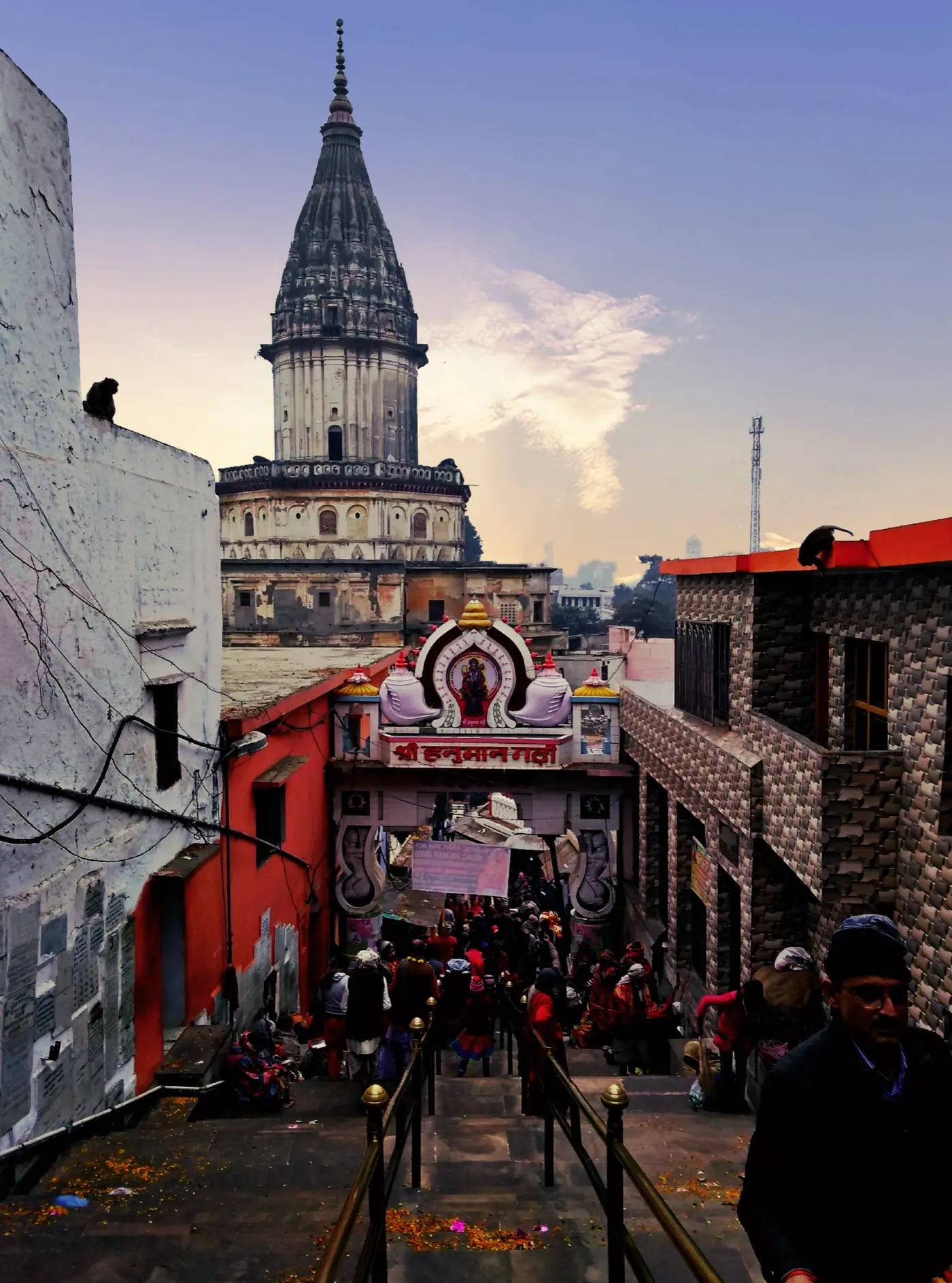
Quick answer: Twelve of the most famous Hanuman temples in India are Hanuman Garhi in Ayodhya, Sankat Mochan in Varanasi, Bade (Lete) Hanuman in Prayagraj, Salasar Balaji and Mehandipur Balaji in Rajasthan, Kashtabhanjan Dev at Salangpur in Gujarat, Jakhu in Shimla, Mahavir Mandir in Patna, Yantrodharaka in Hampi, Namakkal Anjaneyar in Tamil Nadu, Karmanghat in Hyderabad and the Panchmukhi Hanuman temple in Rameswaram. Below, each temple is described from official tourism pages, district administrations and major newspapers, with legends labelled as traditions.
Hanuman is worshipped across India under many names: Anjaneya in the south, Maruti in Maharashtra, Bajrangbali and Mahavir in the north, and Balaji in Rajasthan. The temples in this guide show that range. One is a hilltop fort in Ayodhya, one a reclining image that the Ganga reaches in the monsoon, two are desert and hill shrines in Rajasthan, and others stand by the Tungabhadra in Hampi, under the open sky in Namakkal and on the island of Rameswaram.
The 12 temples at a glance
| Temple | Place | State | Known for |
|---|---|---|---|
| Hanuman Garhi | Ayodhya | Uttar Pradesh | Hilltop fort-temple; Bal Hanuman on Anjani's lap |
| Sankat Mochan | Varanasi | Uttar Pradesh | Tulsidas tradition; besan laddoo prasad; April music festival |
| Bade (Lete) Hanuman | Prayagraj | Uttar Pradesh | About 20 ft reclining image near the Sangam |
| Salasar Balaji | Salasar, Churu district | Rajasthan | Bearded, moustached Balaji; Purnima fairs |
| Mehandipur Balaji | Dausa district | Rajasthan | Balaji with Pret Raj Sarkar and Kotwal Bhairav |
| Kashtabhanjan Dev | Salangpur (Sarangpur), Botad district | Gujarat | Swaminarayan (Vadtal) temple of Hanuman |
| Jakhu Temple | Shimla | Himachal Pradesh | Hilltop shrine; 108 ft statue; ropeway |
| Mahavir Mandir | Patna | Bihar | Opposite Patna Junction; naivedyam laddoo; trust hospitals |
| Yantrodharaka Hanuman | Hampi | Karnataka | Hanuman in a yantra; Vyasatirtha tradition |
| Namakkal Anjaneyar | Namakkal | Tamil Nadu | About 18 ft image open to the sky, facing Narasimha |
| Karmanghat Hanuman | Hyderabad | Telangana | Dhyana Anjaneya; Kakatiya-era tradition |
| Panchmukhi Hanuman | Rameswaram | Tamil Nadu | Five-faced Hanuman; "floating stones" |
Why devotees worship Hanuman
In the Ramayana, Hanuman is the son of Anjana and Kesari, blessed by Vayu, the wind god. He finds Sita in Lanka, carries the Sanjeevani mountain to save Lakshmana and serves Rama without asking anything for himself. Devotees see in him three qualities together: strength, wisdom and humility. They pray to him for courage, protection and the removal of obstacles, and many recite the Hanuman Chalisa on Tuesdays and Saturdays, the traditional days of his worship in much of India.
His temples range from tiny roadside shrines to large pilgrimage centres. The twelve below are among the best known, chosen to cover north, west, east and south India.
Hanuman Garhi, Ayodhya (Uttar Pradesh)
Hanuman Garhi stands about 1 km from Ayodhya railway station, according to the Ayodhya district administration. The name means "Hanuman's fort", and the temple is built as a fortified complex on a mound, reached by a long flight of steps, commonly cited as 76. The main image shows Hanuman as a child (Bal Hanuman) seated on the lap of his mother, Anjani.
Local tradition recorded by the district holds that Hanuman lived here and guarded Ayodhya. From that belief comes a widely followed custom: many pilgrims visit Hanuman Garhi before going for darshan of Ram Lalla at the Ram Janmabhoomi temple, treating Hanuman as the guardian whose blessing comes first. This is a tradition, not a temple rule.
On history, sources differ. The district records a tradition crediting King Vikramaditya, while Livemint describes an 18th-century shrine built for the Ramanandi naga ascetics with funds from the Nawab Safdarjung, later expanded into the present temple-fortress. Lucknow airport and Ayodhya station are the main access points. Expect long queues on Tuesdays, Saturdays and festival days. Read our full guide to Hanuman Garhi.
Sankat Mochan Hanuman Temple, Varanasi (Uttar Pradesh)
Sankat Mochan means "the one who frees from troubles". Tradition, repeated on the Incredible India site, credits the poet-saint Goswami Tulsidas, author of the Ramcharitmanas, with founding the temple at the place where he is said to have had a vision of Hanuman. A feature noted by Incredible India is that Hanuman here faces his lord, Rama.
The temple's prasad is besan laddoo (gram-flour laddoo), and devotees also offer sindoor and flowers. On Hanuman Jayanti a Shobha Yatra procession sets out from the nearby Durgakund temple. Every April the temple hosts the Sankat Mochan Sangeet Samaroh, a festival of classical music and dance that draws leading artists. Tuesdays and Saturdays are the busiest days. Combine a visit with the ghats, but check the temple's own notices for current rules on phones and bags.
Bade Hanuman (Lete Hanuman) Temple, Prayagraj (Uttar Pradesh)
Close to Prayagraj Fort and the Sangam, the Bade Hanuman Ji temple, also called the Lete Hanuman temple, enshrines an image of Hanuman about 20 feet long in a reclining position, according to Incredible India. The image lies in a pit some six to seven feet below ground level. A legend recorded by Incredible India says Hanuman rested here, at Sita's insistence, after burning Lanka.
The temple is best known for a monsoon tradition. When the Ganga and Yamuna rise, river water enters the sanctum, and devotees regard it as the Ganga coming to bathe Hanuman. Newspapers including the Hindustan Times and Aaj Tak have reported crowds gathering to watch, and priests performing Ganga aarti and abhishek as the water arrives. While the sanctum is flooded, worship moves to a smaller image and the temple may be closed to visitors, so check local news before travelling in July to September.
Salasar Balaji, Churu district (Rajasthan)
Salasar Balaji Temple, also called Salasar Dham, is in Sujangarh tehsil of Churu district. Hanuman is worshipped here as Balaji, in a form with a beard and moustache. The temple's account links this to the devotee Mohandas Maharaj, who, tradition says, first saw Hanuman as a bearded sadhu. Mohandas's samadhi and ever-burning dhuna stand in the complex.
According to the temple and Rajasthan Tourism, a farmer at Asota found the stone image while ploughing, and it was brought to Salasar by bullock cart on Shravan Shukla Navami of Vikram Samvat 1811 (Rajasthan Tourism equates this to 1754 CE). Worship passed to Mohandas's nephew Udairam, whose descendants still serve as priests. Devotees tie coconuts with red moli thread as part of a vow and offer savamani, a large food offering.
The two great fairs fall on Chaitra Purnima (Hanuman Janmotsav) and Ashvin (Sharad) Purnima, and Rajasthan Tourism notes they can draw six to seven lakh people. Sujangarh is the nearest railway station listed by the temple, and Jaipur airport is about 184 km away. Read our Salasar Balaji temple guide.
Mehandipur Balaji, Dausa district (Rajasthan)
Mehandipur Balaji stands among the hills of Dausa district. Incredible India describes the sanctum image of Balaji (Hanuman) flanked by representations of Pret Raj Sarkar and Kotwal Bhairav, the two other deities worshipped here. Tuesdays and Saturdays draw the largest crowds, and Jaipur International Airport is about 110 km away.
The temple is widely known as a place where people come seeking relief from what they believe to be the influence of spirits or negative energies, and Incredible India describes its rituals as aimed at spiritual healing. Some of these rituals can be intense to watch, so visitors, especially families with children, should be prepared. Practical advice:
- Follow the temple's own rules and the instructions of temple staff on offerings and conduct.
- Do not hire touts or self-styled agents who offer special rituals, quick darshan or "cures" for money.
- Faith and prayer are a personal matter, but they are not a substitute for medical or mental-health care. Anyone unwell should also see a doctor.
Read our Mehandipur Balaji temple page for more on the shrine.
Kashtabhanjan Dev Hanumanji Mandir, Salangpur (Gujarat)
At Salangpur in Botad district (the name is also written Sarangpur, and Gujarat Tourism uses that spelling), Hanuman is worshipped as Kashtabhanjan, the "crusher of sorrows". The temple belongs to the Vadtal Gadi of the Swaminarayan Sampraday. Gujarat Tourism notes that it is the only Swaminarayan temple whose main deity is neither Swaminarayan nor Krishna, and that the image was installed by Sadguru Gopalanand Swami. The temple's account says he drew its design himself and had it carved by Kanji Mistri.
A 54-foot statue of Hanuman, which the temple calls the "King of Salangpur", was unveiled on Hanuman Jayanti, 6 April 2023. The temple runs a bhojanalay and pilgrim rooms, which it says are allotted only on arrival, with no advance or online booking through the temple or any agent. Gujarat Tourism places Salangpur about 153 km by road from Ahmedabad; Botad Junction is the nearest station.
Jakhu Temple, Shimla (Himachal Pradesh)
Jakhu (Jakhoo) Temple sits on Jakhoo Hill, which the Shimla district administration describes as the highest peak in the city, about 2 km uphill from the Ridge. Tradition, repeated on the Incredible India site, says Hanuman rested here while travelling to fetch the Sanjeevani herb for Lakshmana.
A 108-foot statue of Hanuman was unveiled in the temple premises on 4 November 2010, The Tribune reported. A 450-metre ropeway from the Ridge opened in April 2017. You can also walk up in roughly 30 to 45 minutes or take a taxi. The hill is home to many monkeys, so keep food, glasses and small belongings secure.
Mahavir Mandir, Patna (Bihar)
Mahavir Mandir stands just in front of Patna Junction railway station, according to Bihar Tourism. Records cited by Bihar Tourism and Incredible India, including a 1948 Patna High Court judgment, credit Swami Balanand of the Ramanandi sect with establishing the temple in 1730, and the court recognised it as a public temple in 1948. Bihar Tourism notes that it was renovated in the 1980s.
The temple is famous for its naivedyam, a laddoo prasad that Bihar Tourism says is prepared by experts from Tirupati. Ram Navami brings very large crowds. The temple trust, Shri Mahavir Sthan Nyas Samiti, is also known for its charitable work: it runs the Mahavir Cancer Sansthan in Patna, founded in 1998, along with Mahavir Vatsalya hospital and Mahavir Arogya hospital. Bihar Tourism describes the temple as a centre of both worship and social service.
Yantrodharaka Hanuman Temple, Hampi (Karnataka)
In Hampi, the Yantrodharaka Hanuman temple stands on top of a small hill on the bank of the Tungabhadra, about 2 km from the Virupaksha temple, close to Chakratirtha, where the river bends, and near the Kodandarama temple. Karnataka Tourism credits its installation to Sri Vyasaraja (Vyasatirtha), the Dvaita philosopher and rajaguru of the Vijayanagara empire, about 500 years ago.
The image is unusual. Carved on a single boulder about eight feet high, it shows Hanuman seated in meditation inside a hexagonal yantra, surrounded by twelve monkey figures. Tradition says Vyasaraja drew Hanuman's figure on the rock in charcoal each day and it kept vanishing, until Hanuman appeared before him on the twelfth day; the twelve monkeys are said to represent those twelve days. Tradition also counts this as the first of 732 Hanuman images that Vyasaraja installed.
Location note: Yantrodharaka is not on Anjanadri (Anjaneya) Hill. Anjanadri is a separate hill across the Tungabhadra near Anegundi, with its own temple marking the tradition of Hanuman's birth there. Some listings mix the two up, so ask locally for "Yantrodharaka" or "Chakratirtha" to reach the right shrine.
Namakkal Anjaneyar Temple, Namakkal (Tamil Nadu)
The Namakkal Anjaneyar temple houses a standing stone image of Hanuman about 18 feet tall, one of the tallest Hanuman images in Tamil Nadu. The Tamil Nadu Temples Project notes that the image has no roof over it and stands open to the sky. It faces the Lakshmi Narasimha shrine at the foot of the Namakkal rock, about 130 metres away.
Tradition says Hanuman stands here in worship of Narasimha, which is why the image faces that shrine; because it is open to the air, the Tamil Nadu Temples Project notes, he is also called Digambara Anjaneyar. The project dates the original temple to around the 6th century, contemporary with the nearby Narasimha temple, while the present structure is a renovation of recent decades. The Namakkal district administration lists the temple among the district's main attractions. Most pilgrims visit the Narasimha shrine in the same trip.
Karmanghat Hanuman Temple, Hyderabad (Telangana)
The Karmanghat Hanuman temple stands in Karmanghat, near Santoshnagar towards the Nagarjuna Sagar road on the south-eastern side of Hyderabad. The main image is Dhyana Anjaneya, Hanuman seated in meditation. Telangana Tourism describes it as one of the oldest temples in Hyderabad, and the temple's official website is run under the Telangana government.
Tradition dates the temple to the Kakatiya era. A popular story says a Kakatiya king, resting in the forest during a hunt, heard the chant of Rama's name and found the image of Hanuman in meditation, then had a temple built around it. Tuesdays, Saturdays and Hanuman Jayanti bring large crowds. Read our Karmanghat Hanuman temple guide.
Panchmukhi Hanuman Temple, Rameswaram (Tamil Nadu)
About 2 km from the Ramanathaswamy temple, the Panchmukhi (five-faced) Hanuman temple is, Incredible India says, believed to be the place where Hanuman revealed his five faces. In the traditional five-faced form, Hanuman's own face is joined by those of Narasimha, Garuda, Varaha and Hayagriva.
The temple displays what are called "floating stones". Incredible India records the belief that these are stones of the kind used to build the Ram Setu so that Rama's army could cross to Lanka. This is a tradition; the origin of the stones has not been established scientifically. Most pilgrims visit the temple as part of a Rameswaram trip that includes the Ramanathaswamy temple and Dhanushkodi.
More Hanuman temples from our source-checked list
These five temples were part of the earlier version of this guide. Their facts come from district administrations, state tourism departments and newspapers.
Gandi Sri Veeranjaneya Swamy Temple, Kadapa district (Andhra Pradesh)
At the foot of a hill on the Papagni river in Chakrayapet mandal, where the river runs through a gap between two hills. The district describes it as a Vayu Kshetra, and local tradition says Rama drew Anjaneya's figure on a rock here on his way back from Lanka. The state handed the temple to the TTD in 2019, and a Maha Kumbhabhishekam was held from 8 to 13 May 2026. Sravana Saturdays draw very large crowds.
Yoga Anjaneyar Hill Temple, Sholinghur (Tamil Nadu)
On the smaller of Sholinghur's two hills in Ranipet district, Hanuman sits in a yogic posture facing the Yoga Narasimhar shrine, one of the 108 Divya Desams, on the larger hill. Sunday is regarded as especially important here.
Hanuman Setu Mandir, Lucknow (Uttar Pradesh)
The Sankat Mochan shrine at Hanuman Setu near Lucknow University is linked with the saint Neem Karoli Baba, and in September 2026 Uttar Pradesh Tourism included it in a circuit of places associated with him. It is one of the city's main shrines during Bada Mangal, the Tuesdays of Jyeshtha.
Hanuman Vatika, Rourkela (Odisha)
A garden temple complex run by the Hanuman Vatika Trust, best known for a standing statue of Hanuman about 75 feet tall, surrounded by shrines including the twelve Jyotirlingas.
Sri Mukhyaprana Temple, Bekal Fort (Kerala)
A Hanuman shrine at the entrance of Bekal Fort in Kasaragod district, which Kerala Tourism pairs with the old mosque nearby as a symbol of the area's religious harmony.
Other well-known Hanuman temples
- Bala Hanuman Temple, Jamnagar (Gujarat): by Lakhota (Ranmal) Lake, known for the continuous chanting of "Shri Ram Jai Ram Jai Jai Ram", which has been reported as unbroken since 1 August 1964.
- Prachin Hanuman Mandir, Connaught Place (New Delhi): one of Delhi's best-known Hanuman temples, which tradition dates to the Mahabharata era; very crowded on Tuesdays and Saturdays.
- Ragigudda Anjaneya Temple, Bengaluru (Karnataka): on a hillock in Jayanagar 9th Block, built in 1969, with a 12-day Hanuman Jayanti festival (Incredible India).
- Kondagattu Anjaneya Swamy Temple, Jagtial district (Telangana): a hill shrine at Muthyampet in Mallial mandal, listed by Telangana Tourism and a centre for Hanuman deeksha.
- Hanuman Tok, near Gangtok (Sikkim): about 11 km from Gangtok on the Nathu La road at about 2,195 m, maintained by a unit of the Indian Army since 1968 (Incredible India).
- Panchamukhi Anjaneya Temple, Ganadhal (Raichur district, Karnataka): across the Tungabhadra from Mantralayam, where tradition says Sri Raghavendra Tirtha did penance and had a vision of the five-faced Hanuman.
- Bhadra Maruti Temple, Khuldabad (Maharashtra): about 4 km from the Ellora Caves, one of the few temples with Hanuman in a reclining (bhav samadhi) posture (Incredible India).
Hanuman temples in South India
South India has some of the most distinctive Hanuman images. Namakkal's open-air Anjaneyar and Yantrodharaka's yantra-bound Hanuman in Hampi are unlike anything in the north. Tamil Nadu adds the Yoga Anjaneyar at Sholinghur and the Panchmukhi temple at Rameswaram. In Telangana, Karmanghat and Kondagattu are the best known, and in Andhra Pradesh, Gandi on the Papagni. Karnataka has Ragigudda in Bengaluru and Panchamukhi near Mantralayam. In much of the south Hanuman is called Anjaneya or Anjaneyar, and offerings such as vadai garlands, betel-leaf garlands and butter are common.
Regional pilgrimage circuits
- Uttar Pradesh (Ganga circuit): Ayodhya (Hanuman Garhi), Prayagraj (Bade Hanuman) and Varanasi (Sankat Mochan) can be combined in one trip, with Lucknow's Hanuman Setu as an add-on.
- Rajasthan (Balaji circuit): Salasar Balaji and Mehandipur Balaji are both reached from Jaipur, in different directions.
- Gujarat: Salangpur (Kashtabhanjan Dev) and Jamnagar (Bala Hanuman) fit a Saurashtra itinerary.
- Tungabhadra: Hampi (Yantrodharaka and Anjanadri) and Panchamukhi near Mantralayam lie on the same river.
- Tamil Nadu: Namakkal, Sholinghur and Rameswaram are far apart but fit a longer temple tour.
- Telangana and Andhra Pradesh: Karmanghat in Hyderabad, Kondagattu in Jagtial district and Gandi in Kadapa district.
Festival days and weekends bring the heaviest crowds everywhere. Check each temple's official notices for darshan hours before you travel; they change with seasons and festivals.
How to worship at a Hanuman temple
- Choose your day: Tuesday and Saturday are the traditional days in much of India, though local customs differ (at Sholinghur, Sunday is especially important).
- Offerings: sindoor (vermilion) mixed with oil, red flowers, betel leaves, laddoos, coconuts, and in the south vadai and butter. Follow each temple's rules on what may be taken inside.
- Prayer: many devotees recite the Hanuman Chalisa, read the Sundara Kanda or simply repeat Rama's name, since Hanuman is believed to be present wherever Rama is remembered.
- Pradakshina: walk around the shrine clockwise, usually an odd number of times.
- Etiquette: dress modestly, leave footwear at the stand, keep phones silent and follow photography rules. Our Hindu temple visit guide covers darshan, dress and etiquette in detail.
Simple Hanuman mantras
You do not need long rituals to pray to Hanuman. These three are widely used:
- ॐ श्री हनुमते नमः (Om Shri Hanumate Namah): a simple salutation to Hanuman.
- Hanuman Gayatri (traditional): ॐ आञ्जनेयाय विद्महे वायुपुत्राय धीमहि। तन्नो हनुमत् प्रचोदयात्॥
- श्री राम जय राम जय जय राम (Shri Ram Jai Ram Jai Jai Ram): the Rama mantra, dear to Hanuman.
For a full prayer, read the Hanuman Chalisa with meaning.
Visiting from abroad
- Plan around one region: these temples stretch from Himachal Pradesh to Tamil Nadu, so most NRI families pick one circuit that fits an existing trip home.
- Allow for festivals: if your visit falls on Hanuman Jayanti, a Purnima fair at Salasar or Ram Navami in Patna, expect long waits and book accommodation early.
- Carry ID: some temples and pilgrim rooms ask for identity proof; keep your passport or OCI card handy.
- Elderly parents: Hanuman Garhi and Jakhu involve steps or a climb, and Yantrodharaka sits on a rocky hill. Ask in advance about queues and help for senior citizens.
- Weekly worship where you live: Hanuman temples abroad keep the same Tuesday and Saturday rhythm.
Frequently asked questions
Which are the most famous Hanuman temples in India?
Among the best known are Hanuman Garhi (Ayodhya), Sankat Mochan (Varanasi), Bade Hanuman (Prayagraj), Salasar Balaji and Mehandipur Balaji (Rajasthan), Kashtabhanjan Dev (Salangpur, Gujarat), Jakhu (Shimla), Mahavir Mandir (Patna), Yantrodharaka (Hampi), Namakkal Anjaneyar (Tamil Nadu), Karmanghat (Hyderabad) and the Panchmukhi temple at Rameswaram.
Which are the famous Balaji temples of Hanuman?
In Rajasthan, Hanuman is called Balaji, and the two most famous Balaji temples are Salasar Balaji in Churu district and Mehandipur Balaji in Dausa district. They are different from the Tirumala temple of Venkateswara, who is also popularly called Balaji.
Which are the best-known Hanuman temples in South India?
Namakkal Anjaneyar, Yantrodharaka in Hampi, the Yoga Anjaneyar at Sholinghur, the Panchmukhi temple at Rameswaram, Karmanghat and Kondagattu in Telangana, Gandi in Andhra Pradesh and Ragigudda in Bengaluru.
Why does Salasar Balaji have a beard and moustache?
The temple's account links the form to the devotee Mohandas Maharaj, who, tradition says, first saw Hanuman as a bearded sadhu.
Where can I see Hanuman in a reclining posture?
At the Bade (Lete) Hanuman temple near the Sangam in Prayagraj, where the image is about 20 feet long, and at the Bhadra Maruti temple in Khuldabad near Ellora in Maharashtra.
Is the Yantrodharaka temple on Anjanadri Hill?
No. Yantrodharaka is on a small hill by the Tungabhadra near Chakratirtha and the Kodandarama temple in Hampi. Anjanadri is a separate hill across the river near Anegundi.
What should I know before visiting Mehandipur Balaji?
It is very crowded on Tuesdays and Saturdays, and some of its rituals can be intense to watch. Follow the temple's rules, avoid touts who offer special rituals for money, and do not treat a visit as a substitute for medical care.
Which day is best for visiting a Hanuman temple?
Tuesday and Saturday are the traditional days in much of India. Some temples have their own important days, such as Sunday at Sholinghur and the Bada Mangal Tuesdays of Jyeshtha at Lucknow's Hanuman Setu.
Do these temples publish darshan timings?
Some do, and timings change with seasons and festivals. Check the temple's official website or notices, or the district administration, a day or two before you travel.
Related guides
- Birth story of Lord Hanuman: Anjani, Kesari and Vayu
- Anjaneri Hills: birthplace of Lord Hanuman and Anjani Mata temple
- Hanuman Ashtottara: 108 names with meaning
- Hanuman temples in the USA: city-wise directory
Editor's note
Updated 17 November 2026: expanded to 12 temples, adding Sankat Mochan, Bade Hanuman, Mehandipur Balaji, Mahavir Mandir, Yantrodharaka, Namakkal Anjaneyar, Karmanghat and the Panchmukhi temple at Rameswaram, with facts checked against official tourism pages, district administrations and newspapers. Legends are labelled as traditions. The five temples from the previous version are kept with their checked facts. Timings and arrangements change, so please confirm with each temple before travelling.
Share this with family and friends
Send it on WhatsApp, post it, or copy the link.
More on Famous Hanuman Temples
- Must Visit Temples on Saturday: Top 12 Shani & Hanuman Temples in India for Powerful Shanivar Blessings
- Hanuman Jayanti 2026 in New Zealand: Date, Timings, Complete Birth Story, Puja Vidhi & Major Hanuman Temples Across NZ Cities
- Hanuman Jayanti 2026 in USA: Date, Timings, Complete Birth Story, Puja Vidhi & Major Hanuman Temples Across American Cities
- Hanuman Jayanti 2026 in Nepal: Date, Timings, Complete Birth Story, Puja Vidhi & Major Hanuman Temples
- Hanuman Jayanti 2026 in Sri Lanka: Date, Timings, Complete Birth Story, Puja Vidhi & Major Hanuman Temples
- Hanuman Jayanti 2026 in Malaysia: Date, Timings, Complete Birth Story, Puja Vidhi & Major Hanuman Temples
More from Temples
- Mannarpolur Sri Alaghu Mallari Krishnaswamy Temple: Krishna with Jambavati and the Syamantaka Legend
- Why Is Sabarimala Temple Open Only on Certain Days? The Calendar, the Reasons and the 2026-27 Season
- Kateel Sri Durgaparameshwari Temple: History, Legend, Timings and Prabhas's Visit
- Hindu Temples in Pakistan After the 1947 Partition: The Forgotten Religious Heritage of Hindus
- Anjaneri Hills, Nashik: The Traditional Birthplace of Lord Hanuman and the Anjani Mata Temple


