Karthika Masam Across Time Zones: How NRIs Can Sync With Indian Ritual Timings
By HinduTone Desk For millions of Non-Resident Indians scattered across the globe, maintaining spiritual connections to ancestral traditions often means…
By HinduTone Desk
For millions of Non-Resident Indians scattered across the globe, maintaining spiritual connections to ancestral traditions often means navigating the complex intersection of devotion and geography. Karthika Masam, one of Hinduism's most sacred months, presents a unique challenge: how do you honor time-specific rituals when you're thousands of miles away from the land where these traditions originated?
Karthika Masam 2026 dates: the month runs from Tuesday 10 November to Tuesday 8 December (Telugu and Kannada amanta calendar), with Karthika Pournami on Tuesday 24 November. See our Karthika Masam 2026 guide for the full calendar.
Understanding Karthika Masam's Temporal Significance
Karthika Masam, which typically falls between October and November in the Gregorian calendar, is considered the holiest month in the Hindu lunar calendar. What makes this month particularly challenging for NRIs is that many of its rituals are intrinsically tied to specific astronomical events—sunrise, sunset, and the appearance of celestial bodies.
The month derives its name from the Karthika star (Pleiades constellation) and is especially sacred to Lord Shiva and Lord Vishnu. Traditional observances include lighting diyas at dawn and dusk, performing Tulsi puja, observing fasts, and reciting specific mantras during brahma muhurta (the pre-dawn hours).
The Time Zone Dilemma
When a devotee in California wakes up at 6 AM PST, it's already 7:30 PM IST in India—well past the ideal brahma muhurta window. This temporal disconnect creates a genuine spiritual quandary: Should you follow the ritual timings of your current location or align with Indian time?
Religious scholars offer varying perspectives, but most agree on a practical approach: the divine timeline follows the sun, not the clock.
Step-by-Step Guide: Converting Indian Ritual Timings
Step 1: Understand the Four Critical Time Windows
Karthika Masam observances revolve around four key periods:
- Brahma Muhurta: 1.5 hours before local sunrise
- Pratah Kala (Morning): From sunrise to 3 hours after
- Sandhya Kala (Twilight): 48 minutes before and after sunset
- Pradosh Kala (Evening): 1.5 hours after sunset
Step 2: Calculate Your Local Sunrise and Sunset
For USA residents:
- East Coast (EST/EDT): Download apps like "Sunrise Sunset Calculator" or use timeanddate.com
- Central Time: Add 1 hour to EST timings
- Mountain Time: Add 2 hours to EST
- Pacific Time: Add 3 hours to EST
- Alaska/Hawaii: Use local astronomical calculators
Example: If sunrise in New York is at 7:15 AM EST during Karthika Masam (late October/early November), brahma muhurta begins at approximately 5:45 AM EST.
Step 3: The Local Astronomical Method (Recommended)
Most Hindu priests and scholars recommend following your local sunrise and sunset for daily rituals. Here's why:
- The cosmic energies that make Karthika Masam auspicious are solar-based
- Your body's circadian rhythm aligns with local celestial events
- Practical sustainability of daily practice
Practical Application:
- Wake up 90 minutes before your local sunrise
- Light your Karthika deepam at your local sunset
- Perform Tulsi pooja during your local twilight hours
Step 4: The Hybrid Approach for Special Occasions
For major festival days within Karthika Masam (like Karthika Purnima or Karthika Somavaram), you might want to sync with Indian timings:
USA to India Time Conversion Quick Reference:
- Pacific Time (PST/PDT): Add 13.5 hours (12.5 during DST)
- Mountain Time (MST/MDT): Add 12.5 hours (11.5 during DST)
- Central Time (CST/CDT): Add 11.5 hours (10.5 during DST)
- Eastern Time (EST/EDT): Add 10.5 hours (9.5 during DST)
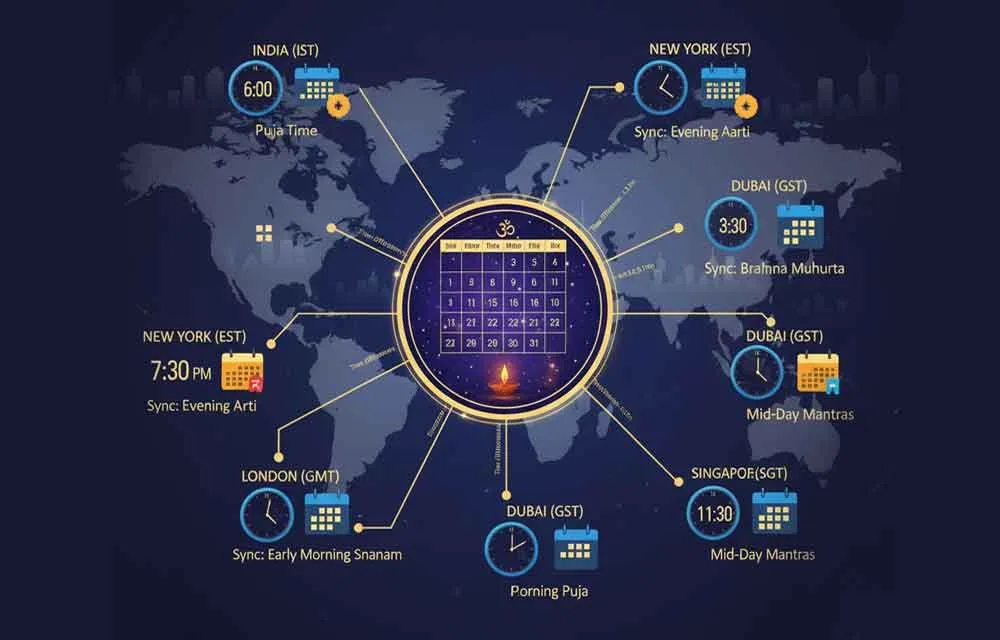
Example: If a temple in India performs Maha Abhishekam at 6:00 AM IST, you can virtually participate at:
- 7:30 PM EST (previous day)
- 6:30 PM CST (previous day)
- 4:30 PM PST (previous day)
Step 5: Using Technology to Stay Connected
Essential Apps and Tools:
- Drik Panchang: Provides muhurta timings adjusted for any global location
- Vedic Calendar: Shows tithis, nakshatras based on your coordinates
- Hindu Calendar: Customizable for your time zone
- World Clock Apps: Keep multiple time zones visible for family coordination
Pro Tip: Set recurring alarms on your phone 15 minutes before key ritual times so you never miss brahma muhurta or sandhya kala.
Creating Your Personalized NRI Pooja Schedule
Here's a sample daily schedule for someone in California during Karthika Masam:
Morning Rituals (Pacific Time - November example)
- 5:15 AM: Wake up (brahma muhurta begins)
- 5:30 AM: Bath and preparation
- 5:45 AM: Light Karthika deepam, offer prayers
- 6:00 AM: Recite Vishnu Sahasranamam or other slokas
- 6:45 AM: Local sunrise - face east, offer arghya
Evening Rituals (Pacific Time)
- 4:45 PM: Prepare pooja area
- 5:00 PM: Local sunset approaches - light lamps
- 5:15 PM: Tulsi pooja during sandhya kala
- 5:30 PM: Karthika Deepam main ceremony
- 6:00 PM: Aarti and prasadam
Special Considerations for Shift Workers
For NRIs working night shifts or irregular hours:
- Morning obligations: If you can't wake before sunrise, perform abbreviated pooja when you wake up, acknowledging the timing constraint
- Evening deep lighting: Use electric timer-controlled diyas that turn on automatically at sunset
- Weekend intensive practice: Compensate with more elaborate rituals on days off
- Intention matters: Genuine devotion with adapted timings is better than skipped observances
When to Strictly Follow Indian Timings
Some observances should align with Indian astronomical events:
- Ekadashi fasts: Follow the Indian tithi calculation as these are lunar-based
- Karthika Purnima: The full moon's exact timing matters
- Family coordination: If virtually joining relatives in India for special ceremonies
- Temple events: When your local Hindu temple follows Indian panchangam
Addressing Common Concerns
"Won't my prayers be less effective if I don't follow Indian time?"
Hindu philosophy emphasizes that divine presence is omnipresent. Your sincere devotion at the astronomically appropriate time for your location is fully valid. The sun that rises over California is the same Surya Narayana that rose over Chennai.
"My parents insist I should wake up when it's brahma muhurta in India."
Respectfully explain the astronomical principle. Perhaps compromise on special festival days while maintaining local timings for daily practice. Your sustainable, regular practice honors tradition better than an unsustainable schedule that leads to burnout.
"My local temple follows different timings than what I calculated."
Temples often follow their established panchangam. You can attend temple events according to their schedule while maintaining your personal practice based on local astronomy.
Resources for Accurate Timing
Websites:
- timeanddate.com/astronomy: Sunrise/sunset for any global location
- mypanchang.com: Customizable for your coordinates
- drikpanchang.com: Comprehensive muhurta calculations
Consulting Priests: Many Indian temples in the USA have priests available for consultation. They can provide personalized guidance based on your specific location and circumstances.
The Spiritual Essence Beyond Time
While this guide provides practical frameworks for timing, remember that Karthika Masam's true essence transcends time zones. The month celebrates:
- Discipline: Waking early, maintaining daily practice
- Devotion: Consistent connection with the divine
- Light over darkness: Symbolized by the daily deepam
- Simplicity: Traditional observances often involve simple acts performed with great sincerity
Your effort to maintain these practices while adapting to your geographical reality demonstrates profound dedication. The divine recognizes your intention and effort, regardless of which clock you follow.
Building Community Across Time Zones
Consider these ways to stay connected:
- Virtual sanghas: Join online groups observing Karthika Masam together
- Family video calls: Coordinate a time when relatives in India and you can both participate
- Local NRI communities: Many cities have groups that gather for special occasions
- Social media: Share your daily Karthika deepam photos using community hashtags
Conclusion: Finding Your Sacred Rhythm
Karthika Masam observance for NRIs isn't about perfectly replicating what happens in India—it's about finding a sustainable, meaningful practice that honors tradition while respecting your current reality. Whether you follow local astronomical timings, maintain connection with Indian time for special occasions, or create a hybrid approach, what matters most is the light you kindle—both literally and spiritually.
As you light your Karthika deepam this season, remember: the same divine consciousness that receives prayers in Varanasi at sunrise welcomes your devotion in Virginia at sunrise. Time zones may separate us geographically, but devotion transcends all boundaries.
Have you developed unique ways to observe Karthika Masam in your time zone? Share your experiences and tips in the comments below to help fellow NRIs maintain their spiritual practice.
#TimeZonePooja #NRITraditions #KarthikaMasam #HinduFestivals #DiasporaDevotions #PoojaTimingsUSA #IndianTraditionsAbroad #SpiritualPractice #HinduCalendar #VedicTimings #GlobalHinduism #NRISpirituality #KarthikaDeepam #BrahmaMuhurta #SunriseSunsetPooja
About HinduTone: Your trusted source for practical guidance on Hindu traditions, festivals, and spiritual practices for the modern global Hindu community.
Frequently Asked Questions
Should NRIs follow Indian time or local time for Karthika Masam rituals?
Most Hindu priests and scholars recommend following local sunrise and sunset for daily rituals, since the divine timeline follows the sun, not the clock. Indian timings are best kept for special occasions.
When is brahma muhurta during Karthika Masam abroad?
Brahma muhurta is 1.5 hours before local sunrise. For example, if sunrise in New York is at 7:15 AM EST, it begins at approximately 5:45 AM EST.
When should NRIs strictly follow Indian timings?
Ekadashi fasts follow the Indian tithi calculation because they are lunar-based, and the exact full-moon timing matters for Karthika Purnima. Indian timings also apply when joining family in India virtually or when a local temple follows the Indian panchangam.
How do I convert Indian ritual timings to US time zones?
Pacific Time is behind India by 13.5 hours (12.5 during DST), Mountain by 12.5 (11.5), Central by 11.5 (10.5) and Eastern by 10.5 (9.5). A 6:00 AM IST Maha Abhishekam would be 7:30 PM EST the previous day.
Are my prayers less effective if I don't follow Indian time?
No. Divine presence is omnipresent, and sincere devotion at the astronomically appropriate time for your location is fully valid. The sun that rises over California is the same Surya Narayana that rose over Chennai.
How can NRI shift workers observe Karthika Masam?
Perform an abbreviated pooja when you wake up if you cannot rise before sunrise, and use timer-controlled electric diyas that turn on at sunset. Weekend intensive practice can make up the rest, since genuine devotion with adapted timings beats skipped observances.
Share this with family and friends
Send it on WhatsApp, post it, or copy the link.
More from Festivals
- Karthika Puranam Chapter 14 (Adhyaya 14) in English: Story, Meaning and Lesson | Karthika Masam 2026 Day 14
- Karthika Puranam Chapter 13 (Adhyaya 13) in English: Story, Meaning and Lesson | Karthika Masam 2026 Day 13
- Karthika Puranam Chapter 12 (Adhyaya 12) in English: Story, Meaning and Lesson | Karthika Masam 2026 Day 12
- Karthika Puranam Chapter 11 (Adhyaya 11) in English: Story, Meaning and Lesson | Karthika Masam 2026 Day 11
- Karthika Puranam Chapter 10 (Adhyaya 10) in English: Story, Meaning and Lesson | Karthika Masam 2026 Day 10
You might also like
Akshaya Tritiya 2026 in the USA: Date, Significance, Puja Vidhi, Gold Buying & Eternal Prosperity Guide for Hindus
Hindu Dharma Worldwide: Complete NRI Diaspora Guide to Festivals, Temples, Mantras & Traditions (USA, UK, Canada, Australia, UAE & Europe — 2026)
Hindu Temples & Festivals in Europe — Complete NRI Guide to Sanatana Dharma Across the Continent (2026)