Kedareswara Vratam 2026: Date (Sunday 8 November), Vratha Katha, Pooja Vidhanam and the 21-Knot Thoram
Kedareswara Vratam (Kedara Gauri Vratam) 2026 falls on Sunday 8 November 2026, the Deepavali Amavasya, per Drik Panchang for Hyderabad and New Delhi. The Amavasya tithi runs from 11:27 AM IST on 8 November to 12:31 PM IST on 9 November. Our summary of the vratha katha and its variations, a step-by-step pooja vidhanam, the 21-knot thoram, naivedyam, a health note for the fast and the dates for families in the USA, Canada, the UK and beyond.
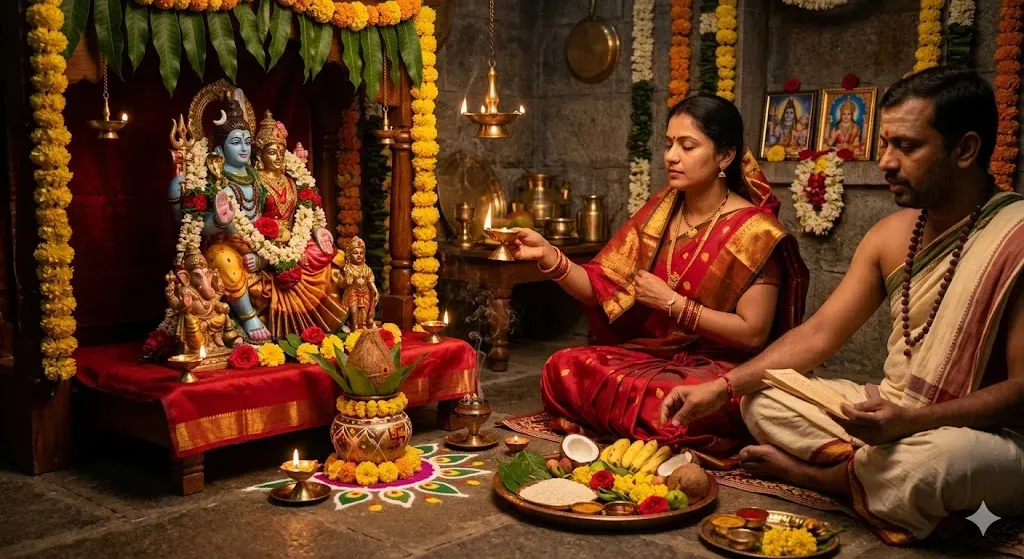
Quick answer: Kedareswara Vratam 2026 (Kedara Gauri Vratam, Kedareswara Nomu) falls on Sunday 8 November 2026, the Deepavali Amavasya, per Drik Panchang for Hyderabad and New Delhi. The Amavasya tithi runs from 11:27 AM IST on 8 November to 12:31 PM IST on 9 November. Families worship Lord Shiva as Kedareswara with Goddess Gauri, keep the 21-knot thoram before the deity, hear the vratha katha and then tie the thoram, praying for harmony in the family.
Last updated: 21 October 2026
Kedareswara Vratam 2026 date and Amavasya timings
| Detail | 2026 (Drik Panchang, IST) |
|---|---|
| Kedareswara Vratam / Kedar Gauri Vrat | Sunday 8 November 2026 |
| Amavasya tithi | 11:27 AM, Sun 8 Nov to 12:31 PM, Mon 9 Nov |
| Same day | Deepavali, Lakshmi Puja, Narak Chaturdashi, Darsha Amavasya |
| Sunrise / sunset in Hyderabad, 8 Nov | 6:18 AM / 5:42 PM |
| Next day | Kartika Amavasya, Monday 9 November |
| Karthika Masam begins (Telugu, amanta) | Tuesday 10 November 2026 |
Source: Drik Panchang day panchang for Hyderabad and New Delhi. Chaturdashi is current at sunrise on 8 November and Amavasya begins at 11:27 AM, so the Amavasya covers the afternoon and evening of Deepavali Sunday, when most families do the pooja. Some family panchangams and temples may fix the vratam differently; follow your elders. We do not give a muhurat clock time.
What is Kedareswara Vratam?
Kedareswara Vratam is a vow to Lord Shiva as Kedareswara, the Lord of Kedara, worshipped together with Goddess Gauri (Parvati). It is one of the best-known nomulu (household vows) of Telugu families, and the same vow is kept as Kedara Gowri Nombu in Tamil homes and as Kedara Gowri Vrata in Karnataka. It falls on the Amavasya of Deepavali, on the eve of Karthika Masam.
The heart of the vow is the union of Shiva and Shakti. Shiva and Parvati are worshipped as one, often remembered as Ardhanareeswara, the form that is half Shiva and half Parvati. Families keep it with a prayer for harmony between husband and wife, for the well-being of the household and for steady devotion. It is a devotional vow, not a guarantee of any particular result.
In many Telugu families the vow is kept by married couples together, in others mainly by women, and in some households it is kept every year once a family has begun it. A family that has stopped often restarts it only after asking elders or a priest. These customs differ, so follow what your family does.
Kedareswara Vratha Katha: the story in brief
The vratha katha is read or heard at the end of the pooja. Versions differ from book to book. This is our own short summary of the story as it is commonly told in Telugu and Tamil homes.
Parvati's vow and Ardhanareeswara
As commonly told, the sage Bhringi was so devoted to Shiva alone that, when he came to Kailasa, he went around Shiva and ignored Parvati. Hurt that she was being treated as separate from her Lord, Parvati asked how she could become inseparable from Shiva. A sage, in most versions Gautama, taught her the Kedara vratam. Parvati kept it with full devotion, and Shiva, pleased, gave her half of his own body. From then on they were worshipped as Ardhanareeswara, and no devotee could worship one without the other.
The household story
Many vratha kathas add a second story about an ordinary family. In a common form, two sisters who had fallen into hardship learnt the vow from celestial women, kept it with sincerity and saw their family's troubles ease and their home become whole again. Other versions tell of a king or a merchant family instead. The lesson in every version is the same: keep the vow with faith and humility, and do not give it up out of pride once prosperity returns.
Variations you may hear
- The sage who teaches Parvati the vow is Gautama in most Telugu books; some tellings name a different sage or have Shiva himself explain it.
- In some Tamil and Kannada families the vow is kept over 21 days that end on Deepavali Amavasya; many Telugu families keep only the main day.
- The household story changes from book to book (two sisters, a king, a merchant family), and the names of the characters also change.
- Some families read the katha before the thoram is tied, others after; both are common.
Kedareswara Vratam Pooja Vidhanam: step by step
This is a simple outline. Family books and priests add more detail, such as the full shodasopachara (16-step) worship.
- Preparation: clean the pooja space, draw a muggu (kolam) and place a kalasham on a small heap of rice or grain. Keep turmeric, kumkum, flowers, betel leaves, fruits, a lamp and incense ready.
- Snanam and sankalpam: bathe, wear clean clothes and take a sankalpam (resolution) to keep the Kedareswara vratam, saying your name and gotra if your family does so.
- Ganapati pooja: begin with a short prayer to Lord Ganesha so the vow goes without obstacles.
- Invocation: invoke Kedareswara and Gauri in the kalasham, or before a Shiva lingam or a picture of Shiva and Parvati.
- The thoram: place the 21-knot thoram, smeared with turmeric, before the deity and worship it along with the deity.
- Worship: offer flowers, bilva leaves if you have them, turmeric, kumkum, incense and a lamp, chanting Om Namah Shivaya. Many families offer 21 of each item, such as betel leaves, fruits or sweets; the exact list varies.
- Naivedyam: offer the family's naivedyam, often ariselu in Telugu homes and adhirasam in Tamil homes, with fruits and coconut.
- Vratha katha: read or listen to the katha with family members.
- Tying the thoram: after aarti, tie the thoram on the right wrist or arm, as the family custom says, and seek the blessings of elders.
- Completion: share prasadam and, if you can, give food or a gift to someone in need.
For the related Tamil practice and the adhirasam naivedyam, see our Kedar Gauri Vrat 2026 and Deepavali Nombu guide. The Telugu ariselu recipe is in our Telugu Deepavali recipes page.
Mantras for Kedareswara Vratam
The simplest prayer, which needs no initiation, is the Panchakshari mantra of Shiva:
ॐ नमः शिवाय॥
oṃ namaḥ śivāya||
Many families also recite the Ardhanarishvara Stotram of Adi Shankaracharya, which praises Shiva and Parvati as one. Its first verse, as given by sanskritdocuments.org:
चाम्पेयगौरार्धशरीरकायै कर्पूरगौरार्धशरीरकाय ।
धम्मिल्लकायै च जटाधराय नमः शिवायै च नमः शिवाय ॥ १॥
cāmpeyagaurārdhaśarīrakāyai karpūragaurārdhaśarīrakāya |
dhammillakāyai ca jaṭādharāya namaḥ śivāyai ca namaḥ śivāya || 1||
Meaning in brief: salutations to Shivaa (Parvati), whose half of the body shines golden like the champaka flower, and to Shiva, whose half is white like camphor; to her with braided hair and to him with matted locks. The full text is on our Ardhanarishwara Stotram page.
Fasting and a health note
Many people keep a fast until the pooja and katha are complete and then eat prasadam. Others take fruit or milk, or a single simple meal. Fasting is a personal devotional choice, not a requirement of the vow.
Health note: if you are pregnant, elderly, diabetic, have low blood pressure, are unwell or take regular medicine, speak to your doctor before fasting and keep a light observance. Drink water if you need to. Since the vratam falls on Deepavali, plan the day so that the pooja and the family's Lakshmi Puja do not leave anyone fasting for too long.
Kedareswara Vratam 2026 for NRI families
The Amavasya is one instant worldwide. Converted to local clocks, it runs as follows. Diwali in these countries is also on Sunday 8 November.
| City | Amavasya begins | Amavasya ends | Vratam day |
|---|---|---|---|
| New York, Toronto (ET) | Sun 8 Nov, 12:57 AM | Mon 9 Nov, 2:01 AM | Sunday 8 November |
| Chicago, Dallas, Winnipeg* | Sat 7 Nov, 11:57 PM (Winnipeg Sun 8, 12:57 AM) | Mon 9 Nov, 1:01 AM (Winnipeg 2:01 AM) | Sunday 8 November |
| Calgary, Edmonton | Sat 7 Nov, 11:57 PM | Mon 9 Nov, 1:01 AM | Sunday 8 November |
| Vancouver | Sat 7 Nov, 10:57 PM | Mon 9 Nov, 12:01 AM | Sunday 8 November |
| Los Angeles, Bay Area, Seattle | Sat 7 Nov, 9:57 PM | Sun 8 Nov, 11:01 PM | Sunday 8 November |
| London (GMT) | Sun 8 Nov, 5:57 AM | Mon 9 Nov, 7:01 AM | Sunday 8 November |
| Dubai | Sun 8 Nov, 9:57 AM | Mon 9 Nov, 11:01 AM | Check local panchangam |
| Singapore | Sun 8 Nov, 1:57 PM | Mon 9 Nov, 3:01 PM | Check local panchangam |
| Sydney (AEDT) | Sun 8 Nov, 4:57 PM | Mon 9 Nov, 6:01 PM | Check local panchangam |
*From November 2026 Manitoba keeps UTC−5, Alberta UTC−6 and British Columbia UTC−7 all year, so Winnipeg's clock matches Toronto's in November. In North America and the UK the Amavasya covers the whole daytime of Sunday 8 November. In the Gulf, Singapore and Australia it begins during the day on 8 November, so families there should follow their local panchangam or temple.
- Working week: the vratam falls on a Sunday in 2026, which makes a full home pooja easier abroad.
- Thoram and materials: Indian stores and temples abroad often sell ready thorams and pooja kits before Deepavali. A home-made thoram of 21 strands of cotton thread with 21 knots, dipped in turmeric, is traditional.
- Temples: some Telugu associations and temples hold a group Kedareswara vratam. Check their own websites or notice boards for dates and registration.
- Safety: keep lamps away from curtains and smoke alarms, and never leave them burning unattended.
For the Diwali dates and Lakshmi Puja times abroad, see Diwali 2026 in the USA, Canada and the UK.
After the vratam: into Karthika Masam
Kedareswara Vratam closes the Deepavali day and opens the most sacred Shiva month of the Telugu year. Karthika Masam begins on Tuesday 10 November 2026, the first Karthika Somavaram falls on Monday 16 November, and Karthika Pournami is on Tuesday 24 November in India. See our Karthika Somavaram 2026 dates and the Karthika Masam 2026 guide.
Frequently asked questions
When is Kedareswara Vratam in 2026?
Kedareswara Vratam (Kedara Gauri Vratam) 2026 is on Sunday 8 November 2026, together with Deepavali. Drik Panchang lists Kedar Gauri Vrat on that day for Hyderabad and New Delhi. The Amavasya tithi runs from 11:27 AM IST on Sunday 8 November to 12:31 PM IST on Monday 9 November.
Is Kedareswara Vratam the same as Kedara Gowri Nombu?
Yes, it is the same vow to Shiva as Kedareswara and Parvati as Gauri. Telugu families call it Kedareswara Vratam or Kedareswara Nomu; Tamil families call it Kedara Gowri Nombu and Kannada families Kedara Gowri Vrata. Customs such as the number of days, the naivedyam and who keeps the vow differ by region and family.
What is the Kedareswara thoram?
It is the sacred thread of the vow, traditionally made of 21 strands with 21 knots, smeared with turmeric and placed before the deity during the pooja. After the pooja it is tied on the right wrist or arm, as the family custom says, and kept as a reminder of the vow.
Can Kedareswara Vratam be done at home without a priest?
Yes. Many families do it at home, reading the pooja vidhanam and the vratha katha from a family book, with elders guiding. Others do it at a temple or with a priest. If your family has a fixed method, follow it; this page gives a simple outline.
Is fasting compulsory for Kedareswara Vratam?
No. Many people fast until the pooja and katha are over, while others eat a light meal. Anyone who is pregnant, elderly, diabetic, unwell or on regular medicine should talk to a doctor first and keep a lighter observance. Prayer and the pooja are complete without a strict fast.
What should NRIs in the USA, Canada and the UK do?
In the USA, Canada and the UK the Amavasya covers the whole daytime of Sunday 8 November, so the vratam falls on that Sunday, the same day as Diwali there. In Australia, Singapore, Malaysia and the Gulf the Amavasya begins in the afternoon of 8 November, so check your local panchangam or temple.
Editor's note (21 October 2026)
Upgraded in place on 21 October 2026. The date and Amavasya times are from Drik Panchang (Hyderabad and New Delhi day panchang); times abroad are the same Drik tithi instants converted to each local clock under the 2026 time-zone rules. The vratha katha is HinduTone's own summary of the story as commonly told, with variations noted, and pooja steps vary between families and regions. The verse is copied unchanged from sanskritdocuments.org. We do not give muhurat times, temple timings or event details; check with your temple.
Related guides
Share this with family and friends
Send it on WhatsApp, post it, or copy the link.
More from Festivals
- Vasant Panchami 2027 (Saraswati Puja, Basant Panchami, Sri Panchami): Date, Panchami Tithi, Puja Muhurat by City, Vidhi and Story
- Holi 2027: Date, Holika Dahan Muhurat City-Wise, Bhadra Timings, Puja Vidhi and Holi Abroad
- Makar Sankranti 2027: Date, Punya Kaal Timings City-Wise, Bhogi, Pongal, Kanuma, Lohri and Uttarayan
- Dev Deepawali 2026 Varanasi: Date, Purnima Time, Ganga Aarti, Story, Puja Vidhi and Deep Daan
- Must-Perform Rituals in Karthika Masam 2026: Complete State-Wise Guide for Devotees Across India
You might also like
Tulsi Vivah 2026: Date, Puja Vidhi, Samagri, Katha and Significance
Dussehra 2026 Date, Puja Muhurat, Significance and Celebrations Around the World
Raas Purnima 2026 in Assam: Date, Majuli Raas Mahotsav, Story and Celebrations