Mahashivratri 2026: Sudarshan Patnaik's Stunning Lord Shiva Sand Sculpture at Puri Beach, Odisha
Imagine standing on the golden shores of Puri Beach, where the Bay of Bengal whispers ancient mantras with every wave.
Imagine standing on the golden shores of Puri Beach, where the Bay of Bengal whispers ancient mantras with every wave.
Imagine standing on the golden shores of Puri Beach, where the Bay of Bengal whispers ancient mantras with every wave. As the sun dips low and the air fills with the chants of "Har Har Mahadev," something extraordinary emerges from the sand—a living tribute to Bholenath himself.
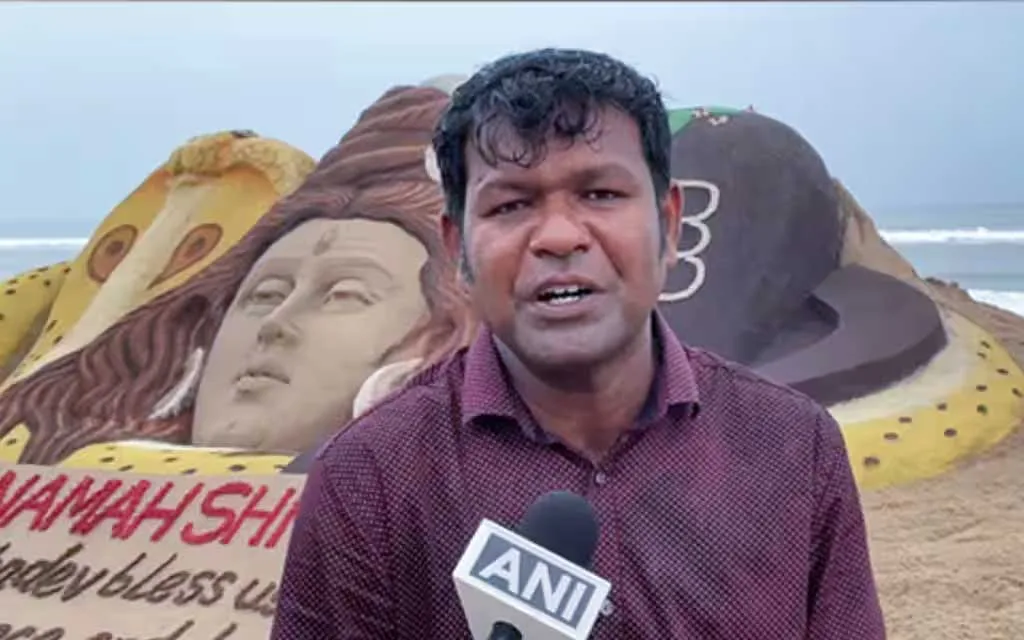
On this sacred occasion of Mahashivratri (celebrated with fervor in 2026), Padma Shri awardee and world-famous sand artist Sudarshan Patnaik has once again turned grains of sand into a portal of devotion. His latest creation: a breathtaking sand sculpture of Lord Shiva in deep meditation, reclining beside a towering Shivling, encircled by hundreds of miniature Shivlings that stand like devoted sentinels against the tide.
The artwork is nothing short of miraculous. Lord Shiva sits in calm poise—eyes closed in eternal bliss, his matted locks crowned with the crescent moon, a serene cobra coiled around his neck, and rudraksha malas adorning his form. The large central Shivling, symbolizing the formless divine, is framed by waves that seem to pay homage, while tiny diya-like Shivlings create a sacred perimeter. It's as if Shiva has descended to the beach, blessing the millions who throng Puri for this auspicious night.
Sudarshan Patnaik, hailing from Odisha and internationally acclaimed for his ephemeral yet profound creations, has long used the beach as his canvas to celebrate Sanatan traditions. From Ganesh Chaturthi motifs promoting self-reliance to Sawan tributes with massive Shivlings, his art merges spirituality with environmental messages. This Mahashivratri piece reminds us of the transient nature of life—like sand sculptures washed away by the sea—yet the eternal presence of Mahadev remains unshaken.
The response has been overwhelming—thousands of likes, shares, and comments echoing "Har Har Mahadev" and "Jai Shiv Shankar." Devotees from across India and beyond see it as a divine sign, a visual prayer for peace, strength, and devotion in turbulent times.
Why does this resonate so deeply? In a fast-paced world, Sudarshan Patnaik's work invites us to pause, reflect, and connect with our roots. On Mahashivratri—the night when Shiva performs the cosmic dance of Tandava—such art becomes a reminder that true power lies in surrender, simplicity, and unwavering faith.
Har Har Mahadev! May this sand masterpiece inspire you to light a diya, chant Om Namah Shivaya, and embrace the destroyer of illusions within.
What are your thoughts on this divine creation? Share in the comments below—let's spread the devotion!
Jai Shri Ram, Jai Mahakal!
Why Mahashivratri Is the Most Sacred Night in the Shaiva Calendar
Mahashivratri, literally 'the Great Night of Shiva,' falls on the fourteenth tithi of the dark fortnight (Krishna Chaturdashi) in the month of Phalguna. Unlike most Hindu festivals celebrated with light and festivity during daytime, Mahashivratri is a night vigil — a jagarana — where devotees remain awake through four praharas, offering bilva leaves, milk, honey, and water to the Shivlinga at each quarter of the night. The Shiva Purana explicitly states that a sincere night-long vigil on this tithi earns a devotee liberation from the cycle of rebirth.
Mythologically, this is the night when Lord Shiva performed the Tandava — his cosmic dance of creation and dissolution — and also the night of his marriage to Goddess Parvati, the daughter of the Himalayas. Both themes converge to make it a celebration of Shakti and Shiva united, the primordial masculine and feminine energies that sustain the universe. For a sand sculpture to capture Shiva in his meditative aspect — perfectly still, eyes closed, serene — on this very night is a profound artistic and spiritual statement.
The Sacred Geography of Puri Beach and Its Shiva Connection
Puri in Odisha is revered primarily as the abode of Lord Jagannath, one of the Char Dham pilgrimage sites, yet its coastal identity has deep Shaiva undercurrents as well. The shoreline of the Bay of Bengal, known locally as Swargadwar (the Gateway to Heaven), has historically been a site of last rites, prayers, and divine invocation. Ancient texts describe the ocean itself — Samudra Deva — as a devotee of Mahadev, and the ceaseless rhythm of the waves is compared to the unbroken recitation of the Panchakshara mantra, 'Om Namah Shivaya.'
Odisha's temple landscape also carries remarkable Shaiva heritage. The Lingaraj Temple in Bhubaneswar, one of the largest Shiva temples in India, houses the Svayambhu (self-manifested) Shivalinga of Harihara — a form fusing Shiva and Vishnu — attesting to the region's integrative devotional culture. By choosing Puri Beach as his canvas each year, Sudarshan Patnaik situates his work at the intersection of Vaishnavism and Shaivism, reflecting Odisha's naturally syncretic spiritual inheritance.
The Iconographic Language Hidden in Sudarshan Patnaik's Shiva Sculpture
Every element Patnaik sculpts in sand carries the weight of deep iconographic tradition. The crescent moon (Chandrakala) adorning Shiva's matted Jata signifies his mastery over time — he wears the crescent as the repository of Soma, the sacred nectar. The cobra coiled around his neck is Vasuki, king of the Nagas, symbolising Shiva's fearlessness in the face of death and poison — a reference to his title Neelakantha, earned when he swallowed the Halahala poison during the churning of the cosmic ocean (Samudra Manthan).
The Rudraksha mala is equally loaded with meaning. Rudraksha literally means 'eyes of Rudra,' and the Shiva Purana recounts that these beads emerged from Shiva's teardrops shed during centuries of meditation for the welfare of all beings. The surrounding miniature Shivlingas in the sculpture evoke the Kotilingeshwara concept — the consecration of crores of Shivalingas as an act of supreme devotion — seen in practice at the Kotilingeshwara Temple in Kolar district, Karnataka. Together, these symbols make the sand artwork a complete theological text, legible even without words.
Sudarshan Patnaik's Artistic Legacy as a Form of Living Bhakti
Sudarshan Patnaik began sculpting at Puri Beach as a child, largely self-taught, turning poverty and proximity to the sea into a lifelong sadhana. He has won multiple Guinness World Records, including one for the largest sand sculpture created by a single artist, and has represented India at international sand art festivals across Japan, Russia, France, and the United States. His Padma Shri, awarded by the Government of India, recognised not just artistic excellence but the role his work plays in cultural diplomacy and devotional expression.
What distinguishes Patnaik's Shiva sculptures from mere artistic spectacle is their deliberate impermanence — a quality that itself mirrors a core teaching of Shaiva philosophy. The Mahashivratri sculpture will be reclaimed by the tide within days, echoing the Shaiva concept of Pralaya, the periodic dissolution of the universe into Shiva's being. Far from being a loss, devotees and the artist himself have spoken of this dissolution as a form of offering — the entire sculpture surrendered to Mahadev, much like flowers offered at a Shivalinga that wither and return to the earth.
How to Observe Mahashivratri: The Fourfold Night Worship and Its Inner Meaning
The Shiva Purana prescribes a specific ritual structure for Mahashivratri divided into four praharas, each roughly three hours long through the night. In the first prahara, the Shivalinga is bathed with milk (Dugdha Abhisheka) while chanting 'Om Namah Shivaya'; in the second, with curd; in the third, with ghee; and in the fourth, with honey. Bilva leaves — the trifoliate leaf of Aegle marmelos, considered supremely dear to Shiva — are offered at each stage. Devotees maintain an upavasa (fast), often subsisting on fruits and water alone.
On the inner, contemplative level, the four praharas correspond to the four states of consciousness described in Mandukya Upanishad: waking (Jagrat), dreaming (Svapna), deep sleep (Sushupti), and the transcendent fourth state (Turiya). Staying awake through all four is thus an exercise in expanding awareness toward Turiya — the state of pure witnessing consciousness that is, according to Advaita Vedanta, identical with Shiva himself. The night-long vigil is not mere ritual endurance; it is a structured meditation on consciousness itself.
Sand Art as Spiritual Communication in the Age of Digital Devotion
When Patnaik's Mahashivratri sculpture was shared across social media, it reached millions of people who may never visit Puri Beach in person. This virality is not incidental — it reflects a growing pattern where traditional devotional art finds new life through digital platforms, democratising darshana (the auspicious sight of the divine) in a way that transcends physical pilgrimage. The photograph of a sand Shiva, shared on a screen in Mumbai or Melbourne, still functions as a moment of visual prayer for the viewer.
This mirrors the ancient principle of Chitra Puja — worship through image — found in texts like the Vishnu Dharmottara Purana, which devotes an entire section to the theology of sacred art. Just as a two-dimensional temple painting or a bronze Nataraja communicates the divine, a sand sculpture — however ephemeral — carries the same potential for awakening devotion. Patnaik's annual Mahashivratri creation has thus become a form of public seva, a contribution to the collective spiritual atmosphere of the nation offered freely to every eye that falls upon it.
Frequently Asked Questions
When is Mahashivratri 2026?
Mahashivratri is observed on its traditional tithi in the Hindu lunar calendar; refer to the year's panchang for the exact date in your region.
What is the significance of Mahashivratri?
Imagine standing on the golden shores of Puri Beach, where the Bay of Bengal whispers ancient mantras with every wave. As the sun dips low and the air fills with the chants of "Har Har Mahadev ," something extraordinary emerges from the sand—a living tribute to Bholenath himself.
How is Mahashivratri celebrated?
Devotees observe it with puja, fasting or special offerings, visiting temples, chanting mantras, and gathering with family. Customs vary by region and tradition.
What should devotees do on Mahashivratri?
Worship Lord Shiva, perform the day's puja and offerings, observe the fast where prescribed, and chant the associated mantras with devotion.
You might also like
Karthika Purnima 2026: Significance, Rituals, and the Triple Festival Across Hindu, Sikh, and Jain Traditions
Mahalakshmi Vrata 2026: Significance, Rituals, and the Sixteen-Day Puja That Brings Lakshmi Home
Sri Suktam: Complete Guide to the 15-Verse Vedic Hymn to Goddess Lakshmi