Avanibhajana Pallaveshwaram Temple, Siyamangalam
Shiva as Stambeswarar (Thoonandavar) temple · Seeyamangalam (Siyamangalam), Tiruvannamalai, Tamil Nadu, India
The Avanibhajana Pallaveshwaram Temple is a Pallava-period rock-cut Shiva temple at Seeyamangalam (Siyamangalam) in Tiruvannamalai district, Tamil Nadu. Wikipedia says it is also called the Stambeswarar Temple, after the Tamil name Thoonandavar, 'lord of the pillars'.
The name Avanibhajana comes from Avani, a title of the Pallava king Mahendravarman I, who is credited with excavating the cave around 600 to 630 CE.
Faith & Tradition
Religious Significance of Avanibhajana Pallaveshwaram Temple, Siyamangalam
The shrine is best known for a relief of dancing Shiva on a pilaster, shown in the Ananda Tandava posture with a snake below the raised leg, a drummer and a devotee. Wikipedia describes it as among the earliest Nataraja representations in South India, and Puratattva notes that scholars use terms such as ananda-tandava and bhujanga-trasita for the pose.
Wikipedia also records the view of the archaeologist R. Nagaswamy that the sculpture reflects Mahendravarman's knowledge of dance postures from the Natya Shastra.
Heritage
History of Avanibhajana Pallaveshwaram Temple, Siyamangalam
Puratattva states that inscriptions establish Mahendravarman I as the builder, identified with the name Lalitankura in an inscription on the southern pillar, which records the foundation of the temple as Avanibhajana-Pallaveshvara. Wikipedia adds that the inscriptions are in Sanskrit in the Grantha-Pallava script.
Puratattva lists some seventeen later records, including gifts under the Pallava king Nandivarman III (849 CE), the Cholas (including Rajaraja I in 1004 CE) and a Pandya record of 1288 CE. It also records that Jain temples were established nearby under the Western Ganga king, in an inscription of 892-93 CE. Early documentation includes publication of the Pallava inscriptions by E. Hultzsch in 1901 and K. R. Srinivasan's 1958 study of the Mahendra-style pillars.
Architecture and sacred features
Like other Mahendravarman caves, it has a front hall (mukha-mandapa), a half hall and a sanctum, according to Puratattva. The facade has two pillars and two pilasters, with niches topped by makara-torana arches. Pillars have cubical bases and tops with an octagonal middle; lotus medallions appear on lower sections and a lion relief on the upper front face. Two warrior figures stand in the niches.
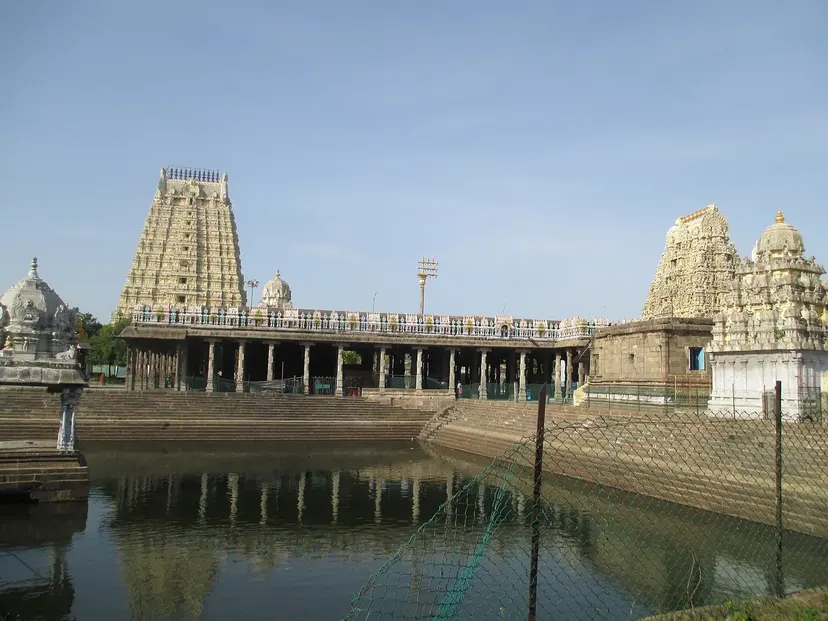
Wikipedia notes a circular sanctum cut into the rock with a lingam, two dvarapalas, and a Nandi shrine outside the pillared hall. A three-tiered gopuram, believed to be a Vijayanagara addition, and later mandapas now hide the original rock-cut shrine, according to both sources. Jain beds and carvings of the 9th century lie on the other side of the hillock.
Plan Your Visit
Darshan and Visitor Information
Wikipedia describes the temple as a protected monument administered by the Archaeological Survey of India, citing an ASI list for the Vellore sub-circle. Visitors should follow ASI rules, avoid touching the carvings and inscriptions, and confirm access and timings with the ASI or local sources, as none are given in the sources consulted.
Timings and arrangements change with seasons and festivals. Confirm current details with Archaeological Survey of India (per Wikipedia) before travelling. Last reviewed 1 November 2026.
Location
How to Reach Avanibhajana Pallaveshwaram Temple, Siyamangalam
Wikipedia places the temple at 12°25′52″N 79°27′59″E in Seeyamangalam, Tiruvannamalai district. Neither source opened gives road or rail directions or visiting details, so check access locally.
Location: Seeyamangalam (Siyamangalam), Tiruvannamalai, Tamil Nadu, India
More in Hindu temples in Tamil Nadu · Shiva as Stambeswarar (Thoonandavar) temples · Temples in Vandavasi Taluk · Temples in Tiruvannamalai District
Questions
Avanibhajana Pallaveshwaram Temple, Siyamangalam: Frequently Asked Questions
Who built the Avanibhajana Pallaveshwaram Temple?
The Pallava king Mahendravarman I, around 600-630 CE, according to inscriptions described by Puratattva and Wikipedia.
What does Avanibhajana mean?
Avani is a title of Mahendravarman, so the name relates to the king.
What is the main sculpture?
A relief of Shiva dancing in the Ananda Tandava posture, described as among the earliest Nataraja images in South India.
Is it also called Stambeswarar Temple?
Yes. Wikipedia says the temple is also called Stambeswarar, after the Tamil Thoonandavar.
Which district is it in?
Tiruvannamalai district, Tamil Nadu.
Who protects the monument?
Wikipedia says it is a protected monument administered by the Archaeological Survey of India.
Sources and attribution
- Wikipedia — Avanibhajana Pallaveshwaram Temple
- Puratattva — Seeyamangalam: Avanibhajana-Pallaveshvaram Cave Temple
Further reading: Avanibhajana Pallaveshwaram Temple, Siyamangalam on Wikipedia (CC BY-SA 4.0).
Spotted an error? Write to info@hindutone.com — see our editorial policy.