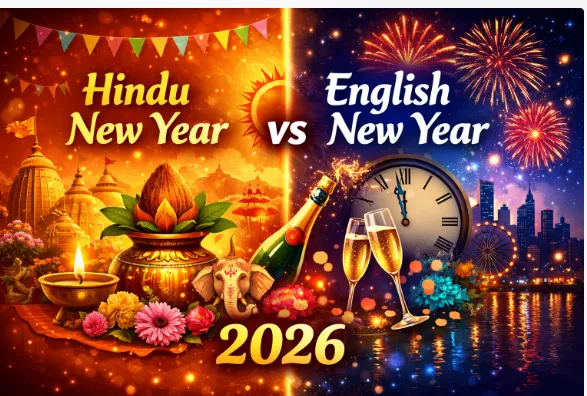
English New Year vs Hindu New Year: Why Hindus Traditionally Celebrate Time Differently
Introduction: Two New Years, Two Worldviews Every year on January 1, much of the world celebrates the English New Year with fireworks, countdowns, parties, and…

Introduction: Two New Years, Two Worldviews
Every year on January 1, much of the world celebrates the English New Year with fireworks, countdowns, parties, and resolutions. In India too, cities light up, hotels host events, and social media floods with “Happy New Year” wishes. Yet, quietly and often unnoticed, many Hindus ask an important question:
Is January 1 really our New Year?
Hindu civilization—one of the world’s oldest continuous cultures—has never viewed time as a simple line from past to future. Instead, it sees time as cyclical, cosmic, and deeply connected to nature. For Hindus, a new year is not just a date change on a calendar; it is a shift in cosmic energy, aligned with the Sun, Moon, Earth, seasons, and human consciousness.
This article explores the deeper meaning behind English New Year vs Hindu New Year, explaining:
- Why January 1 has no traditional Hindu roots
- The scientific and astronomical basis of Hindu calendars
- How Hindu timekeeping is linked to nature and life rhythms
- Whether Hindus should celebrate English New Year at all
This is not about rejection—but about understanding, cultural clarity, and reclaiming civilizational wisdom.
Why January 1 Is Not Traditional to Hindu Culture
The Roman Origins of January 1
January 1 originates from ancient Rome, not India. The month of January is named after Janus, the Roman god of doors, beginnings, and transitions. Janus had two faces—one looking to the past and one to the future—symbolizing transition rather than cosmic alignment.
The Roman calendar itself went through multiple revisions:
- Originally a 10-month calendar
- Later modified by Julius Caesar into the Julian calendar
- Finally standardized as the Gregorian calendar in 1582 by Pope Gregory XIII
This calendar was designed primarily for administrative convenience, taxation, and church observances—not for ecological or astronomical precision.
How January 1 Entered Indian Life
January 1 became prominent in India through:
- British colonial administration
- Adoption of the Gregorian calendar for governance, railways, courts, and education
- Missionary influence and Western schooling
Over time, January 1 transformed from a bureaucratic date into a social celebration, especially in urban and English-educated circles.
However, historically:
- No Vedas
- No Puranas
- No Itihasas (Ramayana, Mahabharata)
- No Dharmashastras
mention January 1 as a significant beginning of time.
For Hindu civilization, time was never imported—it was observed.
Cultural Disconnection and Identity Confusion
Celebrating January 1 without understanding its origin creates a subtle cultural disconnect:
- It prioritizes a foreign calendar over indigenous knowledge
- It slowly normalizes colonial timelines
- It sidelines Hindu cosmology and festivals
This does not mean Hindus must reject January 1—but understanding what it is and what it is not is essential.
Hindu Calendar vs Gregorian Calendar: Two Philosophies of Time
Linear Time vs Cyclical Time
At the heart of the difference lies how time itself is perceived.
Gregorian Calendar:
- Time is linear
- Past → Present → Future
- Progress is material and historical
Hindu Calendar:
- Time is cyclical
- Creation → Preservation → Dissolution → Renewal
- Progress is spiritual and cosmic
This cyclical understanding is reflected in:
- Yugas (Satya, Treta, Dvapara, Kali)
- Kalpas (days of Brahma)
- Samvatsaras (60-year cycles)
Time is not running out—it is repeating, refining, and evolving.
Solar, Lunar, and Lunisolar Systems
The Gregorian calendar is purely solar, based on Earth’s revolution around the Sun.
Hindu calendars are far more sophisticated:
- Solar calendars (based on Sun’s movement)
- Lunar calendars (based on Moon’s phases)
- Lunisolar calendars (balancing both)
This is why Hindu festivals shift dates every year but never lose seasonal accuracy.
Scientific Basis of Hindu Calendars (Solar & Lunar)
Surya Siddhanta: Ancient Astronomical Mastery
Hindu timekeeping is not myth—it is astronomy.
Texts like Surya Siddhanta, written thousands of years ago, calculate:
- Length of a solar year
- Planetary orbits
- Eclipses
- Precession of equinoxes
Modern astronomers have acknowledged the precision of these calculations.
Solar Hindu New Years
Several Hindu New Years are solar-based, occurring when the Sun enters a new zodiac sign (Rashi):
- Ugadi (Andhra Pradesh, Telangana, Karnataka)
- Gudi Padwa (Maharashtra)
- Vaisakhi (Punjab)
- Puthandu (Tamil Nadu)
- Vishu (Kerala)
These align closely with:
- Spring
- Agricultural cycles
- Biological renewal
Lunar Hindu New Years
Some regions follow lunar systems:
- Chaitra Shukla Pratipada (North India)
- Kartika Pratipada (Gujarati New Year after Diwali)
The Moon governs:
- Tides
- Human emotions
- Menstrual and biological rhythms
Hindu sages understood this millennia ago.
How Hindu Timekeeping Is Linked to Nature
Seasons, Agriculture, and Survival
Hindu New Years are deeply tied to:
- Harvest cycles
- Monsoon patterns
- Crop sowing and reaping
A farmer celebrating Ugadi or Vaisakhi is not just marking time—he is aligning life with Earth’s rhythm.
January 1, by contrast:
- Falls in deep winter for much of the world
- Has no agricultural or ecological significance in India
Panchanga: The Fivefold Hindu Almanac
Every Hindu calendar is based on the Panchanga, which includes:
- Tithi (lunar day)
- Vara (weekday)
- Nakshatra (constellation)
- Yoga (Sun-Moon angle)
- Karana (half lunar day)
This system ensures:
- Auspicious timing (Muhurat)
- Alignment with cosmic energies
- Harmony between human action and universal forces
January 1 has none of these considerations.
Festivals as Time Markers, Not Dates
In Hinduism:
- Time is marked by festivals, not numbers
- Festivals celebrate events in consciousness, not calendar squares
Examples:
- Makara Sankranti (Sun’s northward journey)
- Navaratri (seasonal transition)
- Diwali (inner light over darkness)
Hindu New Year is not a party—it is a reset of cosmic alignment.
Hindu New Year Significance: More Than a Calendar Change
Spiritual Renewal, Not Just Resolution
Hindu New Year emphasizes:
- Self-purification
- Dharma (righteous living)
- Gratitude to nature
- Seeking divine blessings
Homes are cleaned, rangolis drawn, temples visited, and scriptures recited.
This contrasts sharply with:
- Alcohol-driven celebrations
- Midnight countdowns
- Short-lived resolutions
Community, Family, and Continuity
Hindu New Year is:
- Celebrated with elders
- Passed down through rituals
- Rooted in regional identity
It strengthens:
- Family bonds
- Cultural memory
- Spiritual continuity
Should Hindus Celebrate English New Year?
A Balanced Perspective
The question is not “Should we stop?”
The question is “What should we prioritize?”
There is no harm in:
- Greeting friends on January 1
- Reflecting on goals
- Enjoying a holiday
The concern arises when:
- Hindu New Year is ignored or forgotten
- January 1 replaces indigenous traditions
- Cultural awareness is lost
Celebration vs Consciousness
Hindus can:
- Acknowledge January 1 socially
- Celebrate Hindu New Year spiritually and culturally
Just as Indians celebrate:
- Christmas as a cultural event
- Without converting religions
Similarly, January 1 can be acknowledged without replacing identity.
Reclaiming Hindu Time Without Rejecting the World
True cultural confidence lies in:
- Knowing one’s roots
- Understanding one’s systems
- Teaching the next generation
Celebrating Hindu New Year consciously is an act of civilizational self-respect, not isolation.
English New Year vs Hindu New Year: A Clear Comparison
Conclusion: Time Is Culture, Not Just Numbers
Time is not neutral.
The way a civilization measures time reflects how it understands life, nature, and the universe.
The English New Year is a product of administrative history.
The Hindu New Year is a product of cosmic observation, ecological wisdom, and spiritual insight.
Understanding the difference between English New Year vs Hindu New Year is not about rejection—it is about awareness.
When Hindus celebrate their New Year:
- They align with the Sun and Moon
- They honor nature
- They renew dharma
- They reconnect with thousands of years of wisdom
For More Devotional Journey, Follow
- Temples
/temples/ - Tirumala Updates
/tirumala/ - Sabarimala Yatra
/category/sabarimala-yatra/ - Pooja, Slokas & Mantras
/pooja-slokas-and-mantras/ - Hindu Gods
/hindu-gods/
In remembering how Hindus traditionally celebrate time, we do not move backward—we move deeper.
Frequently Asked Questions
Why is January 1 not a traditional Hindu New Year?
January 1 comes from ancient Rome, and the month is named after Janus, the god of doors and beginnings. It became common in India through British administration, and the Vedas, Puranas, Itihasas and Dharmashastras do not mention it as a beginning of time.
How does the Hindu view of time differ from the Gregorian calendar?
The Gregorian calendar treats time as linear, running from past to present to future. Hindu thought sees time as cyclical, moving through creation, preservation, dissolution and renewal, as seen in Yugas, Kalpas and Samvatsaras.
Which festivals mark the Hindu New Year in different regions?
Solar new years include Ugadi, Gudi Padwa, Vaisakhi, Puthandu and Vishu. Lunar ones include Chaitra Shukla Pratipada in North India and Kartika Pratipada, the Gujarati New Year after Diwali.
What is the Panchanga and why does it matter for the Hindu New Year?
The Panchanga is the fivefold Hindu almanac made up of Tithi, Vara, Nakshatra, Yoga and Karana. It guides auspicious timing (muhurat) and keeps festivals aligned with seasons, which is why their dates shift each year.
Should Hindus celebrate the English New Year?
There is no harm in greeting friends on January 1, reflecting on goals or enjoying a holiday. The concern is when Hindu New Year is forgotten or January 1 replaces indigenous traditions, so Hindus can acknowledge both.
How is the Hindu New Year celebrated compared with January 1 parties?
Homes are cleaned, rangolis drawn, temples visited and scriptures recited, usually with elders and family. The focus is self-purification, dharma and gratitude to nature rather than countdowns and resolutions.
Share this with family and friends
Send it on WhatsApp, post it, or copy the link.
More from Culture
- Why Is the Family System Weakening? 15 Reasons and What We Can Do
- Godavari Pilichindi: Sir Arthur Cotton, the Dowleswaram Anicut and a Telugu Story of Coming Home
- Hindus Worldwide Must Be Safe in Public Places: Temple Security, Festival Safety and Daily Life
- Why We Never See Dead Monkeys: The Belief and the Natural Explanation
- Why Learn Grammar? – A Sanskrit Verse Explaining the Significance of Correct Pronunciation and Its Interpretation
You might also like
Is Celebrating English New Year Against Hindu Culture? A Balanced Hindu Perspective

Hindu New Year 2026 vs English New Year 2026: A Complete Comparison Guide

Raising Hindu Kids in America: How to Talk About Caste, Privilege, and Misconceptions in School