
Bhai Dooj 2026 in the UK: Tuesday 10 November, a Day Before India, with Tilak Vidhi, Story and Ideas for Siblings Apart
Quick answer: Bhai Dooj 2026 UK falls on Tuesday 10 November 2026, one day before India, where it is on Wednesday 11 November. This is the Drik Panchang date for the UK, and it is the same in London, Leicester, Birmingham, Manchester, Glasgow and Belfast. In London the tilak (Aparahna) window is 12:
Quick answer: Bhai Dooj 2026 UK falls on Tuesday 10 November 2026, one day before India, where it is on Wednesday 11 November. This is the Drik Panchang date for the UK, and it is the same in London, Leicester, Birmingham, Manchester, Glasgow and Belfast. In London the tilak (Aparahna) window is 12:39 PM to 2:29 PM.
Bhai Dooj 2026 in the UK was observed on Tuesday, 10 November. This guide stays useful for planning ahead and for families celebrating with siblings in India, where the festival falls on Wednesday 11 November.
More for Hindus in the UK: temples, festivals and community life in our Hindus in the UK guide.
Part of Diwali 2026: dates and muhurat for all five days are in our Diwali 2026 guide. See also: Bhai Dooj 2026 and Govardhan Puja 2026.
Last updated: 11 November 2026.
For British families who mark the day, Bhai Dooj falls on a working Tuesday this year, two days after Diwali (Sunday 8 November). Because the UK is only a few hours behind India, many people expect the same date. This year it is different, so it is worth telling the family group early.
Key points
- UK date: Tuesday 10 November 2026. India date: Wednesday 11 November 2026.
- Tithi: Kartika Shukla Dwitiya, which begins at 8:30 AM GMT on 10 November.
- Tilak window in London: 12:39 PM to 2:29 PM (Aparahna Kaal). Other UK cities are in the table below.
- Main rituals: tilak, aarti, a sweet, a shared meal and gifts.
- Other names: Yama Dwitiya, Bhai Beej, Bhau Beej, Bhai Phonta, Bhai Tika and Bhagini Hasta Bhojanam.
- Not a bank holiday: most families celebrate after work, at the weekend or by video call.
Bhai Dooj 2026 date in UK: quick facts
| Detail | Information |
|---|---|
| UK date | Tuesday 10 November 2026 |
| India date | Wednesday 11 November 2026 |
| Tithi | Kartika Shukla Dwitiya |
| Observance period | Aparahna Kaal (early afternoon) |
| Main ritual | Tilak and aarti |
| Also called | Yama Dwitiya, Bhau Beej, Bhai Phonta, Bhai Tika |
Bhai Dooj 2026 UK date compared with India
| Day | UK (2026) | India (2026) |
|---|---|---|
| Diwali (Lakshmi Puja) | Sun 8 Nov | Sun 8 Nov |
| Govardhan Puja | Mon 9 Nov | Tue 10 Nov |
| Bhai Dooj (Bhai Beej, Bhau Beej) | Tue 10 Nov | Wed 11 Nov |
Source: Drik Panchang dates for the UK and India. The USA, Canada and UAE also have Bhai Dooj on Tuesday 10 November; Australia has it on Wednesday 11 November.
Why the UK date differs this year
Bhai Dooj falls on Dwitiya, the second lunar day of Kartika's bright fortnight. The lunar day changes at the same moment everywhere, but the UK's day starts hours after India's. In most years that makes no difference. In 2026, Drik Panchang's calculation places the deciding day on Tuesday for the UK and Wednesday for India. Use the UK date if you live in the UK.
Bhai Dooj tilak muhurat in UK cities
Traditionally, the tilak is applied during Aparahna Kaal, the early-afternoon portion of the day. The window depends on local sunrise and sunset, so it shifts a little from city to city. These are the Aparahna windows for Tuesday 10 November 2026, in local UK time (GMT).
| City | Tilak (Aparahna) window, 10 Nov 2026 |
|---|---|
| London | 12:39 PM – 2:29 PM |
| Birmingham | 12:45 PM – 2:34 PM |
| Leicester | 12:42 PM – 2:30 PM |
| Manchester | 12:46 PM – 2:33 PM |
| Leeds | 12:43 PM – 2:29 PM |
| Glasgow | 12:52 PM – 2:35 PM |
Dwitiya begins at 8:30 AM GMT on 10 November, so every window above falls within it. Timings can differ by a minute or two between panchangs; confirm for your own town.
If you are at work during the window, you are not alone. Many British families keep the tilak in the evening after work, or move the family meal to the weekend. Family customs vary, and the love behind the ritual matters more than the clock. Do not convert India's muhurat into UK time; each sibling should follow the timing for their own town.
Bhai Dooj puja vidhi at home
What to put on the Bhai Dooj thali
- Kumkum or roli
- Akshata (whole, unbroken rice grains)
- Sandalwood paste, if it is your family custom
- A ghee or oil diya
- Flowers
- Sweets
- Fruits
- A coconut
- Incense
- A sacred thread, if it is your family custom
Six steps for the tilak and aarti
- Prepare the space. Clean a corner of the living room and set out the thali. In a flat, a small table or tray works well.
- Seat the brother. He sits on a low stool, cushion or mat, facing his sister, ideally facing east or north. Some families cover his head with a handkerchief.
- Apply the tilak. The sister applies kumkum or roli to his forehead, then presses a few grains of akshata onto it. Some families add sandalwood paste first.
- Perform the aarti. She lights the diya and circles it before her brother in a clockwise direction, praying for his long life, health and success. If your building has sensitive smoke alarms, keep the flame small and the incense brief.
- Offer a sweet. She feeds him a sweet and, in many homes, offers a coconut or fruit. Some families tie a sacred thread at this point.
- Gifts, blessings and the meal. The brother gives his sister a gift and his blessing, and promises to protect her. The family then eats together, ideally a meal cooked by the sister.
How UK Hindu families celebrate Bhai Dooj
In British homes the core of the day is the same as in India: tilak, aarti, a sweet and a meal together. What changes is the setting. The aarti may happen in a terraced house in Leicester, a flat in Croydon or a student room in Manchester, and the timing is often fitted around school and work.
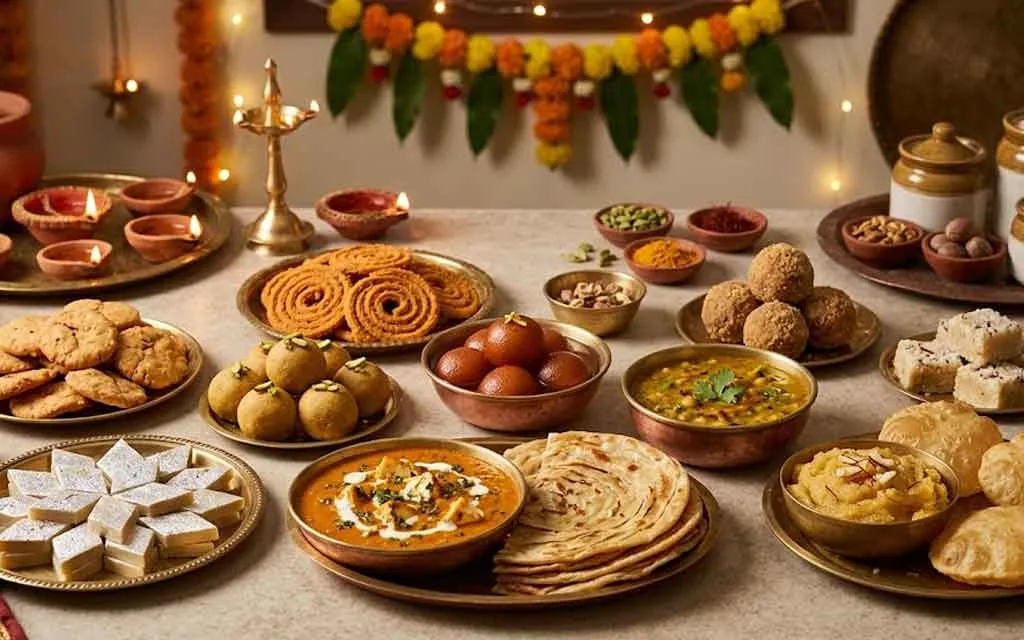
Traditional food. Many families cook the brother's favourite dishes. Popular choices include Poori and Aloo Curry, Chole Bhature, Puran Poli, Veg Biryani, Pulihora and Payasam. For sweets, Gulab Jamun, Rasgulla, Kaju Katli, Motichoor Laddu, Mysore Pak and Jalebi are favourites. Some families cook at home; others buy from an Indian sweet shop.
Family gatherings. Siblings who live in different UK towns often meet at their parents' home, or plan a Sunday lunch instead if Tuesday is a working day. In many families a sister also applies tilak to cousins.
Online celebration ideas. When siblings are apart, keep a thali ready at both ends and do the ritual on a video call. Cook the same dish at the same time, or send sweets to each other's doors.
Bhai Dooj in London, Leicester and Birmingham
These short city notes are practical pointers only. Temple programmes and opening hours vary, so check the website or social media of your local temple before you travel.
London
London's largest Hindu communities are in and around Wembley, Harrow, Southall, Croydon and Hounslow. Indian sweet shops and grocers in these areas are busy in Diwali week, so order sweets a day or two ahead. If you want to visit a temple on the day, check temple websites for programmes and timings.
Birmingham, Leicester and the Midlands
Leicester, especially around Belgrave Road, Birmingham and Coventry have large Gujarati, Punjabi and South Asian communities, and Nottingham has a growing one. Sweet shops here often stock Diwali and Bhai Dooj boxes through the week. Keep the Leicester or Birmingham tilak window from the table above.
Manchester and Leeds
Manchester and Leeds have well-established Hindu communities and several temples. The Aparahna window is a few minutes later than in London, so use the city figures in the table.
Glasgow and Edinburgh
Scottish families have the latest window of the cities we list, beginning at 12:52 PM in Glasgow. Edinburgh's timing is close to Glasgow's. Many families make sweets at home or order online in advance.
Wales and Northern Ireland
Families in Cardiff, Newport, Swansea and Belfast often celebrate at home or with a few friends. Check your local panchang for the town-specific window, and book Indian sweets early if you are ordering by post.
The Yama and Yamuna story as commonly told
As commonly told, Yamuna, goddess of the river, loved her brother Yama, the god of death, and often invited him home. He was always too busy, but on the Dwitiya after Diwali he came at last. She greeted him with a tilak, an aarti and a feast. Delighted, Yama blessed the day: any brother who receives his sister's tilak on Yama Dwitiya need not fear an untimely death. This is why the day is also called Yama Dwitiya.
Another version tells of Krishna visiting his sister Subhadra after slaying Narakasura, and her welcoming him with a tilak and sweets.
Regional traditions and names across communities
British families come from many regions, so you may hear several names for the same day.
- North India: Bhai Dooj, also called Bhatru Dwitiya or Yama Dwitiya, centres on tilak, aarti and a meal at the sister's home.
- Gujarat: Gujarati families say Bhai Beej.
- Maharashtra: Marathi families keep Bhau Beej, often with a special meal and sweets such as basundi or shrikhand.
- Bengal: Bengali families call it Bhai Phonta, marking the brother's forehead with sandalwood paste. Bengali almanacs may date it differently, so check.
- Andhra Pradesh and Telangana: Telugu families know it as Bhagini Hasta Bhojanam, literally "a meal from a sister's hand", where the brother eats a meal cooked and served by his sister.
- Nepal: Nepali families in the UK keep Bhai Tika, the last day of Tihar, with a multi-coloured tika and a garland.
Bhai Dooj gift ideas UK
Gifts for brothers
- Indian sweets or dry fruits from a local sweet shop, or ordered to your brother's door.
- Something cosy for a British November: a good umbrella, a warm scarf or a hot-water bottle cover.
- A book, headphones or a gift card for his favourite shop.
- Tickets to a show or match you can go to together.
Gifts for sisters
- Jewellery, a handbag or a saree or kurta.
- A spa voucher, a cookery class or an afternoon tea for two.
- A book, perfume or plants for her home.
- A charity donation in your sister's name.
Long-distance gifts for NRIs
- For siblings in India, use a delivery service in their city; international post can be slow.
- Send a digital gift card or an online voucher that arrives instantly.
- Order a sweets box from a shop near your sibling's home.
- Record a short video message or make a photo book of childhood memories.
Bhai Dooj for NRIs in the UK
The UK has one of the closest time gaps with India of any large diaspora, which makes long-distance Bhai Dooj easier than from North America.
- UK and India: in November India is five and a half hours ahead, so a late-evening call in the UK is already past midnight in India, while a Wednesday-morning call in the UK reaches India on Wednesday afternoon. One option is a call on each date, so both sides share their own Bhai Dooj.
- UK and Europe: siblings in Germany, the Netherlands or France are one hour ahead, so a Tuesday evening call is easy. Check their local panchang date too.
- On screen: the sister does aarti on camera; the brother applies the tilak himself. Some sisters apply tilak to a photo.
Seven steps for families with relatives in India
- Agree the dates early. Tell the family group that the UK keeps Tuesday 10 November and India Wednesday 11 November.
- Pick a call time that suits both sides. A UK lunchtime call on Tuesday is early evening in India.
- Prepare a thali at both ends. Kumkum, akshata, a diya and a sweet are enough.
- Order gifts in advance. Book local delivery in India at least a few days ahead of Diwali week.
- Keep the timings local. Each sibling follows the muhurat for their own town; do not convert India's timings into UK time.
- Include grandparents. Add parents and grandparents in India to the call so they can give their blessings.
- Plan a second call. Ring again on Wednesday when it is Bhai Dooj in India, so each side keeps its own day.
Teaching British-born children about Bhai Dooj
Children raised in Britain often know Diwali from school but not Bhai Dooj. Simple activities help.
- Let children help decorate the thali with flowers and rangoli colours.
- Tell the Yama and Yamuna story at bedtime, and ask them to retell it in their own words.
- Make handmade cards for brothers, sisters and cousins.
- Cook a simple sweet together, such as coconut laddu.
- Explain the meaning of the tilak and the diya in plain words.
- Teach them the Bhai Dooj prayer below, line by line.
- Set up a video call so they can do tilak with cousins in India.
Bhai Dooj prayer
Many sisters say a short prayer while applying the tilak. One commonly recited version is:
गंगा पूजे यमुना को, यमी पूजे यमराज को। सुभद्रा पूजे कृष्ण को, गंगा-यमुना नीर बहे, मेरे भाई आप बढ़ें, फूले-फलें॥
Meaning: As Ganga worships Yamuna, Yami worships Yamaraj and Subhadra worships Krishna, and as the waters of Ganga and Yamuna flow on, may my brother grow, flourish and prosper. The wording varies from family to family and region to region.
Bhai Dooj wishes and messages
Happy Bhai Dooj, dear brother! From the UK to wherever you are, my tilak and prayers are with you. Stay healthy, happy and always protected. Share on WhatsApp
Happy Bhai Dooj to my wonderful sister! Thank you for the aarti, the sweets and a lifetime of love. I will always stand by you. Share on WhatsApp
Dear Mum and Dad, thank you for the gift of siblings. This Bhai Dooj, may your home be filled with health, peace and family laughter. Share on WhatsApp
Happy Bhai Dooj to the friends and colleagues who became family here in Britain. May our bond stay warm through every grey November and beyond. Share on WhatsApp
May Maa Lakshmi bless every brother and sister this Bhai Dooj with good health, gentle hearts and harmony that no distance can break. Share on WhatsApp
Bhai Dooj wish in Telugu
అన్నాచెల్లెళ్ల అనుబంధానికి ప్రతీకైన భాయ్ దూజ్ పండుగ శుభాకాంక్షలు. మీ జీవితంలో ఆయురారోగ్యాలు, సుఖసంతోషాలు, ఐశ్వర్యం నిండాలని కోరుకుంటున్నాము.
Bhai Dooj wish in Hindi
भाई-बहन के पवित्र रिश्ते और प्रेम का प्रतीक भाई दूज की हार्दिक शुभकामनाएं। भगवान आपके जीवन में सुख, शांति, समृद्धि और खुशियां प्रदान करें।
Share the Diwali 2026 blessing
On Bhai Dooj, a small diya in a sister's thali becomes a prayer for her brother's long life and happiness. Whether your sibling is down the road in Leicester, across the Channel or back home in India, that lamp carries the same love and the victory of light over darkness, as commonly told. May Maa Lakshmi's grace keep every sibling bond bright. Share a blessing with your brother, sister and the whole family group.
Deepa shloka: the lamp prayer
शुभं करोति कल्याणम् आरोग्यं धनसम्पदा। शत्रुबुद्धिविनाशाय दीपज्योतिर्नमोऽस्तु ते॥
Shubham karoti kalyanam arogyam dhana-sampada, shatru-buddhi-vinashaya deepa-jyotir namostu te.
Meaning: I bow to the light of the lamp, which brings what is auspicious and good, health and prosperity, and destroys ill-will. Many families recite it as they light the evening diya.
Lakshmi mantra for Diwali
ॐ श्रीं महालक्ष्म्यै नमः॥
Om Shreem Mahalakshmyai Namah.
Meaning: Salutations to Mahalakshmi. Shreem is the seed syllable traditionally associated with Lakshmi.
A Diwali message to share
As Ayodhya glowed to welcome Lord Rama home, as commonly told, may your home glow with love and togetherness this Diwali 2026. Share on WhatsApp
A short Diwali prayer
Maa Lakshmi and Lord Ganesha, I bow before you with gratitude. Watch over my brothers and sisters, near and far, and keep them in good health. Remove the obstacles from their path and mine. Let patience and kindness guide our words, and let love bridge every mile between us. Help me to work with sincerity and to remain thankful for every blessing I already have.
Frequently asked questions
What is the date of Bhai Dooj 2026 in the UK?
Drik Panchang gives Tuesday 10 November 2026 for the UK. In India it is Wednesday 11 November.
What is the tilak time for Bhai Dooj in London?
The Aparahna window in London on Tuesday 10 November 2026 is 12:39 PM to 2:29 PM GMT. For Birmingham, Leicester, Manchester, Leeds and Glasgow, see the city table above. India's timings do not apply in the UK.
Why is the UK a day before India when the time difference is only a few hours?
Bhai Dooj is kept on Kartika Shukla Dwitiya. When a tithi changes close to the deciding point of the day, even a few hours can move the festival onto a different date. In 2026 that happens: Tuesday in the UK, Wednesday in India.
My brother lives in India. Which day should we celebrate?
Both dates are correct for each location. Many families choose a call on Tuesday in the UK, then a second short call on Wednesday when it is Bhai Dooj in India, so each side keeps its own day.
Is Bhai Dooj a bank holiday in the UK?
No. Bhai Dooj is not a UK bank holiday, so many families celebrate in the evening after work or school, or hold the family meal at the weekend.
What should be on the Bhai Dooj thali?
Kumkum or roli, akshata, a ghee or oil diya, flowers, sweets, fruits, a coconut and incense. Add sandalwood paste and a sacred thread if they are part of your family custom.
Can British-born children take part in Bhai Dooj?
Yes. Children of any age can take part, and many families involve them in decorating the thali, hearing the story and doing tilak with cousins, in person or by video call.
Which temples can we visit for Bhai Dooj in the UK?
Check the websites or social media pages of your local temples. Programmes and opening hours vary from temple to temple and year to year.
Is Bhai Dooj the same as Raksha Bandhan?
Both celebrate the bond between siblings, but they are different festivals. Raksha Bandhan, in Shravana, centres on the rakhi thread. Bhai Dooj, after Diwali, centres on the tilak and a meal at the sister's home.
What is Bhai Dooj called in Gujarati and Marathi homes?
Gujarati families often call it Bhai Beej, and Marathi families call it Bhau Beej. Bengali families say Bhai Phonta, and Nepali families Bhai Tika.
Editor's note
Editor's note (11 November 2026): This guide was restored at its original address after the earlier version was lost, and has now been expanded. We have added city-by-city Aparahna (tilak) times for London, Birmingham, Leicester, Manchester, Leeds and Glasgow, along with a full puja vidhi, city notes, gift ideas and guidance for NRI families. Dates are from Drik Panchang for the UK and India. Timings can differ by a minute or two between panchangs, so confirm for your own town. Stories are given as commonly told, and family customs vary.
Related guides
Share this with family and friends
Send it on WhatsApp, post it, or copy the link.
More on Bhai Dooj
- Kedarnath Kapat Closing 2026: Portals Close on Bhai Dooj, 11 November, as Baba Kedar Enters Samadhi
- Diwali 2026 in Noida and Greater Noida: Lakshmi Puja Muhurat, NCR Green Cracker Rules, Sale Sites, Govardhan Puja and Bhai Dooj
- Diwali 2026 in Nagpur: Laxmi Pujan Muhurat, Padwa, Bhau Beej, Koradi and Tekdi Temples, and the Police Cracker Order
- Diwali 2026 in Kolkata: Kali Puja Nishita Time, Bhoot Chaturdashi, Bhai Phonta, Temples and Cracker Rules
- Diwali 2026 in Pune: Laxmi Pujan Muhurat, Padwa, Bhau Beej, Dagdusheth, Diwali Pahat and Cracker Rules
- Panchangam 11 November 2026 (Wednesday): Bhai Dooj, Yama Dwitiya, Chitragupta Puja and Chandra Darshana, Tithi and Puja Vidhi
More from Festivals
- Chhath Puja 2026 in Dubai and the UAE: Dates, Arghya Times and How Families Celebrate
- Importance of Lakes in Chhath Puja: Spiritual Significance, Rituals and the Message of Water Conservation
- Makar Sankranti in Rajasthan: Kites, Holy Dips, Daan and Winter Sweets
- Makar Sankranti Sayings by Region: What They Mean and When They Are Said
- Haridwar Makar Sankranti Snan: A Guide to Har Ki Pauri, the Ganga Aarti and the Ardh Kumbh
You might also like
Hindus in the UK: Temples, Festivals, Community and City Guide
Hindu Rituals to Perform After Diwali 2026: Complete Guide to Govardhan Puja, Annakut, Bali Pratipada, Bhai Dooj and Karthika Masam for Hindus in USA, UK & Canada
Bhai Dooj 2026 in Singapore, Malaysia and New Zealand: Wednesday 11 November, the Same Day as India, with Aparahna Tilak Times for 9 Cities