Ekant
Ekant (एकान्त) is a Sanskrit-origin Hindu boy-name meaning “Solitude, devoted (to one path)”. Find pronunciation, origin, deity association, popularity and similar Hindu baby names.
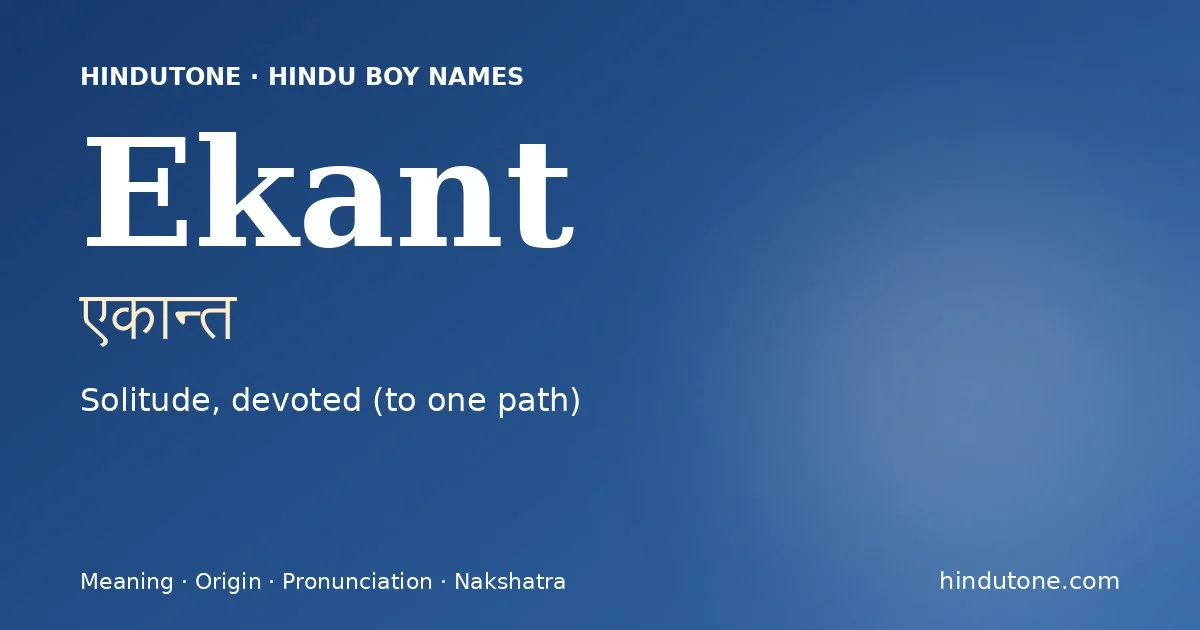
Ekant (एकान्त) is a Sanskrit-origin Hindu boy-name meaning “Solitude, devoted (to one path)”. This guide covers Ekant’s meaning, origin, pronunciation, deity association, popularity and similar names — useful for Hindu families in India, USA, UK, Canada and Australia choosing a meaningful baby name.
What does Ekant mean?
Ekant means Solitude, devoted (to one path) in Sanskrit. The name carries a serene devotional resonance — it is composed in the classical tradition where every Hindu name encodes a virtue, a deity, or a cosmic principle.
Origin and Sanskrit script
Ekant is written एकान्त in Devanagari and is rooted in the Sanskrit tradition. It transliterates as Ekant, retaining its phonetic clarity across English, Hindi, Tamil, Telugu, Kannada, Bengali and other Indic scripts. The Sanskrit mātṛkā (mother-syllables) of the name preserve its sacred sound — important when the name is recited aloud, especially in Vedic naming ceremonies (Namakarana Samskara).
Pronunciation of Ekant
Ekant is pronounced as it is spelled in standard Hindi/Sanskrit. The sound is gentle and even-syllabled — comfortable for English speakers and naturally rhythmic in Indic languages. Diaspora parents often prefer Ekant precisely because it travels well across school registers, government forms and social settings in the USA, UK, Canada and Australia.
Why parents choose Ekant
Ekant carries the timeless feel of classical Sanskrit and has been used in Hindu families for generations. Ekant remains a comparatively rare and distinctive Hindu boy-name — perfect for parents seeking something unique with deep cultural roots.
Naming ceremony (Namakarana Samskara) note
In Hindu tradition the formal naming of a child is the Namakarana Samskara, performed on the 11th, 12th or 16th day after birth. The name is whispered three times into the baby’s right ear by the father or family priest, while flowers and rice are offered to the family deity. Ekant fits this ceremony naturally — the Devanagari spelling एकान्त preserves the correct sacred phonetics.
Quick facts about the name Ekant
- Gender: Hindu boy-name
- Sanskrit: एकान्त
- Meaning: Solitude, devoted (to one path)
- Origin: Sanskrit
- Popularity: 55/100 in 2026
- Style: traditional Sanskrit name
Hindutone curates Hindu baby names with verified Sanskrit, deity associations and meanings. Browse more names alphabetically below.
Frequently Asked Questions
What does the name Ekant mean?
Ekant ( एकान्त ) is a Sanskrit-origin Hindu boy-name meaning “Solitude, devoted (to one path)” . This guide covers Ekant’s meaning, origin, pronunciation, deity association, popularity and similar names — useful for Hindu families in India, USA, UK, Canada and Australia choosing a meaningful baby name.
Is Ekant a good Hindu baby name?
Yes — it is a traditional Hindu name with an auspicious meaning, suitable for a baby and rooted in Sanatana Dharma values.
What is the origin of the name Ekant?
It has Sanskrit/Hindu origins; its roots, deity association and significance are detailed above.
Are there variations or similar names to Ekant?
Related and similarly-themed Hindu names, along with their meanings, are listed in the guide above to help you choose.
Ekant — Name Facts
- Meaning
- Solitude, devoted (to one path)
- Gender
- Hindu boy name
- Nakshatra
- Krittika
- Rashi
- Vrishabha (Taurus)
- Numerology
- 8
Frequently asked questions
What does the name Ekant mean?
Ekant is a Sanskrit-origin Hindu boy name meaning “Solitude, devoted (to one path)”.
Is Ekant a boy or girl name?
Ekant is traditionally a Hindu boy name.
Which nakshatra and rashi suit the name Ekant?
By the first-syllable rule of Vedic naming, Ekant aligns with the Krittika nakshatra, under the Vrishabha (Taurus) rashi.
What is the numerology number of Ekant?
The Chaldean name number of Ekant is 8.
Explore more: Krittika nakshatra names · Vrishabha rashi names · Hindu boy names with E · All Hindu names A–Z
Share this with family and friends
Send it on WhatsApp, post it, or copy the link.