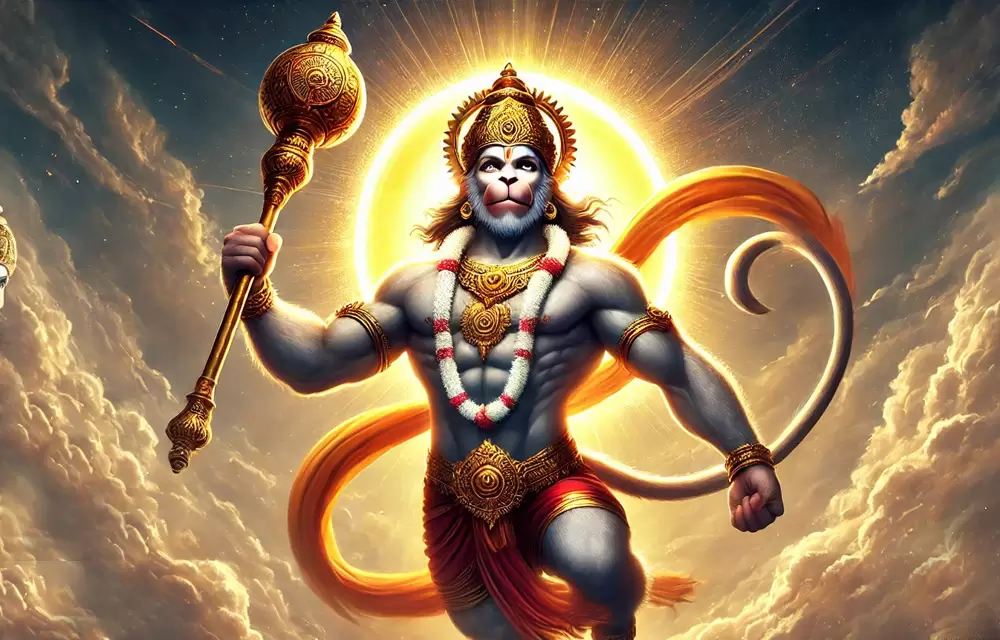
Hanuman Mala 41 Days: Rules, Daily Routine and Udyapan for Hindus Abroad (2026-27 Dates)
A practical guide to the 41-day Hanuman Mala deeksha for Hindus in the USA, UK, Canada and Australia: commonly followed rules, a daily routine, the 41st-day udyapan, health notes and start and end dates for 2026-27, including a mala that ends on Hanuman Jayanti in Karnataka on 22 December.

Last updated: 31 October 2026
Quick answer: The Hanuman Mala (Hanuman Deeksha) is a 41-day vow in which a devotee wears a consecrated mala, keeps a simple vegetarian and disciplined life, and recites the Hanuman Chalisa and a short mantra daily. It ends with an udyapan on the 41st day. If you count 41 days ending on Hanuman Jayanti in Karnataka, Tuesday 22 December 2026, the first day is Thursday 12 November 2026. Rules differ by guru and temple, so take the mala from, and follow the guidance of, someone you trust.
This guide is written for families in the USA, UK, Canada, Australia and other countries who have jobs, school and no temple next door. It explains the commonly followed rules and how people adapt them. It does not promise any particular result: the aim of the deeksha is discipline, devotion and steadiness of mind.
What is the Hanuman Mala deeksha?
A deeksha is a period of vowed discipline. In the Hanuman Mala tradition, followed widely in Telugu, Kannada and Tamil communities, the devotee wears a mala of tulsi, rudraksha or red sandalwood beads, often with a small Hanuman pendant, for 41 days. The 41 days are a traditional measure (a traditional period often called a mandala). The daily practice usually combines a bath, a lamp, chanting of the Hanuman Chalisa, japa with the mala, and service.
The practice is related to, but distinct from, the Ayyappa mala (whose season starts on 17 November 2026) and the Bhavani and Shiva deeksha traditions. Do not mix vows; ask your guru swami how to proceed if you have taken more than one.
Hanuman Mala 41-day dates for 2026-27
Count the first day as day 1 and the udyapan as day 41, which is 40 days after the start. Tuesday and Saturday are the days most associated with Hanuman, so many people start on one of them.
| Start (day 1) | Day 41 / udyapan | Note |
|---|---|---|
| Tue 10 Nov 2026 | Sun 20 Dec 2026 | Starts in Diwali week; Tuesday start |
| Thu 12 Nov 2026 | Tue 22 Dec 2026 | Ends on Hanuman Jayanti, Karnataka (Hanumad Vratha, Drik) |
| Sat 14 Nov 2026 | Thu 24 Dec 2026 | Saturday start; ends Annapurna Jayanti and Margashirsha Purnima |
| Tue 17 Nov 2026 | Sun 27 Dec 2026 | Ends on Mandala Pooja day (Sabarimala) |
| Sat 21 Nov 2026 | Thu 31 Dec 2026 | Saturday start; ends on the last day of the year |
| Tue 24 Nov 2026 | Sun 3 Jan 2027 | Karthika Purnima start; ends early in January |
Dates are from the Drik Panchang calendar for India. The rows are only suggestions; follow the date your guru or temple gives. Hanuman Jayanti in other traditions falls in spring (Chaitra Purnima in North India) and in Vaishakha (Telugu states), so a 41-day deeksha in those traditions ends then; see our Hanuman Jayanti 2026 guide for the earlier date.
Hanuman Jayanti in Karnataka: 22 December 2026 by country
Karnataka keeps Hanuman Jayanti as Hanumad Vratha on Margashirsha Shukla Trayodashi. The tithi runs from 05:36 PM IST on 21 December to 02:23 PM IST on 22 December. By the tithi at local sunrise it is Tuesday 22 December in the UK, Germany, the UAE, Singapore, Malaysia and Australia, and Monday 21 December in New York and Toronto. Ask your local temple which day it follows. Details are in our Hanuman Jayanti Karnataka 2026 guide. Never convert India's clock times; British Columbia, Alberta and Manitoba keep permanent daylight time from November 2026.
Amanta and Purnimanta: Margashirsha Shukla is the bright half in both calendars, so the Trayodashi has the same name in Karnataka (Amanta) and in North India (Purnimanta). The difference lies in the dark half, which is named for the earlier month in Amanta.
Commonly followed rules
Rules are set by your guru and temple. The list below is what many families follow; none of it replaces their guidance.
- Simple vegetarian food: many avoid meat, fish, eggs, alcohol, onion and garlic, and tobacco for the 41 days. Plan meals ahead when you work long hours.
- Discipline of conduct: many observe brahmacharya, truthfulness, politeness and restraint in speech and media use, in the way their guru explains it.
- Cleanliness: bathe before the daily puja and wear clean clothes. Many wear red, saffron or orange.
- The mala: wear it daily; keep it clean and do not let it touch the floor. Take it off only as your guru permits.
- A fixed time: do the puja and chanting at the same time each day, morning being common.
- Service: help a neighbour, feed someone or volunteer at a temple.
- Sleep and comfort: some sleep on a mat; this is optional and should suit your health.
Women and girls can follow the deeksha. Customs about puja and temple visits during menstruation differ by family and guru; most traditions place no restriction on mental prayer. Ask your guru. Elders and those with health conditions can keep a lighter form.
Health first
Do not skip meals, fast to the point of weakness, or sleep on the floor if you have diabetes, blood pressure problems, heart or kidney disease, a back problem, or are pregnant or elderly. Take regular medicines as prescribed, and ask a doctor before changing your diet. Caffeine, if you give it up, is best reduced gradually. A lighter observance is fully respected by every tradition.
Preparation before day 1
- Choose the start date and tell your family, so that meals and schedules can be planned.
- Obtain the mala and a small Hanuman picture or murti. Take the mala from a temple, a priest or a guru swami, who will give the sankalpa and rules.
- Set up a small altar: a clean cloth, a lamp with ghee or oil, incense, flowers (red or marigold) and a simple naivedya.
- Read the Chalisa with its meaning for a few days beforehand. See our Hanuman Chalisa with meaning.
- Tell your employer or school if you will need an early start or a vegetarian meal.
Daily routine (30 to 45 minutes)
- Purify: bathe, wear clean clothes, and sit on a clean mat facing east or north.
- Begin: a short prayer to Ganesha, then to Rama, Sita and Lakshmana, and Hanuman.
- Offer: light a lamp and incense, and offer flowers and a simple naivedya.
- Japa: hold the mala and chant the Hanuman mantra below, at least one round of 108.
- Chalisa: recite the Hanuman Chalisa as many times as your guru advises; 7 or 11 times is common, and once or three times is fine on a busy day.
- Close: aarti, prasad and a prayer for strength and courage to do your duties.
ॐ हं हनुमते नमः॥
oṃ haṃ hanumate namaḥ||
Meaning: Om, Ham (the seed of Hanuman), salutations to Hanuman. A short mantra for japa.
Many devotees also chant the Rama name, which Hanuman loves:
श्री राम जय राम जय जय राम॥
śrī rāma jaya rāma jaya jaya rāma||
Meaning: Glory to Rama. A simple chant for travel and for busy days.
Adapting the deeksha to life abroad
- Morning is easiest before work. If you commute, do silent japa on the train or bus if allowed, but keep the formal puja at home.
- Use recorded Chalisa audio to learn the pronunciation, then recite on your own.
- Visit a Hanuman temple on Tuesdays or Saturdays when you can; see our guide to Hanuman temples in the USA.
- Pack vegetarian lunches that do not need heating, such as curd rice, fruit, nuts and idli.
- Where open flames are not allowed in apartments, use an LED lamp at home and light a real lamp at the temple.
- For work dinners, order a plain vegetarian dish and explain politely. Colleagues usually respect the request.
The 41st day: udyapan
- Bathe early and wear clean clothes. Perform the puja with extra offerings.
- Many families do a small havan with ghee and the mantra; if an apartment does not allow it, offer a symbolic purnahuti with a coconut at the temple or give a donation.
- Offer prasad to family, friends and neighbours. Feeding people is a part of the udyapan.
- Remove the mala only as your guru instructs.
- After the udyapan, keep a small daily habit going, such as one Chalisa or a short walk to a temple.
Common mistakes
- Starting without a guru or a clear instruction about the rules.
- Taking on a strict fast or diet that your health cannot carry.
- Treating the vow as a bargain for a result. Hanuman worship is about courage, humility and service.
- Skipping the practice on busy days. Keep a minimal version: one Chalisa and a lamp.
- Mixing vows (Ayyappa, Bhavani, Hanuman) without guidance.
Frequently asked questions
What is the Hanuman Mala 41-day deeksha?
It is a 41-day vow in which a devotee wears a Hanuman mala, follows a simple, disciplined life, recites the Hanuman Chalisa and a mantra each day, and completes the vow with an udyapan on day 41.
When should I start the Hanuman Mala in 2026?
Start on a day your guru or temple advises. Many people choose a Tuesday or Saturday. A mala that begins on Thursday 12 November 2026 ends on Tuesday 22 December 2026, which is Hanuman Jayanti in Karnataka.
Is the date of Hanuman Jayanti the same everywhere?
No. North India keeps it on Chaitra Purnima, the Telugu states in Vaishakha, Karnataka on Margashirsha Shukla Trayodashi (22 December 2026) and Tamil Nadu in Margazhi. Choose the date your family follows.
Can women and children take the Hanuman Mala?
Women and girls can follow the deeksha and children can take a simplified form. Customs on puja during menstruation vary by family and guru; ask your guru. Children and elders should keep the discipline gentle.
What if I miss a day?
Follow your guru's instruction. Many traditions ask you to resume with a short prayer and to note the lapse humbly; some ask for a repeat of that day. A minimal practice on a travel or work day is better than none.
Is a diet required during the Hanuman Mala?
Most gurus ask for simple vegetarian food without meat, fish, eggs and alcohol, and many also avoid onion and garlic. If you have a health condition, ask your doctor and tell your guru. Devotion matters more than strictness.
Does the Hanuman Mala guarantee results?
No. The deeksha is a discipline of devotion, courage and service. It does not guarantee any particular outcome, and it is not a substitute for medical, legal or financial help.
Editor's note
Editor's note (31 October 2026): We rewrote this guide on 31 October 2026. Changes: removed the outdated April 2026 Hanuman Jayanti note, the list of promised outcomes (visa, court, protection from black magic, wish fulfilment), the advice to write wishes on paper and keep them secret, and an instruction we could not source; added a start and end date table for 2026-27 from Drik Panchang, the Karnataka Hanumad Vratha date by country, health notes, verified mantras and seven new FAQs. The country dates are HinduTone's reading of the Drik sunrise tithi, not a panchangam ruling. Rules vary by guru and temple, and this guide describes common practice. Nothing here is medical advice, and no particular benefit is promised.
Related guides
Share this with family and friends
Send it on WhatsApp, post it, or copy the link.
More from Pooja, Slokas and Mantras
- Kubera Puja on Friday: Why Families Choose Shukravar, a Simple Home Worship and Mantras
- Kubera Mantra for Business: Shop and Office Worship Customs, Chopda Puja and New Account Books
- Rajadhirajaya Prasahya Sahine: Full Text, Transliteration, Meaning and Source in the Mantrapushpam
- Kubera Yantra: Meaning, Symbolism and Traditional Worship at Home
- Kubera Gayatri Mantra: Sanskrit Text, Transliteration, Meaning, Variants and How It Is Chanted
You might also like
Powerful Mantras for Students & Parents Before Joining School
Powerful Hindu Mantras for Purushottam Maas 2026: Vishnu Bhakti, Chanting Guide & Global Devotion
Hanuman Worship on Saturday: Powerful Rituals & Remedies for Shani Dosha