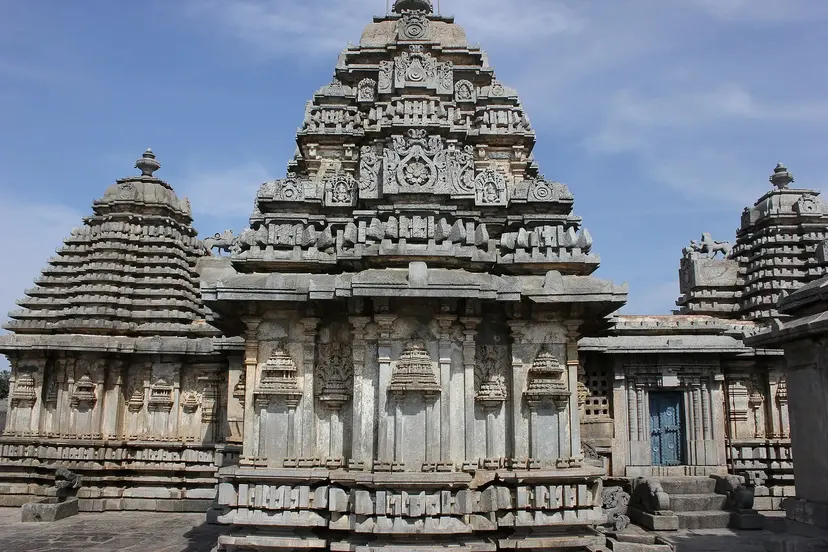
Hoysaleswara Temple, Halebidu
Shiva (twin lingas as Hoysaleswara and Shantaleswara) temple · Halebidu, Hassan, Karnataka, India
The Hoysaleswara Temple stands at Halebidu in Hassan district, Karnataka, the town that was once Dorasamudra, capital of the Hoysala kings. It is a Shiva temple with two sanctums side by side, and Karnataka Tourism describes it as the principal monument of Halebidu.
Since 2023 the temple has been one of the three components of the UNESCO World Heritage property "Sacred Ensembles of the Hoysalas", together with the Channakeshava Temple at Belur and the Keshava Temple at Somanathapura. UNESCO's listing presents the three as the most representative temples of the Hoysala style built in the 12th and 13th centuries.
Faith & Tradition
Religious Significance of Hoysaleswara Temple, Halebidu
The temple is a twin shrine. According to Wikipedia and Karnataka Tourism, the two sanctums each hold a Shiva linga and are named Hoysaleswara and Shantaleswara, the second traditionally linked with Queen Shantala Devi, consort of King Vishnuvardhana. Both face east, and two separate pavilions outside house Nandi images, each looking towards its own linga. Wikipedia also records a smaller shrine to Surya attached to one of the Nandi pavilions.
UNESCO treats the Halebidu temple as a key example of what it calls the Hoysala style: a star-shaped (stellate) plan raised on a platform that follows the same outline, many bands of carved friezes, sculptural galleries arranged by theme along the circumambulatory path, and carving that covers almost the whole outer surface. It also singles out the artists' signatures left on the sculpture, which it describes as unusual for the Indian subcontinent and a sign of the standing the sculptors enjoyed.
UNESCO's evaluation notes that, unlike the Channakeshava Temple at Belur, the Hoysalesvara Temple at Halebidu has seen a loss of its religious activities over the centuries, so it is today experienced mainly as a protected heritage monument.
Heritage
History of Hoysaleswara Temple, Halebidu
Wikipedia records that the temple was built in the reign of the Hoysala king Vishnuvardhana and credits it to his official Ketamala, citing an inscription at nearby Ghattadahalli that records land grants dated 1121 CE; the temple itself carries no dedication inscription. Work is generally said to have begun around 1121 and been completed around 1160 CE. The Hassan district administration likewise attributes the Halebidu temples to Vishnuvardhana, with the nearby Kedareshwara temple to Ballala II.
Dorasamudra was the Hoysala capital at the height of the kingdom's power. According to Wikipedia, the city was raided and plundered twice by armies of the Delhi Sultanate in the early 14th century, after which it was abandoned; the later name Halebidu is usually explained as "old capital" or "old camp". Karnataka Tourism notes that the temple is partly ruined as a result of these invasions.
UNESCO observes that the temple's superstructure (its towers over the sanctums) and its enclosure walls have been lost, which is why the building looks flat-roofed today, while the features that define the Hoysala style survive intact. The temple is a protected monument under the Ancient Monuments and Archaeological Sites and Remains Act, 1958, and Wikipedia mentions an Archaeological Survey of India sculpture gallery on the premises that displays fragments recovered from the area.
Architecture and sacred features
Like the other Hoysala temples, it is carved in chloritic schist, a fine-grained stone that UNESCO identifies as the material of all three components of the World Heritage property. Karnataka Tourism highlights the star-shaped platform, ornate ceilings and lathe-turned pillars inside. The outer walls carry horizontal friezes that, as described by The News Minute and Wikipedia, rise through rows of elephants, lions, scrolls, horsemen and mythical creatures to narrative bands.
Above the friezes are large panels of deities from the Shaiva, Vaishnava and Shakta traditions. The Hassan district page and Karnataka Tourism note that the outer walls depict episodes from the Ramayana, the Mahabharata and the Bhagavata, and Wikipedia records that many of the panels bear the signatures of individual sculptors. The doorways are flanked by guardian figures, and The News Minute points to the elaborate carved arch over the entrance.
Plan Your Visit
Darshan and Visitor Information
The temple is an ASI-protected monument and part of a World Heritage property, so treat the carvings with care: do not touch, climb on or lean against sculpture, and follow signage and staff instructions. Karnataka Tourism suggests a guide or audio tour to make sense of the friezes. Confirm current opening hours, ticketing and photography rules with the Archaeological Survey of India before travelling.
Timings and arrangements change with seasons and festivals. Confirm current details with Archaeological Survey of India (protected monument) before travelling. Last reviewed 1 November 2026.
Location
How to Reach Hoysaleswara Temple, Halebidu
The Hassan district administration gives Halebidu as about 17 km from Belur and 30 km from Hassan, with regular buses and taxis from both towns. Hassan has rail connections to Bengaluru, Mysuru, Hubballi, Shivamogga and Mangaluru.
Hassan district has no airport; the district administration names Bengaluru as the nearest airport. Many travellers combine Halebidu with the Channakeshava Temple at Belur, the other Hoysala World Heritage component in the district.
Location: Halebidu, Hassan, Karnataka, India
Nearest airport: Bengaluru (per the Hassan district administration)
Nearest railway station: Hassan (per the Hassan district administration)
More in Hindu temples in Karnataka · Shiva (twin lingas as Hoysaleswara and Shantaleswara) temples · Temples in Halebeedu · Temples in Belur Taluk · Temples in Hassan District
Questions
Hoysaleswara Temple, Halebidu: Frequently Asked Questions
To which deity is the Hoysaleswara Temple dedicated?
It is a Shiva temple with two sanctums, each holding a linga, named Hoysaleswara and Shantaleswara. The second name is traditionally linked with Queen Shantala Devi.
Who built the Hoysaleswara Temple and when?
It was built in the reign of the Hoysala king Vishnuvardhana. Wikipedia credits his official Ketamala, citing an inscription of 1121 CE, and gives about 1160 CE as the completion date.
Is the Hoysaleswara Temple a UNESCO World Heritage Site?
Yes. Since 2023 it has been one of three components of the UNESCO property "Sacred Ensembles of the Hoysalas", along with the temples at Belur and Somanathapura.
Why does the temple have no tower?
UNESCO notes that the superstructure of the Hoysalesvara Temple and its enclosure walls were lost over time; the city was plundered in the early 14th century, according to Wikipedia.
What stories are carved on the temple walls?
The outer walls show episodes from the Ramayana, the Mahabharata and the Bhagavata, above friezes of elephants, lions, horsemen and other motifs, along with large panels of deities.
How far is Halebidu from Belur and Hassan?
The Hassan district administration gives Halebidu as about 17 km from Belur and 30 km from Hassan, with buses and taxis from both.
Sources and attribution
- UNESCO World Heritage Centre — Sacred Ensembles of the Hoysalas (archived listing, Outstanding Universal Value)
- Hassan District Administration, Government of Karnataka — Hoysaleshwara Temple, Halebidu
- Karnataka Tourism — Hoysaleswara Temple
- The News Minute — What awaits tourists at Karnataka's Hoysala temples, newly declared World Heritage Site
- Wikipedia — Hoysaleswara Temple
- Wikidata — Hoysaleswara Temple (Q3517561)
Further reading: Hoysaleswara Temple, Halebidu on Wikipedia (CC BY-SA 4.0).
Spotted an error? Write to info@hindutone.com — see our editorial policy.