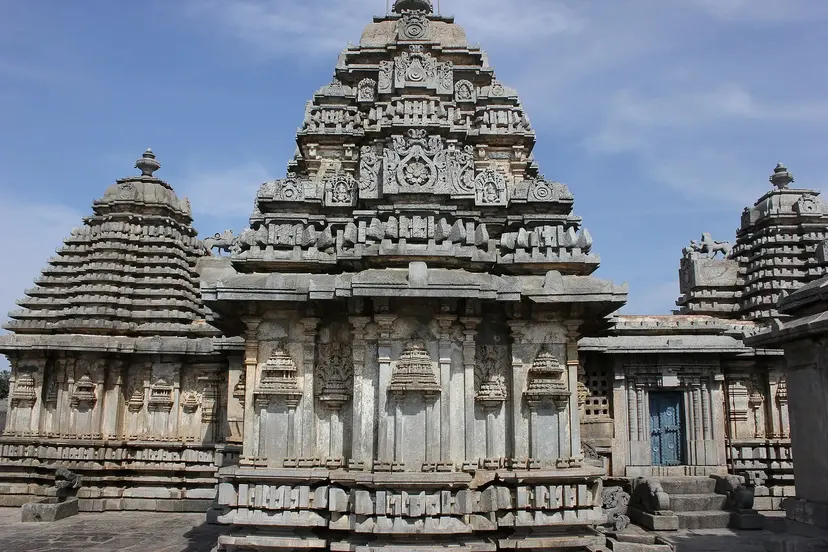
Kedareshwara Temple, Halebidu
Shiva (as Kedareshwara) temple · Halebidu, Hassan, Karnataka, India
The Kedareshwara Temple (also spelt Kedaresvara or Kedareshvara) is a Hoysala-period Shiva temple at Halebidu in Hassan district, Karnataka, a short distance from the better-known Hoysaleswara Temple. Halebidu, historically Dorasamudra or Dwarasamudra, was the Hoysala capital, and Wikipedia counts the Kedareshwara among its most notable surviving monuments.
According to Wikipedia, the temple was built under the Hoysala king Veera Ballala II (r. 1173-1220) and his queen Ketaladevi, and it is protected by the Archaeological Survey of India (ASI) as a monument of national importance. It is a three-shrined (trikuta) building of soapstone, known for its star-shaped plan and the dense bands of sculpture on its walls.
Faith & Tradition
Religious Significance of Kedareshwara Temple, Halebidu
Although Kedareshwara is a Shiva temple, Wikipedia notes that its friezes and wall panels show stories from both Shaiva and Vaishnava tradition. Among the sculptures it singles out are a dancing Bhairava (a fierce form of Shiva), Krishna lifting the Govardhana hill, Vishnu as Varadaraja, and a huntress. The Central Institute of Indian Languages' Classical Kannada portal adds that the walls carry about 180 carved figures, along with friezes of epic scenes, swans and makaras (mythical aquatic creatures).
The temple is one of the defining buildings of Veera Ballala II's reign. Wikipedia's article on the king lists the Kedareshwara at Halebidu with the Veera Narayana temple at Belavadi and the Amruteshwara temple at Amruthapura as among the best-known temples built in his time, a period in which the Hoysala kingdom grew into an independent empire.
Heritage
History of Kedareshwara Temple, Halebidu
Wikipedia cites the art historian Adam Hardy for a date before 1219 CE, and the Classical Kannada portal gives 1219 CE. The two sources differ on the queen: Wikipedia names Ketaladevi, while the portal names Shantala. Wikipedia's account, which cites the ASI, is followed here.
Halebidu was the Hoysala capital until the 14th century, when, as Wikipedia records, it was raided twice by forces of the Delhi Sultanate and later deserted; the name Halebidu is usually explained as 'old capital' or 'ruined city'. The images of worship are now missing from all three sanctums of the Kedareshwara temple, and the towers over all three shrines have been lost. The temple is now maintained by the ASI.
Architecture and sacred features
Like other Hoysala temples, Kedareshwara stands on a raised platform (jagati) reached by steps; Wikipedia, citing the historian Suryanath Kamath, notes that the platform both provides a path for walking around the temple and gives visitors a clear view of the wall sculpture. The main shrine has a star-shaped (stellate) plan, and the two side shrines have perforated stone screens (jali). The three sanctums open through vestibules onto a central hall with a staggered-square plan, and a porch leads in from the platform.
The base of the walls is treated as a series of horizontal mouldings, each carved with a frieze of animals or episodes from the Puranas. Inside, lathe-turned pillars support ornate domed ceiling bays. The temple is built of soapstone, a material Wikipedia notes was popularised by the Western Chalukyas before becoming standard for Hoysala builders.
Plan Your Visit
Darshan and Visitor Information
Kedareshwara is an ASI-protected monument with no images in its sanctums, and the sources consulted do not describe regular worship. Do not touch or climb on the carvings and follow the ASI's rules for protected sites. Confirm current opening hours, any entry fee and access arrangements with the Archaeological Survey of India (Bengaluru circle) or the site staff at Halebidu before visiting.
Timings and arrangements change with seasons and festivals. Confirm current details with Archaeological Survey of India before travelling. Last reviewed 1 November 2026.
Location
How to Reach Kedareshwara Temple, Halebidu
Wikipedia gives Halebidu as about 30 km from Hassan by road on SH-21, about 150 km from Mysuru, and about 15 km from Belur, the other main Hoysala temple town. The Classical Kannada portal gives similar distances (149 km from Mysuru and about 16 km from Belur).
The Kedareshwara temple is a short walk from the Hoysaleswara Temple; Wikipedia notes that Halebidu's main temples, the Jain basadis and the Hulikere stepwell all lie within about a kilometre of each other.
Location: Halebidu, Hassan, Karnataka, India
Nearest railway station: Hassan (about 30 km by road)
More in Hindu temples in Karnataka · Shiva (as Kedareshwara) temples · Temples in Halebeedu · Temples in Belur Taluk · Temples in Hassan District
Questions
Kedareshwara Temple, Halebidu: Frequently Asked Questions
Who built the Kedareshwara Temple at Halebidu?
According to Wikipedia, it was built under the Hoysala king Veera Ballala II (r. 1173-1220) and his queen Ketaladevi, before 1219 CE.
Which deity is the Kedareshwara Temple dedicated to?
Shiva. The images of worship are now missing from all three sanctums, but the wall sculptures include both Shaiva and Vaishnava subjects.
What is a trikuta temple?
A temple with three shrines. At Kedareshwara, three sanctums open onto a shared central hall; the main shrine has a star-shaped plan.
How far is Kedareshwara from the Hoysaleswara Temple?
It is a short distance away; Halebidu's main temples all lie within about a kilometre of each other.
Is the Kedareshwara Temple protected?
Yes. It is protected by the Archaeological Survey of India as a monument of national importance.
How do I reach Halebidu?
Halebidu is about 30 km from Hassan by road, about 15 km from Belur and about 150 km from Mysuru.
Sources and attribution
- Wikipedia — Kedareshwara Temple, Halebidu
- Wikipedia — Halebidu
- Wikipedia — Veera Ballala II
- Centre of Excellence for Studies in Classical Kannada, Central Institute of Indian Languages (shastriyakannada.org) — Halebeedu (Halebid)
Further reading: Kedareshwara Temple, Halebidu on Wikipedia (CC BY-SA 4.0).
Spotted an error? Write to info@hindutone.com — see our editorial policy.