Vishwakarma Puja: Invoking the Divine Architect for Creativity and Success
September 17, 2025 In the grand tapestry of Hindu festivals, Vishwakarma Puja stands as a unique celebration that bridges the divine and the industrial, the…
September 17, 2025 In the grand tapestry of Hindu festivals, Vishwakarma Puja stands as a unique celebration that bridges the divine and the industrial, the…
September 17, 2025
In the grand tapestry of Hindu festivals, Vishwakarma Puja stands as a unique celebration that bridges the divine and the industrial, the spiritual and the practical. As artisans across India prepare their tools for blessing and factories adorn their machinery with marigold garlands, we witness the beautiful confluence of ancient wisdom and modern enterprise.
The Divine Architect: Understanding Lord Vishwakarma
Lord Vishwakarma, revered as the celestial architect and master craftsman, holds a distinguished position in the Hindu pantheon. His name, derived from 'Vishwa' (universe) and 'Karma' (action), literally means "the creator of the universe." According to the Vedic scriptures, particularly the Rig Veda, Vishwakarma is described as the divine engineer who designed and constructed the cosmos itself.
Mythological Origins and Significance
The Puranas describe Vishwakarma as the son of Brahma, born with innate knowledge of all crafts and arts. He is credited with creating numerous magnificent structures in Hindu mythology:
- Swarna Lanka - The golden city of Ravana
- Dwarka - Lord Krishna's magnificent capital
- Indraprastha - The Pandavas' splendid city
- Hastinapur - The Kuru dynasty's seat of power
- The divine weapons of the gods, including Indra's thunderbolt (Vajra)
Vishwakarma is traditionally depicted with four hands, holding a water pot, a book, a noose, and crafting tools, symbolizing his mastery over the elements and knowledge. His vahana (vehicle) is the elephant, representing strength and wisdom in construction.
The Vedic Connection
The Rig Veda contains several hymns dedicated to Vishvakarma, praising him as the creator and sustainer of the universe. The famous Vishvakarma Sukta (RV 10.81-82) describes him as:
"He who has eyes on all sides, a face on all sides, arms on all sides, feet on all sides - he is the one god who created heaven and earth."
This establishes Vishwakarma not merely as a craftsman deity but as a cosmic principle of creation and design.
Historical Evolution of Vishwakarma Puja
Ancient Traditions
The worship of Vishwakarma has deep roots in India's artisan communities. Historically, blacksmiths, carpenters, weavers, and other craftspeople have revered him as their patron deity. Ancient texts like the Matsya Purana and Brahmavaivarta Purana elaborate on his significance in the cosmic order.
The tradition of tool worship, known as "Ayudha Puja" in South India, has been practiced for centuries. Artisans would clean, decorate, and worship their implements on auspicious days, seeking divine blessings for skill enhancement and prosperity.
Colonial and Post-Independence Era
During the British colonial period, as India began its industrial journey, the worship of Vishwakarma evolved to include modern machinery and equipment. Post-independence, as India embraced industrialization, factories and workshops began observing Vishwakarma Puja as an annual tradition.
The date of celebration varies across regions:
- West Bengal and Bihar: Celebrated on the last day of Bhadra month (September 17, 2025)
- Other regions: Often observed on different dates based on local traditions
Modern Celebrations: From Workshops to Corporate Offices
Traditional Artisan Communities
In traditional settings, Vishwakarma Puja remains deeply rooted in community practices:
Preparation Phase:
- Artisans clean their workshops thoroughly
- Tools are arranged ceremonially and decorated with flowers
- Special rangoli patterns are drawn using geometric designs
- Traditional oil lamps (diyas) illuminate the workspace
Ritual Elements:
- Morning prayers begin with the chanting of Vishwakarma mantras
- Offerings include flowers, fruits, sweets, and specially prepared prasad
- Incense and camphor create a sacred atmosphere
- Community feasts strengthen social bonds
Industrial and Corporate Observances
Modern industries have adapted Vishwakarma Puja to contemporary settings while maintaining its spiritual essence:
Manufacturing Sector:
- Production lines are temporarily halted for the ceremony
- Machinery is cleaned and decorated with marigold garlands
- Safety prayers are incorporated into traditional mantras
- Workers participate collectively in the celebrations
IT and Service Industries:
- Computer systems and equipment receive ceremonial worship
- Office spaces are decorated with traditional motifs
- Virtual celebrations connect remote teams
- Innovation and creativity prayers are emphasized
Workplace Puja: A Comprehensive Guide
Setting Up the Sacred Space
Altar Preparation:
- Choose a clean, prominent location in the workplace
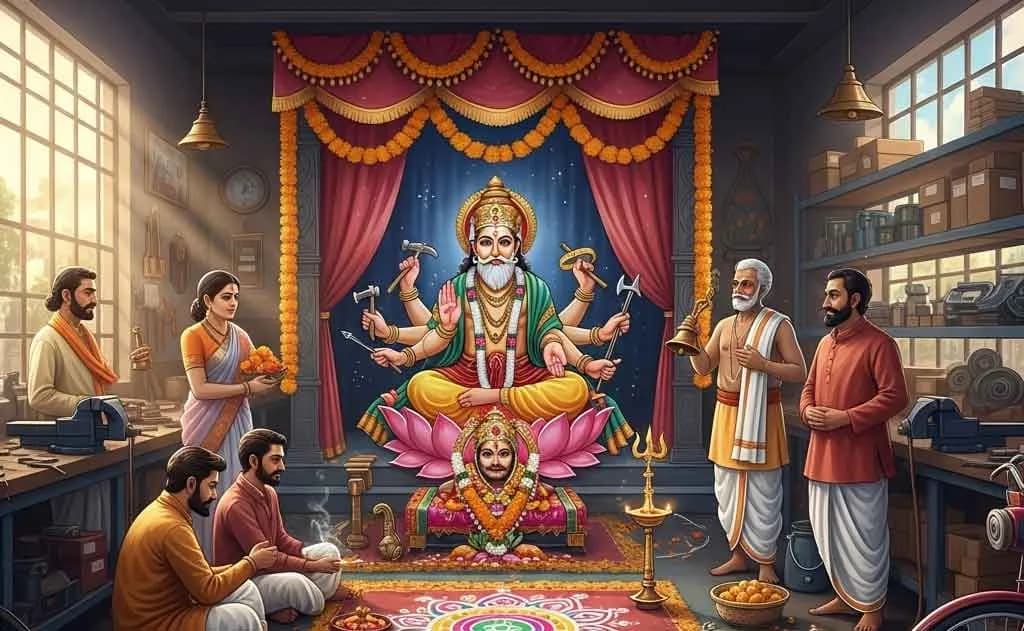
- Place a picture or idol of Lord Vishwakarma as the centerpiece
- Arrange important tools or equipment representatively
- Create a geometric rangoli pattern around the altar
- Set up brass oil lamps or LED alternatives for lighting
Essential Items for Puja:
- Fresh flowers (marigolds, roses, lotus)
- Incense sticks and dhoop
- Fruits and sweets for offerings
- Holy water (Ganga jal) or clean water
- Vermillion (sindoor) and turmeric (haldi)
- Rice grains (akshata)
- Coconut and betel leaves
Step-by-Step Ritual Process
Phase 1: Purification (Shuddhi)
- Begin with workplace cleaning and decoration
- Light incense to purify the atmosphere
- Sprinkle holy water around the area
- Invoke Lord Ganesha for obstacle removal
Phase 2: Invocation (Avahana)
- Install Vishwakarma's image with reverence
- Chant: "Om Vishwakarmaya Namah"
- Offer flowers while reciting his attributes
- Light the ceremonial lamps
Phase 3: Main Worship (Puja)
- Perform Panchamrita Abhishek (if possible)
- Apply tilaka to the deity's forehead
- Offer fruits, sweets, and specially prepared food
- Recite Vishwakarma Chalisa or relevant mantras
- Perform aarti with collective participation
Phase 4: Tool Blessing (Ayudha Puja)
- Arrange all tools and equipment ceremonially
- Apply tilaka to each implement
- Offer flowers and rice to the tools
- Chant specific mantras for skill enhancement
- Seek blessings for safety and productivity
Phase 5: Conclusion (Samapana)
- Distribute prasad among all participants
- Share collective meals or refreshments
- Express gratitude through final prayers
- Take resolution (sankalpa) for ethical work practices
Decoration Themes and Creative Ideas
Traditional Themes
Classical Geometric Patterns:
- Use architectural blueprints as inspiration for rangoli
- Incorporate traditional motifs like lotus, kalash, and swastika
- Create patterns using measuring tools like compass and rulers
- Employ golden and yellow colors representing prosperity
Artisan Heritage Theme:
- Display traditional crafts and handicrafts
- Showcase evolution of tools through history
- Create exhibits of regional artistic traditions
- Honor local craftspeople and their contributions
Contemporary Innovative Themes
Technology Integration:
- Digital displays showing Vishwakarma's cosmic creations
- LED installations mimicking traditional oil lamps
- Interactive displays explaining engineering marvels
- Virtual reality experiences of mythological architecture
Sustainability Focus:
- Use eco-friendly decoration materials
- Incorporate recycled items creatively
- Promote green technology and sustainable practices
- Emphasize environmental responsibility in prayers
Global Fusion:
- Blend international architectural elements
- Include diverse cultural engineering achievements
- Celebrate universal creativity and innovation
- Foster inclusive workplace spirituality
Innovative Prayers and Mantras
Traditional Sanskrit Mantras
Vishwakarma Mool Mantra:
Om Vishwakarmaya Namah
Sarva Karya Siddhim Dehi Dehi Swaha
Translation: "Salutations to Vishwakarma, Grant success in all endeavors."
Skill Enhancement Mantra:
Om Vishwakarma Mahagyani
Sarva Shilpa Pradayakaya
Namah Sarvabhoumaya Cha
Vishwakarma Namo Namah
Workplace Safety Prayer:
Raksha Raksha Mahadeva
Sarva Badha Vinashaya
Karmi Karmani Yogena
Vishwakarma Sadashrayam
Contemporary Adaptations
Innovation Prayer:
Divine Architect of the Universe,
Bless our minds with creative vision,
Guide our hands in skillful creation,
May our work serve humanity's mission.
Team Collaboration Mantra:
Om Gam Ganapataye Namah
Vishwakarmaya Vidmahe
Sarva Karmasu Yogena
Shakti Rupaya Dhimahi
Digital Age Invocation:
Lord of Cosmic Design,
In circuits and codes we find,
Your divine engineering mind,
Bless our digital creations kind.
Regional Variations and Celebrations
West Bengal and Bihar
In these states, Vishwakarma Puja is celebrated with particular enthusiasm:
- Kite Flying Tradition: Children and adults fly colorful kites
- Community Pandals: Elaborate decorations in neighborhood celebrations
- Cultural Programs: Dance, music, and drama performances
- Special Cuisine: Traditional sweets like rasgulla and sandesh
South Indian Observances
Karnataka and Andhra Pradesh:
- Celebrated as part of Navaratri festivities
- Special focus on Ayudha Puja (tool worship)
- Decoration of vehicles and machinery
- Classical music and dance performances
Tamil Nadu:
- Integration with Golu festival displays
- Miniature tool exhibitions
- Traditional craft demonstrations
- Community skill-sharing sessions
Industrial Hubs
Gujarat and Maharashtra:
- Large-scale factory celebrations
- Worker welfare programs
- Technology innovation showcases
- Safety awareness campaigns
NCR and Industrial Corridors:
- Corporate social responsibility events
- Skill development workshops
- Innovation competitions
- Startup ecosystem celebrations
The Philosophy of Work and Worship
Vedantic Principles
Vishwakarma Puja embodies the Vedantic principle of "Karma as Worship" (Karma Yoga). It teaches that:
- Work as Divine Service: Every task performed with devotion becomes worship
- Skill as Spiritual Gift: Abilities are divine endowments to be used responsibly
- Creation as Sacred Act: Building and creating reflect divine nature
- Tool as Temple: Instruments of work deserve reverence and care
Modern Relevance
In today's rapidly evolving technological landscape, Vishwakarma Puja offers timeless wisdom:
Ethical Innovation: Balancing progress with moral responsibility Sustainable Development: Creating with environmental consciousness Inclusive Growth: Ensuring benefits reach all sections of society Cultural Continuity: Preserving traditions while embracing modernity
Planning Your Vishwakarma Puja 2025
Pre-Celebration Checklist
One Week Before (September 10):
- Form organizing committee
- Decide celebration theme and budget
- Book priest or spiritual guide (if required)
- Order flowers, fruits, and decoration items
- Plan menu for prasad and community meal
Three Days Before (September 14):
- Begin workspace cleaning and preparation
- Gather all tools and equipment for blessing
- Prepare rangoli designs and decoration layouts
- Organize music and sound system
- Confirm participation and roles
Day Before (September 16):
- Complete all decorations
- Arrange altar and ceremonial items
- Prepare prasad and food offerings
- Brief all participants about the program
- Set up photography/documentation
Day of Celebration Schedule
Morning Session (8:00 AM - 12:00 PM):
- 8:00 AM: Final preparations and setup
- 9:00 AM: Invocation and Ganesh Puja
- 9:30 AM: Main Vishwakarma Puja
- 10:30 AM: Tool blessing ceremony
- 11:00 AM: Aarti and community prayers
- 11:30 AM: Prasad distribution
Afternoon Activities (12:00 PM - 5:00 PM):
- 12:00 PM: Community feast
- 2:00 PM: Cultural programs and competitions
- 3:30 PM: Skill demonstrations and workshops
- 4:30 PM: Award ceremonies and recognition
Evening Conclusion (5:00 PM - 7:00 PM):
- 5:00 PM: Final prayers and thanksgiving
- 5:30 PM: Photography and documentation
- 6:00 PM: Cleanup and restoration
- 6:30 PM: Reflection and feedback session
Safety and Inclusion Guidelines
Workplace Safety
During Celebrations:
- Ensure clear emergency exits remain unobstructed
- Use fire-safe decoration materials
- Maintain electrical safety with proper wiring
- Keep first aid kit accessible
- Brief participants about safety protocols
Tool Blessing Precautions:
- Handle sharp tools with appropriate care
- Ensure machinery is properly shut down before blessing
- Use non-flammable materials near equipment
- Maintain hygiene standards for food offerings
Inclusive Participation
Cultural Sensitivity:
- Welcome participants from all backgrounds
- Explain significance to newcomers
- Provide translations of prayers when needed
- Respect diverse religious perspectives
- Focus on universal values of creativity and excellence
Accessibility:
- Ensure physically accessible celebration areas
- Provide seating arrangements for elderly participants
- Use clear, loud audio systems for announcements
- Include sign language interpretation if needed
- Accommodate dietary restrictions in prasad
Economic and Social Impact
Community Development
Vishwakarma Puja celebrations contribute significantly to local economies:
- Decoration Industry: Increased demand for flowers, rangoli materials, and festive items
- Catering Services: Community meals and prasad preparation
- Cultural Performers: Musicians, dancers, and traditional artists
- Photography Services: Professional documentation of celebrations
Skill Preservation and Enhancement
The festival serves as a platform for:
- Traditional Craft Promotion: Showcasing dying art forms
- Skill Exchange Programs: Experienced artisans teaching younger generations
- Innovation Workshops: Combining traditional wisdom with modern techniques
- Entrepreneurship Development: Encouraging craft-based businesses
Environmental Considerations
Eco-Friendly Celebrations
Sustainable Decoration:
- Use biodegradable materials for rangoli and garlands
- Employ locally sourced flowers and natural colors
- Avoid plastic decorations and single-use items
- Implement proper waste segregation and disposal
Green Initiatives:
- Plant saplings as part of celebration activities
- Promote solar-powered lighting for decorations
- Encourage carpooling and public transport
- Distribute seed packets instead of conventional gifts
Community Awareness:
- Include environmental messages in prayers and speeches
- Organize cleanup drives post-celebration
- Educate about sustainable manufacturing practices
- Promote eco-friendly product alternatives
Technology Integration in Modern Celebrations
Digital Participation
Virtual Celebrations:
- Live streaming for remote participants
- Digital aarti and prayer participation
- Online skill-sharing workshops
- Virtual exhibition of innovative projects
Social Media Engagement:
- Hashtag campaigns: #VishwakarmaPuja2025
- Photo contests showcasing creativity
- Live updates and behind-the-scenes content
- Community story sharing platforms
Innovation Showcases:
- Display of latest technological achievements
- Startup innovation exhibitions
- Digital art and design competitions
- Augmented reality experiences of mythological structures
Future of Vishwakarma Puja
Evolving Traditions
As India advances technologically while preserving cultural heritage, Vishwakarma Puja continues to evolve:
Integration with Modern Professions:
- Software developers seeking debugging blessings
- Architects praying for sustainable designs
- Entrepreneurs invoking innovation guidance
- Researchers requesting breakthrough insights
Global Recognition:
- International celebration by Indian diaspora
- Cross-cultural appreciation of craftsmanship
- Universal values of creativity and excellence
- Interfaith dialogue on work ethics and spirituality
Educational Integration:
- School curricula including festival significance
- Engineering colleges organizing themed competitions
- Corporate training programs incorporating spiritual elements
- Research on traditional knowledge systems
Conclusion: Embracing the Divine in Daily Work
Vishwakarma Puja transcends mere ritual observance to embody a profound philosophy that sanctifies human endeavor. In an age where work often becomes mechanical and disconnected from purpose, this ancient celebration reminds us that every act of creation is a participation in the divine cosmic design.
As we prepare to celebrate Vishwakarma Puja on September 17, 2025, let us embrace not just the external rituals but the deeper spiritual significance. Whether we are artisans shaping wood and metal, engineers designing bridges and buildings, artists creating beauty, or professionals serving society in countless ways, we all partake in the divine craft of existence.
The tools in our hands, be they traditional hammers and chisels or modern computers and smartphones, are instruments through which the cosmic architect works. When we approach our daily tasks with reverence, skill, and dedication, we transform routine work into worship, professional duty into divine service.
May Lord Vishwakarma bless all seekers of excellence with:
- Skill to master their crafts
- Wisdom to use abilities responsibly
- Innovation to solve humanity's challenges
- Harmony to balance progress with preservation
- Success that serves the greater good
As we bow before the Divine Architect, let us commit to making our workplaces temples of creativity, our tools instruments of service, and our skills gifts to humanity. In this spirit, Vishwakarma Puja becomes not just an annual celebration but a daily practice of conscious, purposeful, and blessed work.
Om Vishwakarmaya Namah - Sarva Karya Siddhir Bhavatu May all our endeavors be crowned with divine success.
This article is prepared with devotion for the spiritual upliftment and practical guidance of all celebrants. May Lord Vishwakarma's blessings be upon all who read, share, and practice these teachings.
For more devotional content and festival guides, visit www.hindutone.com
© HinduTone.com 2025 - Spreading the light of ancient wisdom in modern times
Frequently Asked Questions
What is the Vishwakarma Puja?
September 17, 2025 In the grand tapestry of Hindu festivals, Vishwakarma Puja stands as a unique celebration that bridges the divine and the industrial, the spiritual and the practical. As artisans across India prepare their tools for blessing and factories adorn their machinery with marigold garlands, we witness the beautiful confluence of ancient wisdom an
How many times should the Vishwakarma Puja be chanted?
It is traditionally chanted 108 times using a rudraksha or tulsi mala. Even 11 or 21 sincere repetitions daily are considered beneficial — steady, focused practice matters more than the count.
What is the best time to chant the Vishwakarma Puja?
Dawn (Brahma Muhurta) after a bath is considered ideal, though it may be chanted any time with a calm, focused mind. Many devotees keep a fixed daily time to build consistency.
Who can chant the Vishwakarma Puja?
Anyone may chant it with faith and a pure mind, regardless of age, gender or background. Beginners benefit from first hearing the correct pronunciation and understanding its meaning.
What are the benefits of chanting the Vishwakarma Puja?
It is believed to calm the mind, dissolve negativity, and draw divine grace, protection and clarity to the devotee.
You might also like
Powerful Mantras for Students & Parents Before Joining School

Powerful Hindu Mantras for Purushottam Maas 2026: Vishnu Bhakti, Chanting Guide & Global Devotion

Sacred Hindu Festivals & Temple News: Divine Week — May 2026