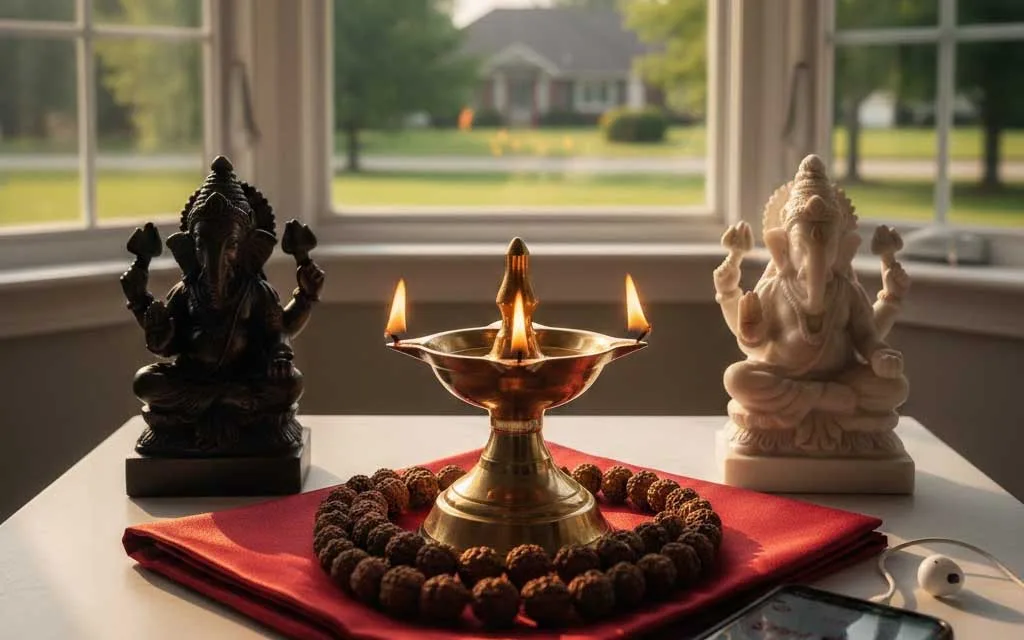
Mantras for Career Growth, Job Success and Promotion: Verified Texts, Daily Routine and Puja Steps
Mantras many Hindus chant while looking for a job, preparing for an interview or hoping for a promotion: Om Gam Ganapataye Namah, the Sankatanashana Ganesha Stotram, and Lakshmi, Venkateswara and Surya mantras, with verified text and meaning, a 40-day routine that pairs chanting with practical career steps, simple puja steps and samagri.

Quick answer: The mantra most Hindus chant for a new job, an interview or a promotion is the Ganesha mantra Om Gam Ganapataye Namah, because Ganesha is honoured as the remover of obstacles and the lord of new beginnings. Many add the Sankatanashana Ganesha Stotram, a Lakshmi mantra for prosperity, Om Namo Venkatesaya or a Surya mantra. Chant regularly, with attention, and pair the practice with real preparation: mantras are a support for steady effort, not a guarantee.
Last updated: 29 October 2026. We rewrote this guide with verified mantra text and meaning, removed an unverified "Kuber" seed-syllable string, and added a 40-day routine, puja steps and samagri. Benefits are described as traditional belief.
The main mantra: Om Gam Ganapataye Namah
ॐ गं गणपतये नमः॥
oṃ gaṃ gaṇapataye namaḥ||
| Word | Meaning |
|---|---|
| Om | The sacred syllable that begins most mantras |
| Gam | The seed syllable (bija) associated with Ganesha |
| Ganapataye | To Ganapati, the lord of the ganas (Shiva's attendants) |
| Namah | Salutations, I bow |
Ganesha is worshipped first in every puja and before new ventures, so this mantra is a natural choice when you start a job search, a new role or a project. For more, see Om Gam Ganapataye Namah: meaning and benefits.
Sankatanashana Ganesha Stotram (twelve names)
This short hymn from the Narada Purana is widely chanted for removing obstacles. The opening and the first verses (verified text):
श्रीगणेशाय नमः । नारद उवाच ।
śrīgaṇeśāya namaḥ | nārada uvāca |
प्रणम्य शिरसा देवं गौरीपुत्रं विनायकम् ।
भक्तावासं स्मरेन्नित्यमायुःकामार्थसिद्धये ॥ १॥
praṇamya śirasā devaṃ gaurīputraṃ vināyakam |
bhaktāvāsaṃ smarennityamāyuḥkāmārthasiddhaye || 1||
Meaning: Bowing my head to the god Vinayaka, son of Gauri, the refuge of devotees, one should remember him daily for long life, desires and wealth.
प्रथमं वक्रतुण्डं च एकदन्तं द्वितीयकम् ।
तृतीयं कृष्णपिङ्गाक्षं गजवक्त्रं चतुर्थकम् ॥ २॥
prathamaṃ vakratuṇḍaṃ ca ekadantaṃ dvitīyakam |
tṛtīyaṃ kṛṣṇapiṅgākṣaṃ gajavaktraṃ caturthakam || 2||
Meaning: First Vakratunda (curved trunk), second Ekadanta (one tusk), third Krishnapingaksha (dark-tawny eyed), fourth Gajavaktra (elephant-faced).
After listing all twelve names, the hymn says:
द्वादशैतानि नामानि त्रिसन्ध्यं यः पठेन्नरः ।
न च विघ्नभयं तस्य सर्वसिद्धिकरः प्रभुः ॥ ५॥
dvādaśaitāni nāmāni trisandhyaṃ yaḥ paṭhennaraḥ |
na ca vighnabhayaṃ tasya sarvasiddhikaraḥ prabhuḥ || 5||
Meaning: Whoever recites these twelve names at the three junctions of the day has no fear of obstacles; the Lord grants all success. (This is the hymn's own traditional statement.)
Other mantras people chant for work
| Deity | Mantra | Traditional focus | Day often chosen |
|---|---|---|---|
| Lakshmi | Om Shreem Mahalakshmyai Namah | Prosperity and a stable income | Friday |
| Venkateswara | Om Namo Venkatesaya | Overcoming hardship, career, faith | Saturday |
| Surya | Om Suryaya Namah | Energy, confidence, health | Sunday, at sunrise |
| Ganesha | Om Gam Ganapataye Namah | Obstacles, beginnings, interviews | Wednesday |
Lakshmi:
ॐ श्रीं महालक्ष्म्यै नमः॥
oṃ śrīṃ mahālakṣmyai namaḥ||
Venkateswara:
ॐ नमो वेङ्कटेशाय॥
oṃ namo veṅkaṭeśāya||
Surya:
ॐ सूर्याय नमः॥
oṃ sūryāya namaḥ||
We removed a long "Kuber" seed-syllable string from our earlier version because we could not verify it in any text. If you want a Kubera prayer, see our Lakshmi Kubera mantra guide, which uses a verified Vedic verse.
A 40-day routine: chanting plus practical steps
Many people take a sankalpa (resolve) for 21, 40 or 48 days. The routine below pairs a short daily practice with concrete career actions, so the time you give to prayer also builds discipline.
| Days | Daily practice (10 to 15 minutes) | Career action for the period |
|---|---|---|
| 1 to 10 | Lamp, Om Gam Ganapataye Namah x 108, Sankatanashana verses 1 to 2 | Update your CV and online profile; list 20 target roles or companies |
| 11 to 20 | Same, plus Om Namo Venkatesaya x 27 | Apply to five roles a week; ask two people for referrals |
| 21 to 30 | Same, plus Om Suryaya Namah x 12 at sunrise | Practise interviews aloud; finish one short course or certificate |
| 31 to 40 | Same, plus Om Shreem Mahalakshmyai Namah on Fridays | Follow up on every application; ask your manager about growth or promotion criteria |
Keep a small notebook: note your chanting and one career action each day. If you miss a day, simply continue; there is no penalty in the tradition for a sincere lapse.
Simple Wednesday Ganesha puja at home
Samagri (items)
| Item | Used for |
|---|---|
| Ganesha picture or small idol | Focus of worship |
| Lamp with ghee or oil, incense | Deepam and dhupam |
| Durva grass (21 blades if available), red flowers | Offerings dear to Ganesha |
| Kumkum, turmeric, akshat (rice) | Tilak and offering |
| Modak, laddu, jaggery or fruit | Naivedyam (food offering) |
| Mala of 108 beads (rudraksha, tulsi or crystal) | Counting the mantra |
Steps
- Bathe, wear clean clothes and sit facing east or north.
- Light the lamp and incense, and take your sankalpa: state your name, the purpose (for example, "a suitable job" or "growth in my work") and the number of days.
- Offer kumkum, akshat, durva and flowers to Ganesha.
- Chant Om Gam Ganapataye Namah 108 times on the mala, then the Sankatanashana verses.
- Offer the naivedyam, do aarti, and pray in your own words.
- Share the prasad, and do one practical career task the same day.
For a fuller method, see how to perform puja at home.
Before an interview
- Chant Om Gam Ganapataye Namah 11 times quietly before you leave or log in.
- Take a few slow breaths; many people find the mantra steadies the mind.
- Revise your key examples (projects, results, numbers) on the way.
- After the interview, offer a short thanks, whatever the outcome.
What the tradition says, and what it does not
In Hindu tradition, chanting with faith is believed to remove inner obstacles such as fear and confusion, and to bring grace and steadiness. Many people say it helps them stay calm and consistent. But no mantra can replace skills, preparation and effort, and we do not promise any job, promotion or salary. If job loss or work stress is affecting your health, please also talk to family, a counsellor or a doctor.
Frequently asked questions
Which mantra is chanted for career growth and job success?
The most common is the Ganesha mantra Om Gam Ganapataye Namah, because Ganesha is honoured as the remover of obstacles and the lord of beginnings. Many people also chant the Sankatanashana Ganesha Stotram, a Lakshmi mantra for prosperity, Om Namo Venkatesaya, or a Surya mantra in the morning.
How many times should I chant the mantra?
A common practice is one mala of 108 repetitions a day. If time is short, 11 or 27 sincere repetitions are fine. Regular, attentive chanting matters more than a large count.
What is the best time and day to chant?
Early morning after a bath is traditional. Wednesday is associated with Ganesha and Budha (Mercury), Friday with Lakshmi, Saturday with Venkateswara and Sunday with Surya. Many people also chant once before an interview or an important meeting.
Will chanting a mantra guarantee a job or promotion?
No. Mantras are a spiritual practice that many people find calming and focusing. Results at work depend on your skills, preparation, effort and circumstances. Use chanting alongside practical steps such as updating your CV, learning new skills and networking.
Can anyone chant these mantras?
Yes. These short name mantras and the Sankatanashana Ganesha Stotram are chanted by people of all ages and backgrounds. Learn the correct pronunciation from a recording or a teacher.
What is the Sankatanashana Ganesha Stotram?
It is a short hymn from the Narada Purana that lists twelve names of Ganesha, beginning with Vakratunda and Ekadanta. Its closing verses say that one who recites the twelve names at the three junctions of the day has no fear of obstacles.
Is there a separate mantra for government jobs?
Many people use the same Ganesha and Surya mantras. We have a separate guide with the Aditya Hridayam verses and a study routine for government job aspirants.
Editor's note
Editor's note (29 October 2026): We rewrote this guide. The Sanskrit is taken from our verified texts (the Sankatanashana Ganesha Stotram from sanskritdocuments.org). We removed an unverified "Kuber" mantra, claims that chanting "ensures" success, and repeated FAQ text. Results depend on many factors; this page is not career or medical advice.
Related guides
Share this with family and friends
Send it on WhatsApp, post it, or copy the link.
More from Pooja, Slokas and Mantras
- Kubera Puja on Friday: Why Families Choose Shukravar, a Simple Home Worship and Mantras
- Kubera Mantra for Business: Shop and Office Worship Customs, Chopda Puja and New Account Books
- Rajadhirajaya Prasahya Sahine: Full Text, Transliteration, Meaning and Source in the Mantrapushpam
- Kubera Yantra: Meaning, Symbolism and Traditional Worship at Home
- Kubera Gayatri Mantra: Sanskrit Text, Transliteration, Meaning, Variants and How It Is Chanted
You might also like

Powerful Hindu Mantras for Financial Freedom and Career Success: Invoke Divine Abundance and Professional Growth
Which Hindu Mantra Should I Chant Daily? 7 Core Mantras (+ More), Meanings and a Beginner's Guide

Powerful Hindu protective mantras