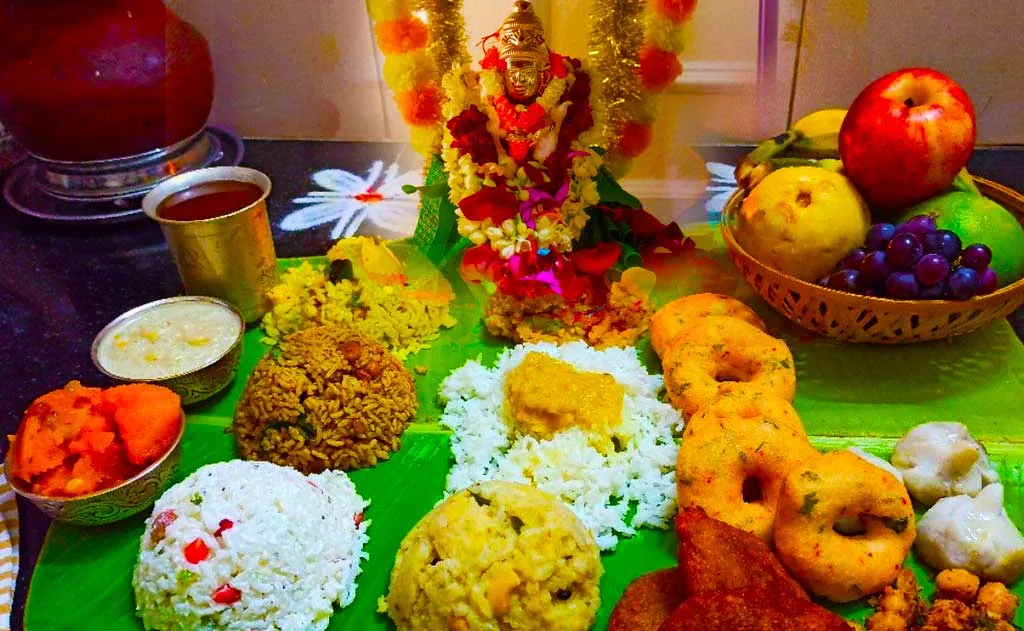
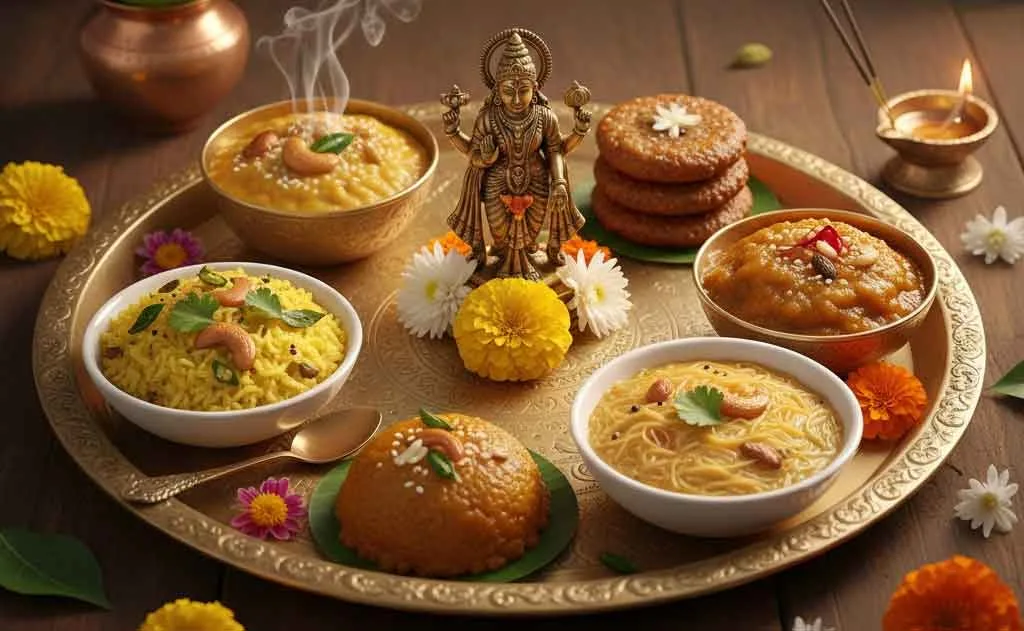
Daddojanam Recipe (Temple-Style Curd Rice for Naivedyam)
Quick answer: Daddojanam is soft-cooked rice mixed with curd and a little milk, then finished with a tempering of mustard seeds, lentils, ginger, chilli and curry leaves in ghee. It is one of the standard rice offerings (naivedyam) in Telugu homes and South Indian temples. Cook the rice very soft, c

Quick answer: Daddojanam is soft-cooked rice mixed with curd and a little milk, then finished with a tempering of mustard seeds, lentils, ginger, chilli and curry leaves in ghee. It is one of the standard rice offerings (naivedyam) in Telugu homes and South Indian temples. Cook the rice very soft, cool it to lukewarm, and add milk so the curd does not turn sour before the puja.
| Key facts | |
|---|---|
| Dish | Curd rice with a ghee tempering, also called dadhyodanam |
| Offered at | Daily puja, Vaishnava temple offerings, Rama Navami, Vaikuntha Ekadashi, Varalakshmi Vratam and other festivals |
| Deity | Offered to all deities; especially common in Venkateswara and other Vishnu temples |
| Serves | 4 |
| Prep time | 10 minutes |
| Cook time | 20 minutes, plus 20 to 30 minutes to cool |
| Allergens | Milk (curd, milk, ghee); tree nuts if you add cashews; some asafoetida contains wheat |
What is daddojanam?
The name comes from the Sanskrit dadhi (curd) and odana (cooked rice). Temple texts and priests use the form dadhyodanam. Tirumala Tirupati Devasthanams (TTD) lists dadhyodhanam (curd rice) among the rice offerings made to Lord Venkateswara at Tirumala, beside tamarind rice (pulihora) and jaggery rice (gudannam).
At home, daddojanam is one of the easiest naivedyam dishes. It needs no onion or garlic, and it sits comfortably beside a sweet such as paramannam or chakkara pongali on a festival plate. Tamil homes call the everyday version thayir sadam, and Kannada homes mosaranna. The temple-style version is usually milder: more ginger, little or no green chilli, and no raw onion or coriander stems.
This page gives one common way to make it. Families differ on the tempering, the amount of milk and whether to add fruit, so follow your elders where they do it differently.
Ingredients
- Raw rice (sona masoori, ponni or another short or medium grain): 200 g (1 US cup)
- Water to cook the rice: 750 to 850 ml (3 to 3 1/2 US cups)
- Plain whole-milk curd (yogurt), not sour: 360 g (1 1/2 US cups)
- Whole milk, boiled and cooled: 120 ml (1/2 US cup)
- Salt: 1 teaspoon, or to taste
- Ghee (or a neutral oil): 1 1/2 tablespoons (about 20 ml)
- Mustard seeds: 1 teaspoon
- Split urad dal: 1 teaspoon
- Chana dal: 1 teaspoon
- Fresh ginger, finely chopped or grated: 2 teaspoons (about 8 g)
- Green chillies, slit (optional; temple-style often uses 1 or none): 1 to 2
- Dried red chilli, broken: 1
- Curry leaves: 10 to 12
- Asafoetida (hing): a pinch
- Black peppercorns, coarsely crushed (optional): 1/2 teaspoon
- Cashews (optional): 8 to 10 (about 12 g)
The rice is weighed raw. One US cup is taken as 240 ml throughout this page; spoon measures are level.
Method
- Wash the rice two or three times until the water runs mostly clear.
- Cook it with 750 to 850 ml of water until it is very soft and slightly mushy. Daddojanam needs softer rice than you would serve with sambar.
- While the rice is hot, mash it lightly with the back of a ladle. Spread it on a plate and let it cool until it is just warm to the touch.
- Add the salt and the cooled milk to the rice and mix well.
- Add the curd and mix gently until every grain is coated. The mixture should be loose and creamy, not stiff.
- Heat the ghee in a small pan. Add the mustard seeds. When they crackle, add the urad dal and chana dal and fry until light golden.
- Add the cashews if using and fry until golden. Then add the ginger, green chilli, red chilli, crushed pepper, curry leaves and asafoetida. Stir for a few seconds and turn off the heat.
- Pour the tempering over the rice and mix. Taste for salt.
- Cover and keep aside. If you are offering it as naivedyam, set the first portion aside for the deity before anyone tastes it.
Notes for a creamy, mild daddojanam
- Why add milk? Curd keeps fermenting after you mix it. Adding cooled milk and leaving the curd fresh slows the sour taste, which helps when the rice has to wait an hour or two for the puja. Never add milk to rice that is still hot and then the curd straight after; let it cool first.
- Thickening: The rice absorbs liquid as it stands. Loosen it with a few spoons of milk or water just before serving.
- Mild taste for the deity: Many families keep naivedyam gently spiced. Use ginger and pepper for warmth and leave the green chilli out.
- Fruit and garnish: Some cooks add grated cucumber, carrot, pomegranate seeds or green grapes for the family meal. Many families leave these out of the naivedyam portion. Follow your own custom.
Pressure-cooker and Instant Pot versions
Pressure cooker: Put the washed rice and 800 ml (3 1/3 cups) of water in the cooker. Cook on medium heat for 4 to 5 whistles and let the pressure release on its own. Mash, cool and continue from step 4.
Instant Pot: Use 1 cup rice to 3 cups water. Pressure Cook (high) for 12 minutes and let the pressure release naturally. The rice should be soft enough to mash.
Rice cooker: Use the porridge or congee setting, or add an extra half cup of water to the normal setting.
Naivedyam notes
- Cook in a clean vessel and keep the naivedyam portion separate before anyone tastes it.
- Daddojanam is offered at room temperature, never hot.
- Customs vary. Some families offer daddojanam only on certain days, some add a tulasi leaf to the bowl, and some keep onion and garlic out of the whole kitchen on puja days. See how to offer naivedyam at home for the steps of the offering itself.
- After the offering, the food is prasadam. Share it with family and guests. The difference between the two words is explained in prasadam and naivedyam.
Swaps for cooks abroad
| Where you live | Curd | Rice | Curry leaves, urad and chana dal |
|---|---|---|---|
| USA and Canada | Plain whole-milk yogurt. Avoid flavoured or very thick Greek yogurt; if you only have Greek, thin it with milk | Sona masoori from Indian grocers, or Calrose | Indian grocers; frozen curry leaves work |
| UK | Plain natural whole-milk yogurt | Sona masoori or ponni from Indian grocers; basmati cooked extra soft also works | Indian grocers and many larger supermarkets |
| Australia and New Zealand | Plain full-cream yogurt | Sona masoori, or Calrose (widely sold) | Indian grocers; curry leaf plants grow well in warmer areas |
| Gulf countries | Plain full-fat yogurt (zabadi). Laban is a drink and too thin | Sona masoori and ponni are easy to find | Easy to find at Indian supermarkets |
| Singapore and Malaysia | Plain full-fat yogurt or homemade curd | Ponni and sona masoori are widely available | Easy to find in Little India markets |
If curry leaves are unavailable, leave them out. Do not replace them with bay leaves; the flavour is different.
Allergens and dietary notes
- Milk: curd, milk and ghee. For a dairy-free family meal, plain unsweetened soy or coconut yogurt with oil in place of ghee gives a similar dish, though most families would not offer it as naivedyam.
- Tree nuts: cashews, if used.
- Gluten: rice is gluten-free, but much compounded asafoetida contains wheat flour. Check the label or leave it out.
- Legumes: urad dal and chana dal in the tempering.
Storage
Eat daddojanam the same day. Refrigerate leftovers within 2 hours, in a shallow covered container, and use them within a day. The rice firms up and the curd turns sour in the fridge; loosen it with milk before eating. Do not freeze it.
Frequently asked questions
Is daddojanam the same as curd rice?
Yes. Daddojanam is the Telugu and temple name for curd rice. The temple-style version tends to be milder, with more ginger and pepper and less chilli, and it is made without onion or garlic.
Can I make daddojanam the night before the puja?
It is better made on the day. If you must cook ahead, cook and refrigerate the rice, then mix in milk, curd and the tempering on the morning of the puja. Many families prefer naivedyam cooked fresh that day.
Why did my daddojanam turn sour?
The curd was already sour, or the rice was mixed while too hot, or it stood in a warm room for several hours. Use fresh curd, cool the rice first, and add cooled milk.
Can I use leftover rice?
For the family meal, yes: warm it with a splash of water until soft, cool it, then continue. For naivedyam, most families cook fresh rice.
Which festivals call for daddojanam?
It appears on many festival plates in South India, including Rama Navami (see Rama Navami 2027), Vaikuntha Ekadashi, Varalakshmi Vratam and Navaratri, and at daily temple offerings. The exact menu depends on the family and the temple.
Related recipes and guides
- Recipes hub
- Panakam recipe
- Vadapappu and kosambari
- Paramannam recipe
- How to offer naivedyam at home
- Navaratri sundal recipes
Sources
- TTD News, "Naivedyam Samarpayami: ritual of offering food to the Lord" (Tirumala Tirupati Devasthanams), for dadhyodhanam among the rice offerings at Tirumala: news.tirumala.org
- US Food and Drug Administration, Safe Food Handling, for the two-hour refrigeration rule.
- US Food and Drug Administration, Food Allergies, for the major allergens.
Quantities are typical home proportions and may need adjusting for your rice and curd. Metric to cup conversions are approximate. Last reviewed: 12 November 2026.
Share this with family and friends
Send it on WhatsApp, post it, or copy the link.
More from Recipes
- Cooking for Annadanam: A Menu and Quantities for 50 and 100
- Prasadam in an Instant Pot, Pressure Cooker or Rice Cooker
- Coconut Laddu Recipe with Jaggery (Kobbari Laddu, Nariyal Ladoo)
- Aravana Payasam Recipe (Sabarimala-Style Home Version)
- Boondi Laddu Recipe, with a Tirupati-Style Home Version