Panchamrit Recipe: The Five Ingredients and How It Is Offered
Quick answer: Panchamrit (pancha amrita, "five nectars") is a mixture of milk, curd, ghee, honey and sugar. It is used to bathe the deity in abhishekam and is then shared in spoonfuls as prasad, especially on Janmashtami, Shivaratri and Satyanarayana puja. Stir the five together in a clean bowl, usu
Quick answer: Panchamrit (pancha amrita, "five nectars") is a mixture of milk, curd, ghee, honey and sugar. It is used to bathe the deity in abhishekam and is then shared in spoonfuls as prasad, especially on Janmashtami, Shivaratri and Satyanarayana puja. Stir the five together in a clean bowl, usually with tulasi leaves; there is no cooking. Never give it to babies under one year, because of the honey.
| Key facts | |
|---|---|
| Dish | Uncooked mixture of five ingredients |
| Used for | Abhishekam (ritual bathing) and prasad |
| Festivals | Krishna Janmashtami, Maha Shivaratri, Satyanarayana puja, Ganesh Chaturthi, and many daily and monthly pujas |
| Deity | Vishnu and his avatars, Shiva, Ganesha, and others by custom |
| Serves | 8 to 10 (small spoonfuls of prasad) |
| Prep time | 5 minutes |
| Cook time | 0 minutes (no cooking) |
| Allergens | Milk (milk, curd, ghee); honey is unsafe for infants under 12 months |
What is panchamrit?
Panchamrit (Hindi; panchamritam in South India; panchamrut in Gujarati and Marathi) means "five nectars". The five are:
| Ingredient | Sanskrit name |
|---|---|
| Milk | ksheera or dugdha |
| Curd (yogurt) | dadhi |
| Ghee | ghrita |
| Honey | madhu |
| Sugar | sharkara |
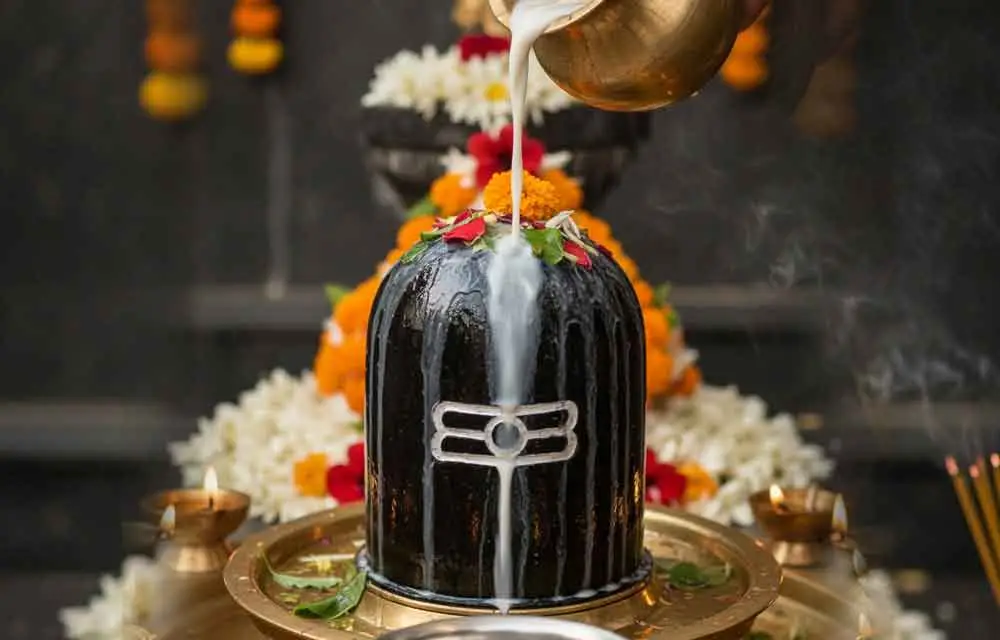
In a home or temple abhishekam, the five are often poured over the image one at a time, each followed by clean water, and then the mixture is collected or made fresh to be given out as prasad. Many families simply mix all five for the offering. Both ways are common.
Panchamrit is different from Palani panchamirtham, the thick sweet of banana, jaggery, ghee, honey and cardamom, with dates and sugar candy, given at the Dhandayuthapani (Murugan) temple at Palani in Tamil Nadu. It received a Geographical Indication tag in 2019. That is a separate dish with its own tradition.
Panchamrit and charanamrit: are they the same?
Not quite, and usage differs by region.
- Panchamrit is the five-ingredient mixture described here.
- Charanamrit (charana, feet, and amrit, nectar) is the water or liquid that has bathed the deity's feet in abhishekam, given out afterwards as sacred. In temples it is often water with tulasi, sometimes with milk or curd. In many North Indian homes, the panchamrit given after Janmashtami or Satyanarayana puja is itself called charanamrit.
If your family uses one word for both, that is a common usage. The recipe below is for panchamrit.
Panchamrit and naivedyam: what is the difference?
Naivedyam is any food offered to the deity, cooked or uncooked. Panchamrit is one kind of offering, and it has two roles: as an abhishekam liquid and as naivedyam that becomes prasad. A cooked dish such as daddojanam or paramannam is offered only as naivedyam. The wider difference between naivedyam and prasadam is explained in prasadam and naivedyam.
Ingredients
- Whole milk, boiled and cooled (raw milk in some families): 120 ml (1/2 US cup)
- Plain curd (yogurt), fresh and not sour: 60 g (1/4 US cup)
- Ghee: 1 teaspoon (about 5 ml)
- Honey: 1 tablespoon (about 20 g)
- Sugar (or mishri, rock sugar, crushed): 1 tablespoon (about 12 g)
- Tulasi (holy basil) leaves, washed: 5 or 6
- Optional additions some families use: a few makhana (fox nuts), chopped dry fruit, a little Ganga water, or a pinch of cardamom
Method
- Wash a steel, silver or glass bowl and dry it. Some families keep a separate vessel for puja use.
- Pour in the cooled milk.
- Add the curd and whisk gently until smooth.
- Add the ghee, honey and sugar. Stir until the sugar dissolves and the honey is mixed in.
- Add the tulasi leaves, and any optional additions your family uses.
- For abhishekam, use it as your priest or family custom directs. For naivedyam, place the bowl before the deity with a small spoon and offer it before anyone tastes.
- After the puja, give each person a spoonful in the right palm, cupped over the left. Many people sip it and then touch the hand to the head.
Notes on quantities and custom
- Proportions vary. Some households use equal measures of all five; others use mostly milk and curd with smaller amounts of ghee, honey and sugar, as above, which is easier to drink. Some follow the ratio their priest gives. There is no single correct ratio.
- Large gatherings: multiply the quantities. About 2 tablespoons per person is plenty, as panchamrit is given in small spoonfuls.
- Abhishekam at home: if you are pouring each ingredient separately, keep them in five small cups and a jug of clean water. See how to do abhishekam at home.
- Milk: some families insist on raw milk for abhishekam; for prasad that people will drink, boiled and cooled milk is the safer choice.
Panchamrit needs no cooking, so there is no pressure-cooker or Instant Pot step.
Naivedyam and prasad notes
- Make panchamrit fresh, shortly before the puja.
- On Krishna Janmashtami it is offered at the midnight puja with makhan and mishri, then shared.
- Panchamrit that has been poured over an image and collected is treated as prasad by many families. Others prefer to give out a fresh portion that was offered but not poured. Follow your temple's or family's practice.
- Do not throw leftover panchamrit in the bin. Many families drink it, or pour any remainder at the foot of a tulasi plant or other plant.
Swaps for cooks abroad
| Where you live | Curd | Honey and sugar | Tulasi |
|---|---|---|---|
| USA and Canada | Plain whole-milk yogurt (not Greek, or thin Greek with milk) | Any pure honey; mishri at Indian grocers, or plain white sugar | Holy basil (tulsi) plants at some Indian grocers and nurseries; Thai basil is a different plant |
| UK | Plain natural yogurt | Any pure honey; mishri at Indian grocers | Tulsi plants at Indian grocers and some temples; dried tulsi if fresh is unavailable |
| Australia and New Zealand | Plain full-cream yogurt | Any pure honey | Tulsi grows well in warm areas; Indian grocers and nurseries |
| Gulf countries | Plain full-fat yogurt (zabadi) | Any pure honey | Tulsi plants are sold at some nurseries and Indian supermarkets |
| Singapore and Malaysia | Plain full-fat yogurt | Any pure honey | Tulsi plants are sold in Little India; selasih in Malaysia is a related basil, not the same |
If you cannot find tulasi, leave it out. Do not replace it with another herb.
Allergens and safety
- Milk: milk, curd and ghee.
- Honey and babies: do not give panchamrit to a child under one year old. The US Centers for Disease Control and Prevention advises never to feed honey to children under 1 year, because of the risk of infant botulism. Give babies a touch of plain water or leave them out of the prasad.
- Vegans: a plant-based version is not traditional panchamrit. Some families offer fruit or water instead.
Storage
Panchamrit is made for the day. It contains raw dairy and honey, so do not keep it at room temperature for more than 2 hours. Refrigerate any leftover and use it the same day.
Frequently asked questions
What are the five ingredients of panchamrit?
Milk, curd, ghee, honey and sugar. Many families also add tulasi leaves, and some add makhana or dry fruit.
Is panchamrit cooked?
No. All five ingredients are mixed raw. Use boiled and cooled milk if the panchamrit will be drunk.
Can I make panchamrit the night before?
It is better made fresh on the day. Curd sours and the mixture separates overnight.
Is panchamrit the same as charanamrit?
Not always. Panchamrit is the five-ingredient mixture. Charanamrit is the liquid that has bathed the deity's feet. In many North Indian homes the words are used for the same prasad.
Is Palani panchamirtham the same thing?
No. Palani panchamirtham is a thick sweet made with banana, jaggery, ghee, honey and cardamom, given at the Palani temple. Home panchamrit is a liquid mixture of milk, curd, ghee, honey and sugar.
Related recipes and guides
- Recipes hub
- Janmashtami prasad recipes: makhan, panchamrit, mishri
- How to do abhishekam at home
- How to offer naivedyam at home
- Panakam recipe
- Daddojanam (temple-style curd rice)
Sources
- US Centers for Disease Control and Prevention, Preventing botulism: "Do not feed honey to a child who is younger than 1 year old."
- The News Minute, Tamil Nadu's Palani panchamirtham prasadam given GI tag, for the Palani sweet and its GI tag.
- US Food and Drug Administration, Food Allergies, for the major allergens.
- US Food and Drug Administration, Safe Food Handling, for the two-hour rule.
Quantities are one common home proportion; families and priests use others. Last reviewed: 12 November 2026.
Share this with family and friends
Send it on WhatsApp, post it, or copy the link.
More from Recipes
- Famous Temple Prasadams of India and What They Are Made Of
- Bhog Khichuri and Labra Recipe for Durga Puja
- Naivedyam by Festival: What to Cook for Each Hindu Festival
- What to Eat During a Hindu Fast: Food Rules by Vrat
- Types of Payasam and Kheer, and When Each Is Offered