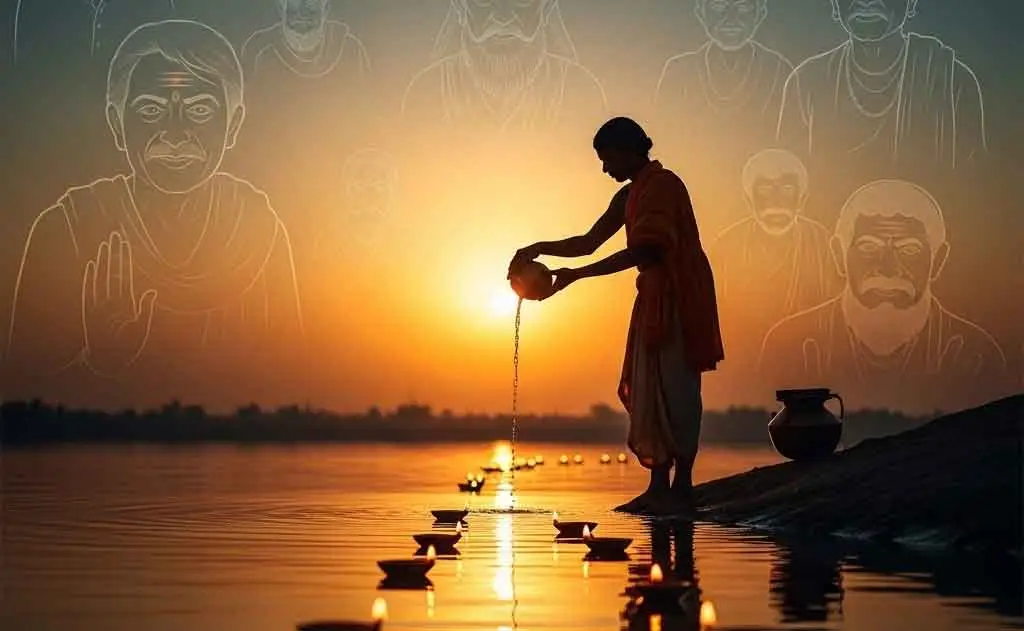
Shashti Poorthi: The 60th Birthday Ceremony in Hindu Tradition, with Rituals, Samagri and Step-by-Step Order
Shashti Poorthi, the ceremony a couple performs when the husband completes 60 years: the 60-year samvatsara cycle behind it, how families choose the day, the usual order of rites from Ganapati puja to kalasha abhishekam and mangalya dharanam, a samagri list, verified mantras and tips for families abroad.
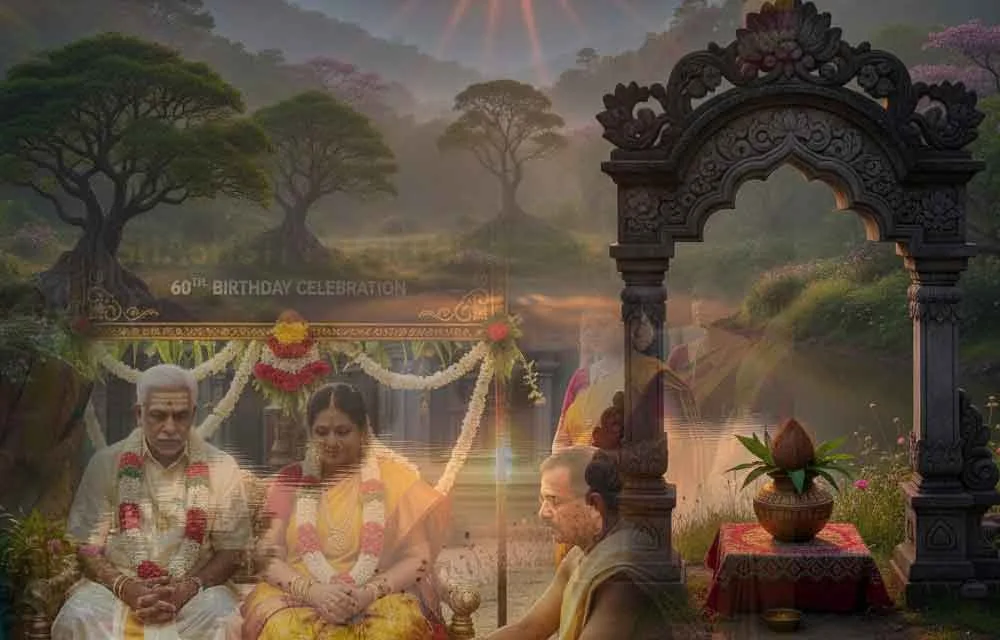
Quick answer: Shashti Poorthi (also Shashtiabdapoorthi or Sashtiapthapoorthi) is the ceremony held when a man completes 60 years. He and his wife perform it together: homas for long life and health, a kalasha abhishekam, a renewal of their wedding rites and blessings from the family. "Shashti" means sixty and "poorthi" (purti) means completion. The ceremony is most common in South India, in Tamil, Telugu, Kannada and Malayali families, and is now widely held abroad too.
Last updated: 26 October 2026. We rewrote this guide with the meaning of the 60-year cycle, how families choose the day, the usual order of rites, a samagri list, verified mantras and planning tips. Spiritual benefits are described as traditional belief.
Why 60 years? The samvatsara cycle
The traditional Indian calendar names its years in a cycle of 60 samvatsaras, from Prabhava to Akshaya. The same cycle names the Telugu and Kannada Ugadi year and the Tamil new year. At 60 a person has lived through one full cycle, and the samvatsara of his birth comes round again. That is why the 61st year is treated as a new beginning, almost a second birth.
A full human life is traditionally reckoned as 120 years, so 60 is also seen as the midpoint. Elders say it marks the end of the busy householder years (grihastha) and the start of a quieter stage given more to prayer, guidance and service (vanaprastha in spirit, though few now leave home).
| Milestone | Age (as commonly listed) | Meaning |
|---|---|---|
| Shashti Poorthi (Shashtiabdapoorthi) | 60 completed | One full 60-year cycle |
| Bhimaratha Shanti | 70 | Thanksgiving and prayer for health in old age |
| Sathabhishekam | 80 (after seeing about 1,000 full moons) | Celebration of a long life |
Customs and ages for the later rites differ between regions and families.
How families choose the day
- Many families hold the ceremony in the month in which the 61st year begins, often on the day of the person's birth nakshatra (janma nakshatra) in his birth month.
- Others choose a convenient day in that year that the family priest finds suitable.
- Some temples have set days or a booking calendar for Shashti Poorthi.
- We do not give muhurat dates. Give the person's birth date, time and place to your priest, who will fix the day.
The rituals, in the usual order
The ceremony usually takes a morning, guided by one or more priests. Family traditions differ, but a common order is:
- Ganapati puja: prayer to Ganesha so that the ceremony goes smoothly.
- Punyahavachanam and sankalpa: purification of the place and people, and the couple's formal resolve, naming the date, place and purpose.
- Kalasha sthapana: kalashas (pots) of water with mango leaves and coconuts are set up and the deities are invoked in them. Many families use a large number of kalashas.
- Homas: offerings into the sacred fire, commonly the Ayushya homa (for long life), the Mrityunjaya homa to Shiva and the Navagraha homa. Some families add a Dhanvantari homa.
- Kalasha abhishekam: the couple is seated together and bathed with the water from the kalashas, a moment many families find very moving.
- New clothes and mangalya dharanam: the couple wears new clothes; the husband ties a new mangalsutra (thali) for his wife, and they exchange garlands. Some families re-enact other wedding customs too, and a few include a playful Kashi Yatra.
- Blessings: children, grandchildren and relatives touch the couple's feet and receive their blessings; elders bless the couple in turn.
- Dana and a meal: gifts to the priests, food for guests and often annadanam (feeding people in need).
These customs are described as commonly practised. Your family priest will follow your own tradition.
Shashti Poorthi samagri (items to arrange)
| Item | Used for |
|---|---|
| Kalashas (pots), mango leaves, coconuts, thread | Kalasha sthapana and abhishekam |
| Turmeric, kumkum, sandal paste, akshat (rice) | Puja |
| Flowers and two garlands | Puja and exchange of garlands |
| New clothes for the couple (silk saree, veshti or dhoti) | Worn after the abhishekam |
| New mangalsutra (thali) | Mangalya dharanam |
| Ghee, samidha (sticks), navadhanya (nine grains) and homa items | Homas (the priest usually gives a list) |
| Betel leaves, areca nuts, fruit, sweets | Offerings and tambulam |
| Dakshina and dana items (clothes, rice, vessels) | Gifts to priests and charity |
Most priests and temples share a detailed list a few weeks before. Ask what they provide and what the family must bring.
Mantras chanted at the ceremony
The ceremony begins with Ganesha:
ॐ गं गणपतये नमः॥
oṃ gaṃ gaṇapataye namaḥ||
The Mahamrityunjaya mantra from the Rigveda (7.59.12) is central to the Mrityunjaya homa and is chanted as a prayer for health and a long life:
ॐ त्र्यम्बकं यजामहे सुगन्धिं पुष्टिवर्धनम्। उर्वारुकमिव बन्धनान्मृत्योर्मुक्षीय माऽमृतात्॥
oṃ tryambakaṃ yajāmahe sugandhiṃ puṣṭivardhanam| urvārukamiva bandhanānmṛtyormukṣīya mā'mṛtāt||
The priests chant the homa mantras; the family can chant the Ganesha and Mahamrityunjaya mantras quietly. Read more in our Maha Mrityunjaya mantra guide and the Navagraha Stotram.
What the ceremony means to families
Families see Shashti Poorthi as a thanksgiving for 60 years of life and marriage. It is traditionally believed to bring the couple blessings for health and peace in the years ahead, and many people feel it is a time to let go of old worries and look forward. For children and grandchildren it is a chance to say thank you to their parents in front of the whole family.
Like the wedding it renews, the ceremony honours the couple together. That is why the wife sits beside her husband for every rite, and why the mangalya dharanam is often its most emotional moment.
Health and comfort for the couple
The rites can take several hours, with long sitting, smoke from the homa and, in some families, fasting until the homa ends. For a couple of 60 or more, plan for comfort: keep water nearby, allow low seats or chairs, keep the homa area ventilated, and let anyone with diabetes, heart, blood pressure or breathing problems eat and take their medicines on time. If either of them has a health condition, speak to their doctor about the day beforehand.
Planning Shashti Poorthi abroad
- Book early: temples in the USA, UK, Canada, Australia and the Gulf often have a waiting list for weekend ceremonies.
- Ask what is supplied: many temples provide the homa items and kalashas for a fee; the family brings clothes, the mangalsutra, garlands and fruit.
- Fire safety: homas at home abroad can set off smoke alarms; many families hold the homa at the temple and the meal at home.
- Include family in India: a video call during the kalasha abhishekam and blessings lets grandparents, siblings and cousins join.
- Travel to India: some families hold the ceremony at a temple their parents love, such as their kula devata's temple.
For other life rites, see our guide to the 16 samskaras.
Frequently asked questions
What is Shashti Poorthi?
Shashti Poorthi (also Shashtiabdapoorthi or Sashtiapthapoorthi) is the ceremony held when a man completes 60 years. He and his wife perform it together, usually with homas, a kalasha abhishekam and a renewal of their wedding rites, and the family seeks the elders' blessings.
Why is the 60th birthday special in Hinduism?
The traditional Indian calendar counts years in a cycle of 60 named samvatsaras, from Prabhava to Akshaya. At 60 a person has lived through one full cycle and the year of his birth returns, so the 61st year is seen as a new beginning.
When should Shashti Poorthi be performed?
Many families hold it in the month the 61st year begins, often on the day of the person's birth nakshatra (janma nakshatra), or on another day the family priest fixes. Ask your priest; we do not give muhurat dates.
What are the main rituals of Shashti Poorthi?
A common order is Ganapati puja, punyahavachanam, sankalpa, kalasha sthapana, homas such as the Ayushya and Mrityunjaya homa, kalasha abhishekam (bathing the couple with the sanctified water), mangalya dharanam and exchange of garlands, blessings and dana.
Can Shashti Poorthi be done if one spouse has passed away?
Practice differs. Some families perform a shanti homa for the person alone, and others do not hold the full ceremony. Speak to your family priest, who will advise according to your tradition.
Is Shashti Poorthi only for men?
The traditional ceremony is timed by the husband's 60th year, but the couple performs it together. Many families now also celebrate a woman's 60th birthday with a puja, a homa or a family gathering.
How can NRI families celebrate Shashti Poorthi?
Many temples abroad conduct Shashti Poorthi with their priests, and some families travel to India or to a temple their parents love. Book early, ask what the temple supplies, and let relatives join by video if they cannot travel.
Editor's note
Editor's note (26 October 2026): We removed a section dated 2025 and some claims stated as fact, and added the order of rites, samagri and planning tips. Rites, ages for later milestones and customs differ between regions and families; follow your family priest. We do not give muhurat dates. The health note is general advice, not medical advice.
Related guides
Share this with family and friends
Send it on WhatsApp, post it, or copy the link.
More from Traditions
- Must-Performed Rituals Every NRI Woman Should Do for Her Family's Wellbeing
- Friday Rituals in Hinduism — Shukravar Lakshmi Puja, Devi Worship & Complete NRI Guide for 2026
- Thursday Rituals in Hinduism — Guruvara Vishnu Puja, Guru Worship & Complete NRI Guide for 2026
- Monday Rituals in Hinduism — Somavar Shiva Puja, Vrat & Complete NRI Guide for 2026
- Thursday Rituals in Hinduism: Complete Guide to Guruvar Pooja, Temples & Sacred Foods
You might also like
Vidyarambha Muhurat 2026 — Best Day to Begin Education
Hindu Dietary Restrictions: A Complete Guide to Food Rules, Practices & TraditionsDietaryHindu Dietary Restrictions: A Complete Guide to Food Rules, Practices & Traditions
Garuda Purana on Ekoddishta Shraddha: Special Rites for Recent Departed