Bhai Phonta 2026: Date in Bengal, Phonta Ritual, Rhyme, Sweets and Diaspora Guide
Bhai Phonta 2026 falls on Wednesday 11 November in India per Drik Panchang. Dwitiya timing, dates for Bengali families abroad, how the phonta is placed, the rhyme, sweets, a sample feast menu and FAQs.
Last updated: 31 October 2026
Quick answer: Bhai Phonta 2026 falls on Wednesday 11 November 2026 in India, per Drik Panchang. Bengali panjikas usually give the same date, but follow your own panjika. On this day sisters place a phonta (tilak) of sandalwood, kajal and curd on their brothers' foreheads, recite the traditional rhyme praying for their long life, and serve a feast of Bengali sweets. Bhai Phonta is the Bengali form of Bhai Dooj.
The dates below are from Drik Panchang for India. Outside India the date can differ by a day, so see the country table and check with your local Bengali association.
Bhai Phonta 2026 at a glance
| Detail (India, IST) | 2026 |
|---|---|
| Bhai Phonta / Bhai Dooj | Wednesday 11 November 2026 |
| Tithi | Kartika Shukla Dwitiya, from 02:00 PM on Tue 10 Nov to 03:53 PM on Wed 11 Nov |
| Nakshatra on 11 November | Anuradha |
| Kali Puja and Diwali night | Sunday 8 November 2026 |
| Also on 11 November | Chitragupta Puja, Yama Dwitiya, Chandra Darshana |
| Month name | Dwitiya of the bright half is Kartika Shukla in both Amanta and Purnimanta calendars |
Source: Drik Panchang. The tithi times are the same everywhere in India. We do not list a phonta muhurat clock time; most Bengali families do the phonta in the morning, while Dwitiya is running. For a time for your city, check Drik Panchang.
Bhai Phonta 2026 date
| Observance (India) | 2026 date |
|---|---|
| Diwali / Lakshmi Puja / Darsha Amavasya | Sunday 8 November 2026 |
| Kartika Amavasya | Monday 9 November 2026 |
| Govardhan Puja | Tuesday 10 November 2026 |
| Bhai Phonta / Bhaiya Dooj | Wednesday 11 November 2026 |
Source: Drik Panchang. Bengali panjikas usually match this date, but follow your panjika. We do not list muhurat clock times. Bengali families observe Kali Puja on the Amavasya night of the Diwali season; check your panjika for the exact Kali Puja night.
Bhai Phonta 2026 dates for Bengali families abroad
Dwitiya runs from the afternoon of 10 November to the afternoon of 11 November (India time), so it touches both days in most countries. Two different rules give two answers abroad. Drik's Bhai Dooj date follows the afternoon. A morning phonta, which is the Bengali custom, depends on the tithi at local sunrise. The table shows both.
| Country | Drik Bhai Dooj date (afternoon rule) | Dwitiya at local sunrise (morning phonta) |
|---|---|---|
| India (Kolkata) | Wed 11 Nov | Wed 11 Nov |
| USA (New York) | Tue 10 Nov | Tue 10 Nov |
| Canada (Toronto) | Tue 10 Nov | Tue 10 Nov |
| UK (London) | Tue 10 Nov | Wed 11 Nov |
| UAE (Dubai) | Tue 10 Nov | Wed 11 Nov |
| Germany, Europe | Tue 10 Nov | Wed 11 Nov |
| Australia (Sydney) | Wed 11 Nov | Wed 11 Nov |
| Singapore, Malaysia | Wed 11 Nov | Wed 11 Nov |
Where the two columns differ (UK, UAE, Germany and the rest of Europe), the usual advice is to follow your Bengali association or temple. Many families simply choose the weekend closest to the day so that brothers and sisters can meet, and that is acceptable. The right-hand column is HinduTone's reading of the Drik sunrise tithi for one city per country, not a panchang ruling. See our Bhai Dooj guides for the USA, UK, Canada, UAE and Australia. Never convert India's clock times to another time zone. British Columbia, Alberta and Manitoba keep permanent daylight time from November 2026, so use a table made for your city.
The Bengali festive timeline, 2026
| Date (India) | Observance |
|---|---|
| Sun 25 Oct | Kojagari Lakshmi Puja (Sharad Purnima) |
| Sun 8 Nov | Kali Puja and Diwali night (Amavasya) |
| Tue 10 Nov | Govardhan Puja; Pratipada |
| Wed 11 Nov | Bhai Phonta, Dwitiya |
| Wed 18 Nov | Jagaddhatri Puja (Chandannagar), Navami |
Read more: Kali Puja 2026 and Jagaddhatri Puja 2026.
From Kali Puja to Bhai Phonta
In Bengal the festive season after Durga Puja continues with Lakshmi Puja on Kojagari Purnima, then Kali Puja on the new-moon night, when homes glow with lamps and candles. Bhai Phonta follows on Dwitiya, the second day of the bright fortnight. For many Bengali families, it closes the long festive season with a warm family gathering.
The festival celebrates the bond between brothers and sisters. A sister prays for her brother's long life and protection; the brother gives her gifts and promises his love and support. Married sisters often invite their brothers home, or brothers travel to visit them.
The story behind the day
As commonly told, the festival recalls Yamuna and her brother Yama, the god of death. Yamuna had long invited her brother to visit. When he finally came on this day, she welcomed him with a tilak, a lamp and a delicious meal. Pleased, Yama blessed her and declared that any brother who receives a tilak from his sister on this day will be protected from untimely death.
This is why the Bengali rhyme speaks of Yama and his door. Another telling links the day with Krishna, who was welcomed by his sister Subhadra with a tilak after defeating the demon Narakasura. Tellings vary by region.
How the phonta is placed
Customs vary from family to family. A widely followed pattern:
- The sister often keeps a fast until she has given the phonta.
- A plate is prepared with sandalwood paste, kajal, curd, a lamp, dhaan-durba (paddy and durva grass), sweets and sometimes a small gift.
- The brother sits on an asan (small mat), usually facing east.
- The sister, often using the little finger of her left hand, places the phonta on his forehead, traditionally three times, while reciting the rhyme.
- She blesses him with dhaan-durba on his head if she is older; if he is older, she touches his feet.
- The conch is blown and the women of the house make the ulu sound (ululation), a joyful Bengali custom.
- She offers him sweets and a festive meal, and they exchange gifts.
The Bhai Phonta rhyme
The best-known lines of the Bhai Phonta rhyme are:
Bhaiyer kopale dilam phonta, Jomer duare porlo kanta.
Meaning, roughly: 'I place the phonta on my brother's forehead, and thorns are laid at Yama's door.' The sister asks that Yama, the god of death, be kept away from her brother. The rhyme continues with further lines that vary from family to family, so we give only these opening words. Recite the version your family knows.
The Bhai Phonta feast and sweets
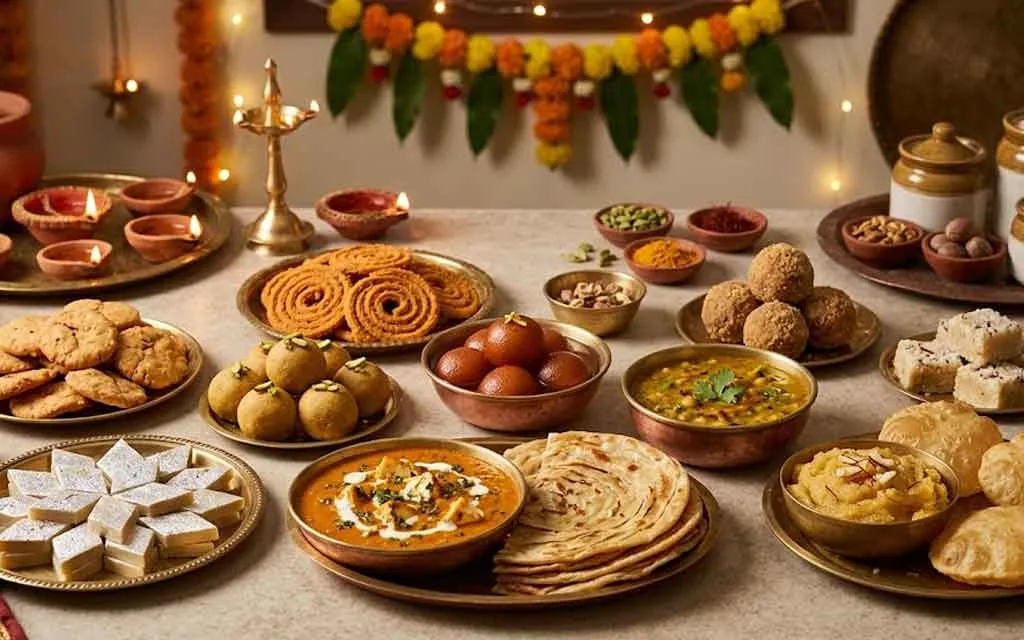
Food is at the heart of Bhai Phonta. After the ritual, the brother is served a large meal, often several courses of home cooking. Sweets are essential. Favourites include rosogolla, sandesh in many shapes and flavours, mishti doi (sweet curd), and other traditional Bengali sweets. Many families also cook luchi, a festive vegetarian dish, fish preparations or a special meat curry, depending on family custom.
Sweet shops in Kolkata and across Bengal are famously busy on Bhai Phonta morning.
A sample Bhai Phonta feast menu
| Course | Examples (customs differ by family) |
|---|---|
| Starters | Luchi with alur dom or cholar dal |
| Mains | Basanti pulao or plain rice, a vegetable dish, fish or a mutton curry in families that eat them, and a simple dal |
| Chutney | Tomato or mango chutney with papad |
| Sweets | Rosogolla, sandesh, mishti doi, payesh |
A vegetarian feast is fully in keeping with the day. Choose dishes that suit your family and any guests' diets.
Safety and practicalities for the phonta
- Use pure sandalwood paste and clean, skin-safe kajal. Avoid applying kajal near the eyes of young children, and check for allergies before using a new product.
- Keep lamps away from loose clothes and from children's hands while the sister holds the plate.
- If the sister is fasting until the phonta is done, keep the ritual in the morning so that she is not without food for long. A fast is a personal choice; elders, pregnant women and people with health conditions should ask a doctor.
- Gifts need not be expensive. A handwritten note or a shared meal is welcome.
Bhai Phonta 2026 for Bengali families abroad
- Check your local date: Use Drik Panchang for your city, or follow your local Bengali association's panjika. Do not convert India's times.
- A Wednesday in 2026: As 11 November 2026 is a weekday, many families do a short phonta in the morning or evening and save the big meal for the weekend.
- Long-distance phonta: Sisters far from their brothers often give phonta over a video call, touching the screen or a photo with the phonta, and send sweets or gifts by post.
- Sweets abroad: Indian sweet shops in larger cities stock rosogolla and sandesh at festival time; homemade sandesh is easy to make with chhena.
- Community gatherings: Some Bengali associations abroad hold get-togethers around Kali Puja and Bhai Phonta. Check their own announcements.
- Include cousins and friends: Many families welcome cousins, friends and 'pataano' (adopted) brothers and sisters, which keeps the custom alive for children growing up abroad.
For dates and tilak timing guidance in other countries, see our Bhai Dooj guides for the USA, UK, Canada and Australia.
Frequently asked questions
When is Bhai Phonta 2026?
Bhai Phonta 2026 is on Wednesday 11 November 2026 in India, per Drik Panchang. Kartika Shukla Dwitiya runs from 02:00 PM IST on 10 November to 03:53 PM IST on 11 November. Bengali panjikas usually give the same date, but follow your own panjika.
Is Bhai Phonta the same as Bhai Dooj?
It is the Bengali form of the same festival of brothers and sisters, known elsewhere as Bhai Dooj, Bhaiya Dooj or Bhau Beej. The Bengali ritual has its own customs, such as the phonta of sandalwood, kajal and curd and the traditional rhyme.
What is used for the phonta?
The phonta is usually made with sandalwood paste, kajal (kohl) and curd. Customs vary between families, and some also use other items such as ghee.
What does the Bhai Phonta rhyme mean?
The lines 'Bhaiyer kopale dilam phonta, Jomer duare porlo kanta' mean, roughly, 'I place the phonta on my brother's forehead, and thorns are laid at Yama's door.' The sister prays that death will be kept away from her brother.
Why do some families observe Bhai Phonta on a different day?
Most Bengali families observe it on Dwitiya, the second day of the bright fortnight after Kali Puja. Some families follow an older custom of their own and observe it on Pratipada, the day before. Follow your family tradition and your panjika.
What is the date in the USA, UK and Australia?
Drik lists Bhai Dooj on Tuesday 10 November in the USA, Canada, the UK, the UAE and Germany, and on Wednesday 11 November in Australia, Singapore and Malaysia. For a morning phonta the tithi at local sunrise gives Tuesday 10 November in New York and Toronto, and Wednesday 11 November in London, Dubai, Sydney and Singapore. Ask your local Bengali association which day it follows.
What time should the phonta be given?
Most families give the phonta in the morning while Dwitiya is running, which in India means before 03:53 PM on 11 November. We do not give a muhurat clock time; check Drik Panchang for your city.
Editor's note
Editor's note (31 October 2026): We updated this guide on 31 October 2026. Changes: an at-a-glance table with the Dwitiya start and end times from Drik Panchang, a date-by-country table showing both the Drik Bhai Dooj date and the tithi at local sunrise, a Bengali festive timeline, a sample feast menu, safety notes for the phonta, links to the Kali Puja, Jagaddhatri Puja and November calendar pages, and seven FAQs. The India dates are from Drik Panchang; Bengali panjikas usually match, but please follow your own panjika. We have not listed muhurat clock times. The story is presented as commonly told, and only the widely known opening lines of the rhyme are quoted. Customs vary between families.
Related guides
Share this with family and friends
Send it on WhatsApp, post it, or copy the link.
More on Bhai Dooj
- Hindu Rituals to Perform After Diwali 2026: Complete Guide to Govardhan Puja, Annakut, Bali Pratipada, Bhai Dooj and Karthika Masam for Hindus in USA, UK & Canada
- Diwali 2026 in Noida and Greater Noida: Lakshmi Puja Muhurat, NCR Green Cracker Rules, Sale Sites, Govardhan Puja and Bhai Dooj
- Diwali 2026 in Nagpur: Laxmi Pujan Muhurat, Padwa, Bhau Beej, Koradi and Tekdi Temples, and the Police Cracker Order
- Diwali 2026 in Pune: Laxmi Pujan Muhurat, Padwa, Bhau Beej, Dagdusheth, Diwali Pahat and Cracker Rules
- Bhai Dooj 2026 in Germany, Europe and South Africa: Tuesday 10 November, a Day Before India, with Aparahna Tilak Times for 17 Cities
- Panchangam 11 November 2026 (Wednesday): Bhai Dooj, Yama Dwitiya, Chitragupta Puja and Chandra Darshana, Tithi and Puja Vidhi
More from Festivals
- Chhath Puja 2026 in Dubai and the UAE: Dates, Arghya Times and How Families Celebrate
- Importance of Lakes in Chhath Puja: Spiritual Significance, Rituals and the Message of Water Conservation
- Makar Sankranti Sayings by Region: What They Mean and When They Are Said
- Haridwar Makar Sankranti Snan: A Guide to Har Ki Pauri, the Ganga Aarti and the Ardh Kumbh
- Magh Mela at Prayagraj: A Guide to the Sangam, Kalpvas and the Bathing Days
You might also like
Diwali 2026 in Kolkata: Kali Puja Nishita Time, Bhoot Chaturdashi, Bhai Phonta, Temples and Cracker Rules
Makar Sankranti in Rajasthan: Kites, Holy Dips, Daan and Winter Sweets
Bhai Dooj 2026 in Singapore, Malaysia and New Zealand: Wednesday 11 November, the Same Day as India, with Aparahna Tilak Times for 9 Cities