Lakshmi and Vishnu: The Divine Couple, Their Story, Avatars and Worship
The story of Lakshmi and Vishnu: the Samudra Manthan, the Srivatsa mark, Lakshmi's form in each avatar of Vishnu, Lakshmi-Narayana temples and how to worship the divine couple.
Lakshmi and Vishnu are the divine couple at the heart of Vaishnava devotion. Vishnu preserves and protects the world; Lakshmi, also called Sri, is the grace, beauty and abundance that make that protection a blessing. Hindu scriptures describe them as inseparable, and devotees worship them together as Lakshmi-Narayana. This guide covers their story, the meaning of their union, how Lakshmi accompanies each avatar of Vishnu, and how to worship them together.
Who are Lakshmi and Vishnu?
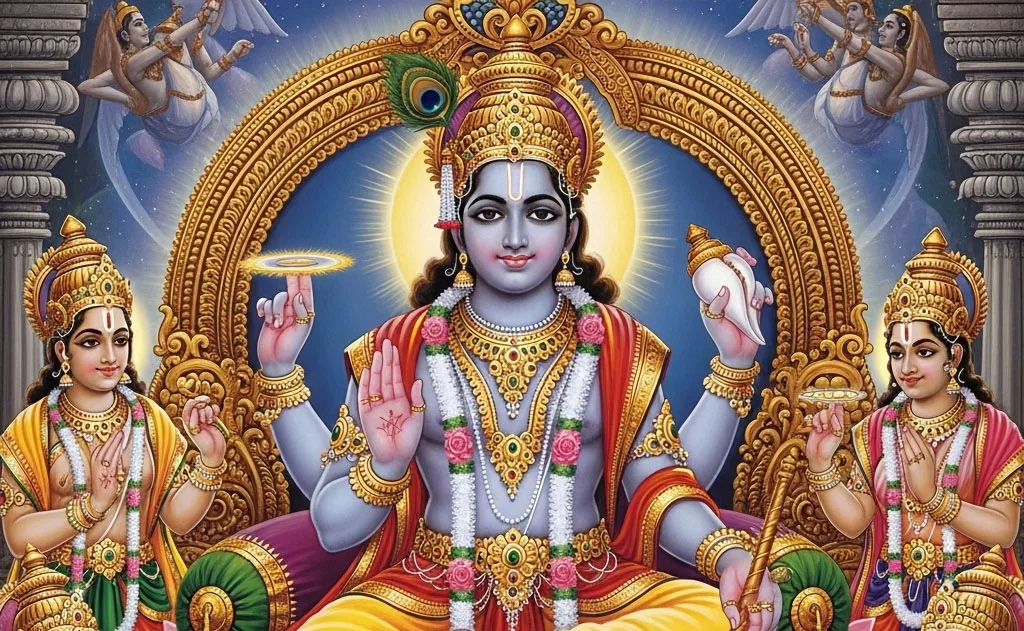
Vishnu is the preserver among the three great deities of Hinduism, who descends in many avatars to restore dharma. He is often shown reclining on the serpent Shesha in the cosmic ocean, or standing with the conch, discus, mace and lotus.
Lakshmi is the goddess of prosperity, good fortune, beauty and auspiciousness. Her many forms are honoured as Ashta Lakshmi. She is called Sri, which is why Vishnu is called Srinivasa (the abode of Sri), Sripati (the lord of Sri) and Madhava (the husband of Ma, or Lakshmi).
How Lakshmi chose Vishnu: the Samudra Manthan
The best-known story of their union comes from the churning of the ocean of milk, the Samudra Manthan. When the gods and asuras churned the ocean with Mount Mandara, many treasures rose from it. Among them came Lakshmi, seated on a lotus. The Vishnu Purana describes the gods praising her, the celestial elephants bathing her with water from golden pots, and the ocean of milk offering her a garland of unfading flowers. Lakshmi then went to Vishnu and took her place on his chest.
The story is often read as a lesson: abundance chooses the one who upholds dharma. She did not go to the strongest or the loudest of those churning the ocean, but to the preserver of the world.
"Never apart": what the scriptures say
The Vishnu Purana states that Sri, the mother of the world, is eternal and never separated from Vishnu, and that just as Vishnu pervades everything, so does she. Vaishnava teachers build on this: wherever Vishnu is worshipped, Lakshmi is present.
In iconography this is shown by the Srivatsa mark on Vishnu's chest, regarded as the seat of Lakshmi. In Sri Vaishnava temples, the main deity is often accompanied by Sridevi (Lakshmi) and Bhudevi (the Earth goddess) on either side.
Lakshmi with every avatar of Vishnu
The Vishnu Purana teaches that whenever Vishnu descends, Lakshmi descends with him:
Avatar of Vishnu | Form of Lakshmi |
|---|---|
Vamana | Padma, also called Kamala, born from a lotus |
Parashurama | Dharani |
Rama | Sita |
Krishna | Rukmini |
The same text says she takes a divine form when he is divine and a human form when he is human, always matching him. Later tradition adds others: in the Tirumala legend, Lakshmi is honoured as Padmavathi, consort of Lord Venkateswara, at Tiruchanur.
The meaning of Lakshmi and Vishnu together
Devotees and teachers draw several lessons from the divine couple:
- Protection and prosperity belong together. Vishnu preserves the world, and Lakshmi makes it flourish. Wealth without dharma is unstable, and dharma without means struggles to help others.
- Grace is near. In Sri Vaishnava teaching, especially that of Ramanuja, Lakshmi is the purushakara, the compassionate mediator who brings the devotee to the Lord. Ramanuja's Sharanagati Gadya begins with surrender to Sri before surrender to Narayana.
- Partnership in the home. Married couples often pray to Lakshmi-Narayana for harmony and shared purpose. See our guide to mantras for a happy married life.
- Lakshmi at Vishnu's feet. In images of Vishnu resting on Shesha, Lakshmi is often shown gently pressing his feet. Devotees read this as loving service, and also as a reminder that she is always close to the Lord who protects the world.
Lakshmi-Narayana temples
Temples dedicated to Lakshmi and Vishnu together are found across India and the diaspora, often called Lakshmi Narayan Mandir or Lakshmi Narayana temple. The Lakshmi Narayan Temple in New Delhi, popularly known as Birla Mandir, is one of the best known. Many temples in the USA, the UK and elsewhere enshrine the couple together; see our guide to Lakshmi Devi temples in the USA.
How to worship Lakshmi and Vishnu together
- Place an image of Lakshmi-Narayana, or images of Lakshmi and Vishnu side by side, on a clean altar.
- Light a ghee lamp and incense.
- Offer Tulasi leaves to Vishnu and lotuses or red flowers to Lakshmi, with kumkum, turmeric and rice.
- Chant Om Lakshmi Narayanabhyam Namah, a widely used salutation to the couple, or Om Namo Narayanaya and Om Shreem Mahalakshmyai Namah.
- Recite the Vishnu Sahasranama or the Sri Suktam if you have time.
- Offer a sattvic sweet such as kheer, then share it as prasad.
Thursday is traditionally associated with Vishnu and Friday with Lakshmi. Ekadashi, Purnima and Diwali are also favoured days.
Festivals that honour Lakshmi and Vishnu
- Diwali: Lakshmi Puja on Amavasya, often with Vishnu or Ganesha. See Lakshmi Puja Vidhi 2026.
- Ksheerabdi Dwadasi and Tulasi Vivah: the marriage of Tulasi and Vishnu as Damodara, celebrated in Karthika. See Ksheerabdi Dwadasi 2026.
- Varalakshmi Vratam: a major Lakshmi festival in South India. See Varalakshmi Vratam 2026.
- Vaikuntha Ekadashi: the opening of the gate to Vishnu's abode, Vaikuntha. See Vaikuntha Ekadashi 2026.
Frequently Asked Questions
Is Lakshmi the wife of Vishnu?
Yes. Lakshmi is the eternal consort of Vishnu. Vaishnava scriptures such as the Vishnu Purana describe her as never separated from him.
How did Lakshmi and Vishnu marry?
According to the Samudra Manthan story, Lakshmi rose from the ocean of milk during the churning and chose Vishnu, placing a garland on him and taking her place on his chest.
Who is Lakshmi in Vishnu's avatars?
The Vishnu Purana says she was Padma or Kamala with Vamana, Dharani with Parashurama, Sita with Rama and Rukmini with Krishna. Tirumala tradition honours her as Padmavathi, consort of Venkateswara.
Why is Lakshmi shown at Vishnu's feet?
In images of Vishnu resting on Shesha, Lakshmi gently presses his feet. Devotees read this as loving service and closeness, not as a lesser status: Vaishnava teaching treats them as inseparable.
What is the Srivatsa mark?
Srivatsa is the auspicious mark on Vishnu's chest, regarded as the seat of Lakshmi. It is a sign that she always dwells with him.
Which mantra is chanted to Lakshmi and Vishnu together?
Om Lakshmi Narayanabhyam Namah is a widely used salutation to the divine couple. Devotees also chant Om Namo Narayanaya and Om Shreem Mahalakshmyai Namah.
Related HinduTone Guides
Share this with family and friends
Send it on WhatsApp, post it, or copy the link.
More from Hindu Gods
- Who Is Lord Kubera? Birth, Alakapuri, Pushpaka, Guardian of the North and Friend of Shiva
- Devi Mahatmya (Durga Saptashati): A Complete Guide to the 13 Chapters
- The Ten Mahavidyas: Complete Guide to the Ten Wisdom Goddesses, Their Forms, Meaning and Temples
- Goddess Kali: Complete Guide to Her Origins, Forms, Symbolism, Mantra and Kali Puja 2026
- Sri Varada Ganesha Swami Dhyanam – For Removal of Obstacles, Prosperity & Fulfillment of Wishes
You might also like

Gaja Lakshmi: Meaning, Iconography, Temples and How to Worship Her