Totakashtakam (Bhava Shankara Deshika Me Sharanam): Full Text with Meaning
The Totakashtakam, 'bhava shankara deshika me sharanam', is the eight-verse hymn in which Totakacharya praised his guru Adi Shankaracharya. Here are all 8 verses in Devanagari and IAST from sanskritdocuments.org, with our own verse-by-verse meaning, the story behind it, when it is traditionally recited and how to recite it.
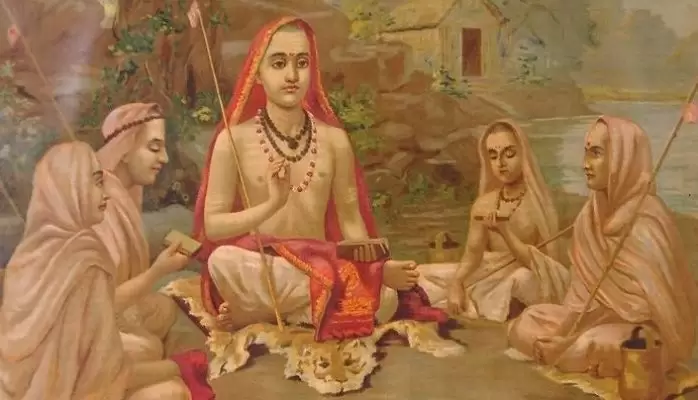
The Totakashtakam, 'bhava shankara deshika me sharanam', is the eight-verse hymn in which Totakacharya praised his guru Adi Shankaracharya. Here are all 8 verses in Devanagari and IAST from sanskritdocuments.
Quick answer: The Totakashtakam is a hymn of 8 verses in which Totakacharya, a disciple of Adi Shankaracharya, praises his guru. Every verse ends with the refrain 'bhava shankara deshika me sharanam' ('O teacher Shankara, be my refuge'). It takes its name from the totaka metre and is traditionally recited on Guru Purnima, Shankara Jayanti, Thursdays and before study.
Last updated: 20 October 2026. The Sanskrit below is the complete text published by sanskritdocuments.org (file totaka8.itx, encoded by Anand Hudli), converted to Devanagari and IAST by software from the source, with no word typed by hand and no letter changed. Our own plain-English meaning follows every verse.
Totakashtakam: full text with meaning
Each verse appears in Devanagari and then in IAST transliteration, followed by its meaning.
Praise of the teacher (verses 1 to 4)
Verse 1
विदिताखिलशास्त्रसुधाजलधे महितोपनिषत् कथितार्थनिधे ।
हृदये कलये विमलं चरणं भव शंकर देशिक मे शरणम् ॥ १॥
viditākhilaśāstrasudhājaladhe mahitopaniṣat kathitārthanidhe |
hṛdaye kalaye vimalaṃ caraṇaṃ bhava śaṃkara deśika me śaraṇam || 1||
Meaning: O ocean of the nectar of all the scriptures, treasure who explains the meaning taught in the great Upanishads: I hold your pure feet in my heart. O teacher Shankara, be my refuge.
Verse 2
करुणावरुणालय पालय मां भवसागरदुःखविदूनहृदम् ।
रचयाखिलदर्शनतत्त्वविदं भव शंकर देशिक मे शरणम् ॥ २॥
karuṇāvaruṇālaya pālaya māṃ bhavasāgaraduḥkhavidūnahṛdam |
racayākhiladarśanatattvavidaṃ bhava śaṃkara deśika me śaraṇam || 2||
Meaning: O ocean of compassion, protect me, whose heart is pained by the sorrow of the sea of worldly life. Make me one who knows the truth of all the schools of philosophy. O teacher Shankara, be my refuge.
Verse 3
भवता जनता सुहिता भविता निजबोधविचारण चारुमते ।
कलयेश्वरजीवविवेकविदं भव शंकर देशिक मे शरणम् ॥ ३॥
bhavatā janatā suhitā bhavitā nijabodhavicāraṇa cārumate |
kalayeśvarajīvavivekavidaṃ bhava śaṃkara deśika me śaraṇam || 3||
Meaning: Through you the people have found their true good, O you whose mind shines in the inquiry into self-knowledge. Make me one who can tell apart God and the individual soul. O teacher Shankara, be my refuge.
Verse 4
भव एव भवानिति मे नितरां समजायत चेतसि कौतुकिता ।
मम वारय मोहमहाजलधिं भव शंकर देशिक मे शरणम् ॥ ४॥
bhava eva bhavāniti me nitarāṃ samajāyata cetasi kautukitā |
mama vāraya mohamahājaladhiṃ bhava śaṃkara deśika me śaraṇam || 4||
Meaning: 'You are Shiva himself': this knowledge has filled my mind with deep joy. Hold back the great ocean of my delusion. O teacher Shankara, be my refuge.
Surrender to the teacher (verses 5 to 8)
Verse 5
सुकृतेऽधिकृते बहुधा भवतो भविता समदर्शनलालसता ।
अतिदीनमिमं परिपालय मां भव शंकर देशिक मे शरणम् ॥ ५॥
sukṛte'dhikṛte bahudhā bhavato bhavitā samadarśanalālasatā |
atidīnamimaṃ paripālaya māṃ bhava śaṃkara deśika me śaraṇam || 5||
Meaning: Only when good deeds have been done in many ways does the longing arise for the vision of oneness through you. Protect me, so very helpless. O teacher Shankara, be my refuge.
Verse 6
जगतीमवितुं कलिताकृतयो विचरन्ति महामहसश्छलतः ।
अहिमांशुरिवात्र विभासि गुरो भव शंकर देशिक मे शरणम् ॥ ६॥
jagatīmavituṃ kalitākṛtayo vicaranti mahāmahasaśchalataḥ |
ahimāṃśurivātra vibhāsi guro bhava śaṃkara deśika me śaraṇam || 6||
Meaning: To protect the world, great luminous souls take on forms and move among us in disguise; among them you shine like the sun, O Guru. O teacher Shankara, be my refuge.
Verse 7
गुरुपुंगव पुंगवकेतन ते समतामयतां नहि कोऽपि सुधीः ।
शरणागतवत्सल तत्त्वनिधे भव शंकर देशिक मे शरणम् ॥ ७॥
gurupuṃgava puṃgavaketana te samatāmayatāṃ nahi ko'pi sudhīḥ |
śaraṇāgatavatsala tattvanidhe bhava śaṃkara deśika me śaraṇam || 7||
Meaning: O best of gurus, whose banner bears the bull: no wise one is your equal. O you who love those who come to you for refuge, treasure of truth: O teacher Shankara, be my refuge.
Verse 8
विदिता न मया विशदैककला न च किंचन काञ्चनमस्ति गुरो ।
द्रुतमेव विधेहि कृपां सहजां भव शंकर देशिक मे शरणम् ॥ ८॥
viditā na mayā viśadaikakalā na ca kiṃcana kāñcanamasti guro |
drutameva vidhehi kṛpāṃ sahajāṃ bhava śaṃkara deśika me śaraṇam || 8||
Meaning: Not even one branch of learning have I clearly understood, and I have no wealth at all, O Guru. Quickly grant me the compassion that is your nature. O teacher Shankara, be my refuge.
Colophon
इति श्रीमत्तोटकाचार्यविरचितं श्रीशङ्करदेशिकाष्टकं सम्पूर्णम् ।
iti śrīmattoṭakācāryaviracitaṃ śrīśaṅkaradeśikāṣṭakaṃ sampūrṇam |
Meaning: Thus ends the Shri Shankara Deshikashtakam, the eight verses to the teacher Shankara, composed by Shri Totakacharya.
The story of the Totakashtakam
The introduction on sanskritdocuments.org retells the story as it appears in the Shankara Digvijaya attributed to Madhava-Vidyaranya. Among Shankara's disciples was one called Giri (the source names him Anandagiri), not known for learning but completely devoted to serving his teacher. One morning, as the class on the Upanishads was about to begin, Giri was at the river washing the teacher's clothes, and Shankara asked the others to wait for him. Padmapada, proud of his own scholarship, said that waiting for Giri was pointless.
Out of compassion for Giri, the story says, Shankara blessed him with knowledge of the scriptures. Giri returned from the river and at once sang these eight verses in the difficult totaka metre, to the wonder of the other disciples. He came to be called Totakacharya and, in the tradition, was later placed in charge of the Jyotirmath at Badari in the Himalayas. The story is told as a lesson that devotion and service to the teacher open the door to knowledge.
| Details | |
|---|---|
| Composer | Totakacharya, disciple of Adi Shankaracharya (per the colophon) |
| Addressed to | Adi Shankaracharya as guru (deshika) |
| Metre | totaka: four groups of short-short-long in each quarter |
| Refrain | bhava śaṅkara deśika me śaraṇam |
| Other name | Shri Shankara Deshikashtakam |
When is it traditionally recited?
- On Guru Purnima: the day of the guru and of Vyasa; see our Guru Purnima guide.
- On Shankara Jayanti: the traditional birth anniversary of Adi Shankaracharya, in the bright half of Vaishakha. Read more about Adi Shankaracharya and his teachings.
- On Thursdays: Thursday (Guruvar) is the day of the guru and of Brihaspati in many families; see our Thursday guide and the Thursday rituals guide for NRI families.
- Before study: many Vedanta classes and students begin with it, asking for clear understanding.
How to recite it at home
- Sit before a picture of Adi Shankaracharya, of your own teacher, or of Dakshinamurti, the form of Shiva as teacher.
- Begin with a moment of gratitude to everyone who has taught you.
- Recite the eight verses slowly; the totaka rhythm (short-short-long) makes them easy to sing, and the whole family can join in the refrain.
- Follow it, if you wish, with the Dakshinamurthy Stotram or the Nirvana Shatakam, both attributed to Shankaracharya.
Pronunciation help
- In the IAST, a line over a vowel (ā, ī, ū) means it is held twice as long; ṇ, ṭ and ḍ are made with the tongue curled back; ś and ṣ are both 'sh' sounds; c is always 'ch'.
- Feel the metre: vi-di-TĀ | khi-la-ŚĀS | tra-su-DHĀ | ja-la-DHE. Every third syllable is long.
- In the refrain, 'śaṅkara' has a nasal ṅ before the k, and 'śaraṇam' ends with the retroflex ṇ.
Traditional beliefs about the Totakashtakam
Devotees traditionally believe that reciting it with devotion:
- draws the grace of the guru, without which, the tradition holds, scriptural knowledge does not bear fruit;
- helps the student's understanding and concentration, as the story of Giri suggests;
- cultivates humility: verse 8 admits that the singer has neither learning nor wealth.
These are matters of faith and tradition, not promises of any particular result, and they are no substitute for study itself.
Tips for NRI families
- A good first Sanskrit hymn for children. The verses are short, the rhythm is regular and the refrain repeats eight times.
- Explore Shankaracharya's own hymns. The Bhaja Govindam, Govindashtakam, Kalabhairava Ashtakam, Shiva Manasa Puja and Devi Aparadha Kshamapana Stotram are all traditionally attributed to him.
Frequently asked questions
Who composed the Totakashtakam?
Totakacharya, one of the four principal disciples of Adi Shankaracharya. The colophon on sanskritdocuments.org reads 'composed by Shri Totakacharya' and calls the hymn the Shri Shankara Deshikashtakam, the eight verses to the teacher Shankara.
Why is it called Totakashtakam?
Because its eight verses are in the totaka metre, in which each quarter has four groups of two short syllables and one long. Tradition says the disciple came to be called Totakacharya after composing in this demanding metre.
What does 'bhava shankara deshika me sharanam' mean?
'O teacher (deshika) Shankara, be (bhava) my refuge (sharanam).' It is the refrain of every verse.
When is it traditionally recited?
On Guru Purnima and Shankara Jayanti, on Thursdays, at the start of Vedanta classes and study, and by many families as a daily prayer to the guru.
Is it a prayer to Shiva or to Shankaracharya?
It is addressed to Adi Shankaracharya as guru. Verse 4 says the devotee's joy comes from knowing that the teacher is Shiva himself, and verse 7 calls him the one whose banner bears the bull, Shiva's emblem, reflecting the tradition that Shankara was an incarnation of Shiva.
How long does it take?
About 2 to 3 minutes. The verses are short and lend themselves to singing.
Editor's note (20 October 2026)
This page was published on 20 October 2026 at the address readers and search engines were already requesting. The Sanskrit is the full text of the Totakashtakam on sanskritdocuments.org (file totaka8.itx, encoded and translated by Anand Hudli). The colophon gives the composer as Totakacharya; the story of Giri is summarised from the file's introduction, which cites the Shankara Digvijaya of Madhava-Vidyaranya, and is told as tradition. No letter of the source is changed. The source also prints two invocation verses (to Vyasa and Shankara, and naming the Advaita guru lineage) before the hymn; they are not part of the ashtakam and are not reproduced. The meanings are our own; the source's English translation is not reproduced.
Related guides
You might also like
Surya Kavacham (Yajnavalkya): Full Text with Meaning
Lalita Pancharatnam (Pratah Smarami Lalita): Full Text with Meaning

Bhavani Ashtakam (Adi Shankaracharya): Full Text with Meaning