How to Teach Hinduism to Children: Stories, Festivals, Mantras and Family Traditions
Children learn Hinduism best by living it with you: a lamp lit together, a story at bedtime, a festival they help prepare, a short prayer before meals. This guide gives age-wise approaches, stories told simply, festival activities, prayers and values, temple and Bala Vihar ideas, diaspora tips, screen-free activities and conversation prompts.
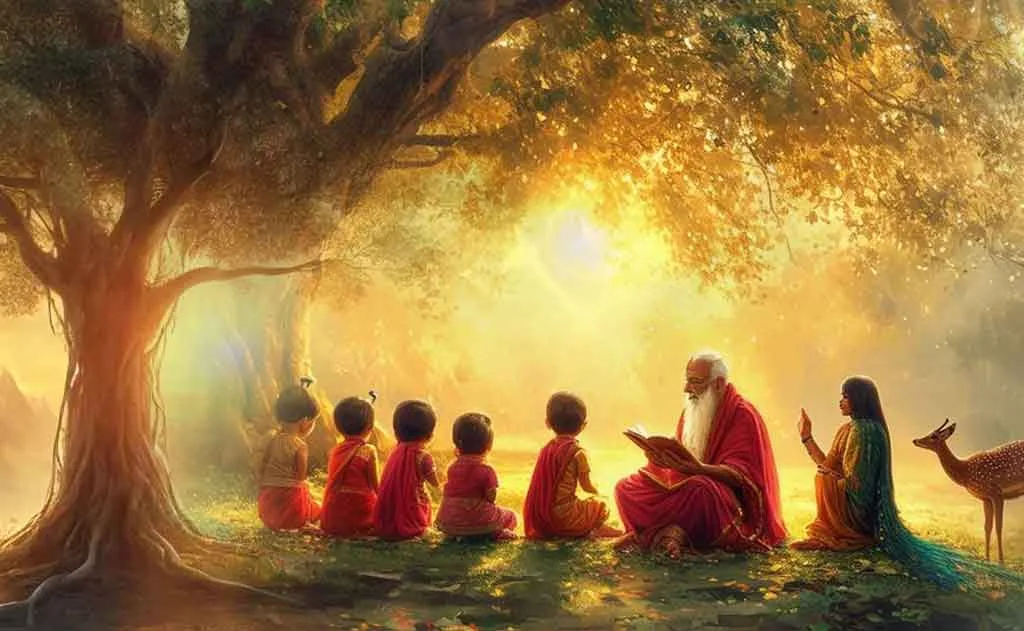
Children learn Hinduism best by living it with you: a lamp lit together, a story at bedtime, a festival they help prepare, a short prayer before meals. This guide gives age-wise approaches, stories told simply, festival activities, prayers and values, temple and Bala Vihar ideas, diaspora tips, screen-free activities and conversation prompts.
Quick answer: The most effective way to teach Hinduism to children is to live it with them: light a lamp together each day, tell one story a week, celebrate festivals through hands-on activities, learn one short prayer at a time, visit a temple regularly, and talk openly about the values behind it all. Match the approach to the child's age, keep it joyful, and answer questions honestly, including "I don't know, let's find out together".
Last updated: 9 October 2026. This guide offers practical ideas for parents and grandparents in India and abroad. Families and traditions differ; adapt it to your own sampradaya and customs.
Hinduism is less a set of facts to memorise than a way of living: daily worship, stories, festivals, food, music, language, respect for elders and for all life. Children absorb it most deeply when it is part of ordinary family life rather than a weekend lesson.
Start with your own family practice
- Notice what your family already does: an evening lamp, a prayer before exams, a family deity, a festival you never miss. Build on that rather than starting from scratch.
- Keep a small home altar where children can take part. Our guide to how to perform puja at home gives a simple 10-step routine that children can join.
- Explain the why as well as the what. "We light the lamp to welcome God and remember that light removes darkness" means more than "because we always do".
- Let children see you practise when it is inconvenient too; consistency teaches more than words.
- Ask grandparents to share family memories, songs and customs, in person or on video calls.
Approaches by age
These are broad suggestions from family experience, not rules. Every child is different; follow their interest.
| Age band | What tends to work | Try this |
|---|---|---|
| Toddlers and preschoolers (about 2 to 5) | Senses, routine and imitation: light, sound, colour, food, rhythm | Ring the bell at aarti, offer a flower, fold hands, sing a short bhajan, look at pictures of deities and name them |
| Early school years (about 5 to 8) | Stories, simple meanings, making things, helping with festivals | Bedtime stories, festival crafts, learning one short mantra with its meaning, drawing a favourite story |
| Middle childhood (about 9 to 12) | Why questions, fairness, heroes, belonging to a group | Discuss the choices characters make, Bala Vihar or Balagokulam classes, helping plan a home puja, reading a children's Ramayana |
| Teens | Identity, reasons, real-world ethics, independence | Discuss the Bhagavad Gita's ideas on duty and action, seva projects, honest talk about doubts, letting them lead a family ritual |
For older teens and young adults, our Sanatan Dharma for young NRIs guide is written for them directly.
Stories: the heart of teaching
The Ramayana, the Mahabharata and the Puranas have been told to children for generations. Tell them in your own words, at your child's level, and pause to ask questions. Here are a few short retellings to start with.
Ganesha and the race around the world
Shiva and Parvati once told their sons Ganesha and Kartikeya that whoever went around the world first would win a prize. Kartikeya leapt onto his peacock and flew off. Ganesha, whose vehicle was a little mouse, thought for a moment, then walked lovingly around his parents and bowed. "You are my whole world," he said, and he won the prize. Ask: What made Ganesha's answer clever? Who is your whole world?
Prahlada and the pillar
Prahlada was a young boy whose father, the demon king Hiranyakashipu, demanded that everyone worship him. Prahlada kept praying to Vishnu, even when he was threatened. When his father mocked him, asking whether Vishnu was in a pillar too, Vishnu appeared from it as Narasimha, half lion and half man, to protect his devotee. Ask: How did Prahlada stay brave? When have you stood up for what is right?
Hanuman's leap to Lanka
When the monkeys searching for Sita reached the ocean, no one thought they could cross it. Jambavan reminded Hanuman of the strength he had forgotten, and Hanuman grew huge and leapt across the sea to Lanka to find Sita. Ask: Why did Hanuman need a friend to remind him? Who reminds you of your strengths?
Krishna lifts Govardhan
When fierce rain flooded the village of Vrindavan, young Krishna lifted Govardhan hill on one finger and held it up like an umbrella, and the whole village sheltered under it together for days. Ask: How did everyone help each other? How can our family shelter others?
Arjuna and the bird's eye
Guru Drona put a wooden bird on a tree and asked each of his students what they could see. One saw the tree, another the leaves, another the sky. Arjuna said, "I see only the bird's eye," and only he was allowed to shoot. Ask: What helps you focus? What distracts you?
For more, read our Ramayana in simple English, the top 10 Hindu stories every child should know, Vishnu's ten avatars for NRI children and Panchatantra tales for young minds. Our article on why Hindu tales matter in parenting explains the thinking behind story-telling.
Festivals through activities
Festivals are the easiest door into Hinduism for children, because they involve doing: cooking, decorating, dressing up, singing and sharing. Give children real jobs, and tell the festival's story before the day.
- Diwali: make and paint clay diyas, draw rangoli, read one story each night. See our Diwali activities for kids and Diwali stories for kids.
- Navaratri and Dussehra: set up a golu doll display, learn the nine forms of Durga one per night, act out Rama and Ravana. See Navratri stories for kids, the Dussehra story for kids and explaining Navratri and Dussehra to children.
- Ganesh Chaturthi: shape a small clay Ganesha, make modaks together, and talk through the questions children ask (Ganesh Chaturthi conversations with NRI kids).
- Janmashtami and Rama Navami: dress up as Krishna or Rama, decorate a cradle, sing bhajans.
- Regional festivals: Ugadi, Pongal, Onam, Bathukamma, Bihu, Durga Puja and many more carry your family's regional identity; celebrate them with their food, songs and language.
Simple prayers and values
Start with one short mantra, learn its meaning, and connect it to a moment in the day. Two that children often learn first:
ॐ गं गणपतये नमः॥
oṃ gaṃ gaṇapataye namaḥ||
Meaning: Salutations to Ganapati. Many families say it before starting homework, a test or a journey.
ॐ ऐं सरस्वत्यै नमः॥
oṃ aiṃ sarasvatyai namaḥ||
Meaning: Salutations to Saraswati, goddess of learning. Often said before study or music practice.
Our 10 essential prarthana slokas to teach your children, 10 Hindu mantras to chant daily and mantras for children's education offer more. Prayers do not guarantee results; present them as a way to remember God, focus and give thanks.
Values matter as much as rituals. Talk about them through daily life:
- Satya (truthfulness): praise honesty, especially when it is hard.
- Ahimsa (non-harming): kindness to animals, plants and people; no hurtful words.
- Seva (selfless service): helping at home, at the temple, or in the neighbourhood without expecting reward.
- Respect for elders and teachers: greeting with namaste or touching elders' feet, as explained in why Hindus touch elders' feet.
- Gratitude: a short thank-you before meals for the food and those who made it.
Temple visits and community programmes
- Visit a temple regularly, at a quiet time, and give children a role. Our Hindu temple visit guide explains darshan and etiquette for first-timers.
- Many temples and Hindu organisations run weekly children's classes, often called Bala Vihar or Balagokulam, with stories, prayers, festivals, values and sometimes language or music. Visit a session before enrolling, and choose one whose approach suits your family.
- Volunteer together at temple festivals or community meals (annadanam). Children remember serving food far longer than hearing a talk.
- Music and dance classes (bhajans, Carnatic or Hindustani music, Bharatanatyam, Kathak and others) carry devotional content and are a joyful way in for many children.
- Learning a little Sanskrit or your mother tongue opens up prayers and stories; see our guide to Sanskrit learning tools for NRI families.
Diaspora tips: raising Hindu children abroad
- Expect questions from classmates and prepare your child with simple, confident answers: "Diwali is the festival of lights; we celebrate good winning over evil."
- Offer to share a festival at school, with the teacher's agreement: a story, a diya craft or a rangoli.
- Use your local city panchang for festival dates; do not copy dates and times from India.
- Connect with other Hindu families so children have friends who share their festivals.
- Keep grandparents involved through video calls for aarti, stories and festival greetings.
- Our guide to raising Hindu children in a Western country covers more of the challenges.
Respecting different traditions
Hinduism includes many traditions, languages, deities, philosophies and customs. Teach children that a friend's family may worship differently, celebrate different festivals or follow different food customs, and that this variety is part of Hinduism's richness. Teach respect for other faiths too: knowing your own tradition well and respecting others' go together.
When children ask about many gods, the 33 koti devatas explainer and the Trimurti explained give older children a starting point.
Screen-free activities
- Draw or paint a scene from a story, then tell it back to the family.
- Make a story box: small toys or paper cut-outs to act out the Ramayana.
- Cook a festival sweet together and offer it before eating.
- Grow tulasi or flowers for the home altar and care for them daily.
- Make a family festival calendar for the year and decorate it.
- Learn a bhajan with simple instruments: bells, cymbals or a drum.
- Make rangoli or kolam with chalk, rice flour or flower petals.
- Play a story quiz at dinner, with children asking the questions.
Conversation prompts
Good conversations matter more than right answers. Try these at dinner or bedtime:
- Which character in a story would you most like to be, and why?
- Was Rama right to go to the forest when he was told to? What would you have done?
- What does it mean to do your duty, even when nobody is watching?
- If God is everywhere, why do we go to the temple?
- What is one kind thing you did today that nobody asked you to do?
- Which festival do you like best, and what would you change about how we celebrate it?
- Is there anything about our religion you find confusing? Let's look it up together.
Frequently asked questions
At what age should I start teaching Hinduism to my child?
You can begin from the first years with what children see and hear: a lamp lit each evening, a short prayer, a festival at home. Stories and simple explanations come next, and deeper questions about God, karma and dharma follow as children ask them. There is no single right age; start where your family already practises.
How do I explain why Hindus worship many gods?
A simple way is: there is one divine reality, and Hindus know and worship it in many forms and names, the way one person can be a mother, a daughter and a teacher at once. Different families feel closest to different forms. Older children can explore the idea further through stories and through our explainers on the 33 koti devatas and the Trimurti.
What are the best Hindu stories for young children?
Short, vivid stories with a clear value work best: Ganesha circling his parents, the child devotees Prahlada and Dhruva, Hanuman's leap to Lanka, Krishna lifting Govardhan hill, and Arjuna's focus at Drona's archery test. Tell them in your own words, then ask what the child noticed.
What simple prayers can children learn first?
Start with one short mantra, such as Om Gam Ganapataye Namah before starting something, or Om Aim Saraswatyai Namah before studies, and a few words of thanks before meals in any language. Add one new prayer at a time and explain its meaning.
What are Bala Vihar and Balagokulam classes?
They are weekly classes for children run by many temples and Hindu organisations, especially outside India. Children learn stories, prayers, festivals, values and sometimes languages with other children. Ask your local temple or community what is offered, and visit a session first.
How do I teach Hinduism if my partner follows a different faith or none?
Agree together on what you will share, keep the focus on stories, festivals, values and family heritage, and let children ask questions about both backgrounds. Respectful, honest conversation matters more than any single practice.
Related guides
- How to perform puja at home
- Hindu temple visit guide
- 10 essential prarthana slokas to teach your children
- Top 10 Hindu stories every child should know
- Raising Hindu children in a Western country
Editor's note (9 October 2026)
This article was rewritten and expanded on 9 October 2026 at the same address, which previously covered raising children with Hindu values. The age bands are practical suggestions, not developmental advice. Stories are retold in our own words from the Ramayana, Mahabharata and Puranas; regional versions differ in detail. Mantras are reproduced from our verified texts.
You might also like
The Resolve of a Monk – A Divine Incident Showcasing Kanchi Paramacharya’s Compassion

Vishnu's Ten Avatars and the One Question Every NRI Child Eventually Asks
Importance of Telugu Pronunciation, Grammar & Pedda Bala Siksha – Let Us Preserve Our Mother Tongue