Famous Temples in Madhya Pradesh: A Source-Checked Guide to Mahakaleshwar, Omkareshwar, Khajuraho, Orchha and Datia
A guide to 17 Madhya Pradesh temples, written only from HinduTone's source-checked temple records: the Jyotirlinga shrines of Mahakaleshwar at Ujjain and Omkareshwar with Mamleshwar, the Bhojeshwar temple at Bhojpur, ten temples of the Khajuraho group from Kandariya Mahadeva to Duladeo, and Bundelkhand's Ram Raja and Chaturbhuj temples at Orchha and Shri Pitambara Peeth at Datia. Each entry covers deity, recorded tradition and history, festivals and visitor notes, with a summary table, pilgrimage circuits, tips for visitors from abroad and FAQs.
A guide to 17 Madhya Pradesh temples, written only from HinduTone's source-checked temple records: the Jyotirlinga shrines of Mahakaleshwar at Ujjain and Omkareshwar with Mamleshwar, the Bhojeshwar temple at Bhojpur, ten temples of the Khajuraho group from Kandariya Mahadeva to Duladeo, and Bundelkhand's Ram Raja and Chaturbhuj temples at Orchha and Shri Pitambara Peeth at Datia. Each entry covers deity, recorded tradition and history, festivals and visitor notes, with a summary table, pilgrimage circuits, tips for visitors from abroad and FAQs.
Quick answer: This guide covers all 17 Madhya Pradesh temples in HinduTone's source-checked records, in three groups: the Shiva shrines of Ujjain, Omkareshwar and Bhojpur (Mahakaleshwar, Omkareshwar, Mamleshwar, Bhojeshwar), the Khajuraho group (ten temples, including Kandariya Mahadeva, Vishwanatha, Lakshmana and the still-worshipped Matangeshwar) and Bundelkhand (the Ram Raja and Chaturbhuj temples at Orchha and Shri Pitambara Peeth at Datia).
Last updated: 20 October 2026. Built from HinduTone's source-checked temple records (checked on 11 October 2026). The records do not publish fixed darshan timings, so confirm timings, aarti times and seva or ticket rules with each temple or the Archaeological Survey of India before you travel.
Shiva shrines of Ujjain, Omkareshwar and Bhojpur
Two of the twelve Jyotirlingas stand in western Madhya Pradesh; our 12 Jyotirlingas guide sets them in the wider pilgrimage. Many devotees plan these visits on a Monday; see our Monday and Shiva worship guide.
Shri Mahakaleshwar Jyotirlinga Temple, Ujjain
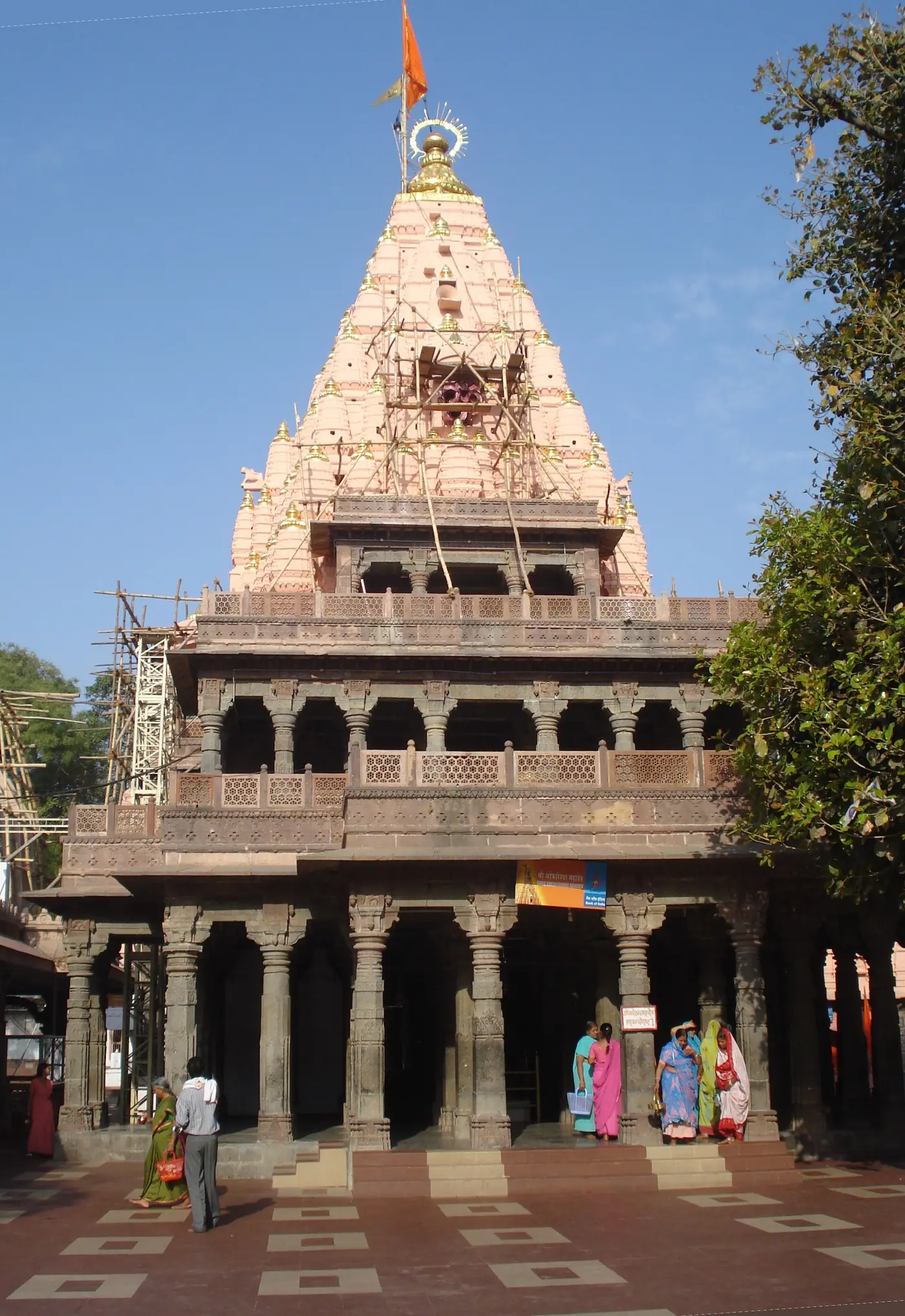
On the banks of the Shipra river in Ujjain, Shiva is worshipped as Mahakala, regarded as the presiding deity of the city, according to the Ujjain district administration. The name joins 'maha' (great) and 'kaal' (time), Madhya Pradesh Tourism explains. The district administration notes that the lingam is believed to be swayambhu and that it faces south (dakshinamurti). The complex also holds the Avantika Devi shrine, regarded locally as a Shakti Peetha, where devotees throng during Navratri, Patrika reports. Ujjain's Simhastha fair is held once in 12 years. Darshan and ritual bookings change from time to time. Mahakaleshwar temple page.
Omkareshwar Mahadev Temple, Omkareshwar
On Mandhata island in the Narmada, in Khandwa district, the Shri Omkareshwar Mandir Trust lists this temple as the fourth of the twelve Jyotirlingas. The island is shaped like the Om symbol. According to the Puranic account given by the trust, the Vindhya mountain worshipped Shiva here, and Shiva appeared as the Pranava linga. Devotees believe Shiva rests here each night, which is why a Shayan darshan is offered. Every Monday a golden palanquin carries a three-faced image of Omkareshwar through the town, at its grandest in Shravan, which Madhya Pradesh Tourism names as the peak pilgrim month. Normal darshan needs no booking, and a parikrama path of about 7 km circles Mandhata Parvat. Omkareshwar temple page.
Mamleshwar (Amareshwar) Temple, Omkareshwar
On the south bank of the Narmada, facing the Omkareshwar temple across the river, stands the Shiva temple of Mamleshwar, known in earlier times as Amareshwar. The Khandwa district administration describes the two temples as having equal status, and the lingas of both are regarded as Jyotirlingas, so many pilgrims visit both. The Archaeological Survey of India protects the site as a group of temples that includes the Kleshwar temple. Mamleshwar temple page.
Bhojeshwar Temple, Bhojpur
At Bhojpur in Raisen district, about 28 km from Bhopal and near the Betwa river, stands an incomplete 11th-century Shiva temple commissioned by Raja Bhoj, according to the Raisen district administration. The district administration gives the single-stone linga's height as over 7.5 feet and its circumference as 17.8 feet, and notes that the temple was built without mortar. The ASI, which protects it as the 'Bhojpur Savite Temple', dates it to the Paramara period. The annual Bhojpur Utsav cultural festival is held near the temple. Follow ASI site rules; Raja Bhoj Airport and Bhopal Junction are the nearest air and rail links. Bhojeshwar temple page.
The Khajuraho group, Chhatarpur district
Khajuraho was the principal seat of the Chandella rulers. Local tradition counts eighty-five temples there, of which about twenty-five still stand, according to the Archaeological Survey of India. Most temples below are in the ticketed Western Group managed by the ASI; Brahma is in the Eastern Group and Duladeo in the Southern Group.
Kandariya Mahadeva Temple
This 11th-century Shiva temple in the Western Group is built of sandstone on a high platform reached by steep steps. Its sanctum holds a marble Shiva linga, as Madhya Pradesh Tourism describes it; the main tower is surrounded by 84 smaller spires. Britannica gives its height as about 31 metres. The Khajuraho Dance Festival, from the last week of February, is described by Madhya Pradesh Tourism as a good time to visit. Kandariya Mahadeva temple page.
Vishwanatha Temple
A foundation inscription records that the Chandela king Dhanga built this Shiva temple in 999 CE, according to the ASI; some scholarly readings of the same inscription give 1002 CE. The inscription also records that two Shiva lingas were enshrined, one of stone and one of emerald, and the emerald linga gave the temple an early name, Marakateshvara. The ASI sees it as a step between the Lakshmana and Kandariya Mahadeva temples in style. Its basement niches show the Seven Mothers flanked by Ganesha and Virabhadra. Vishwanatha temple page.
Lakshmana Temple
The sanctum of this Vishnu temple holds a three-headed, four-armed image of Vishnu as Vaikuntha, combining a human central face with the heads of a boar and a lion. The ASI credits the temple to the Chandella king Yashovarman and dates it to 954 CE. Built in the Nagara style on a high platform, its walls carry dense sculpture, including a middle band of mithunas. Vishnu devotees may like our Thursday and Vishnu worship guide. Lakshmana temple page.
Varaha Temple
Opposite the Lakshmana temple, a small open pavilion on fourteen pillars shelters a single sculpture: a colossal boar, Vishnu's Varaha incarnation, carved from one block of sandstone, with rows of small gods and goddesses in low relief over its body. According to the Varaha story, Vishnu took this form to rescue the earth goddess; at Khajuraho only her feet and a hand on the boar's neck survive, Rough Guides notes. It is a protected ASI monument, not a working temple. Varaha temple page.
Matangeshwar Temple
On the north bank of the Shiva Sagar tank, just south of the Lakshmana Temple, Matangeshwar is still in active worship. A polished Shiva linga about 2.5 m high stands on a Gauri-patta about 6.2 m across, according to ASI figures, and devotees walk around its base as part of worship, says Madhya Pradesh Tourism. The ASI dates the temple to about 900 to 925 CE. At Mahashivaratri, a three-day celebration of Shiva's marriage draws devotees from across India. Devotees believe the linga grows a little every year, a local belief rather than a measured fact. Matangeshwar temple page.
Devi Jagadambi Temple
On the same raised platform as the Kandariya Mahadeva Temple, to its north, this Chandela-era temple is dedicated today to a goddess but was originally a Vishnu temple, and Vishnu still appears throughout its sculpted panels. Sources differ on the sanctum image: Incredible India describes the temple as dedicated to Mata Parvati, while Rough Guides notes that some see a standing Parvati and others the goddess Kali, known here as Jagadambi. Devotees of the goddess may like our Friday worship guide. Devi Jagadambi temple page.
Chitragupta Temple
Despite its name, this Western Group temple, also listed as Bharatji's Temple, is dedicated to Surya. Its sanctum image shows the sun god riding a chariot drawn by seven horses. The outer walls carry hunting scenes, dancers, processions and celestial women, along with a many-headed Vishnu representing his incarnations; Rough Guides counts ten heads, Incredible India eleven. For Sunday sun worship, see our Surya Dev worship guide. Chitragupta temple page.
Parvati Temple
Just south-west of the Vishwanatha temple, this small shrine takes its present name from the goddess Parvati, but its original dedication is uncertain. A figure of Vishnu sits at the middle of the doorway lintel, and Rough Guides says the building may first have been a Vishnu temple. Sources differ on the sanctum image: Incredible India identifies it as Gauri with her vehicle the godha (iguana), while Rough Guides describes the goddess Ganga riding a crocodile. The building is heavily restored. Parvati temple page.
Brahma Temple
In the Eastern Group, on the bank of Khajuraho Sagar and about 1.3 km from the Western Group, this small square shrine is a Shiva temple despite its name: its sanctum holds a four-faced (chaturmukha) linga, and the four faces led people to link it with Brahma. The temple is generally dated to about 900 CE and is built of granite with a sandstone spire. A Vishnu figure on the sanctum lintel suggests it may first have been dedicated to Vishnu. Brahma temple page.
Duladeo Temple
Also called Kunwar Math, this Shiva temple stands on the outskirts of Khajuraho near the Khudar River, about 1 km south-west of the Jain temple enclosure, in the Southern Group. Its sanctum linga is carved with many smaller lingas and described as a sahasra-linga. The name is usually translated as 'holy bridegroom', and newly married couples visit in the belief that it brings good fortune to their marriage, ETV Bharat reports. The ASI dates it to about 1100 to 1150 CE, and sees it as marking the end of temple building at Khajuraho. Duladeo temple page.
Bundelkhand: Orchha and Datia
Ram Raja Temple, Orchha
In Orchha, Niwari district, Rama is worshipped as a king rather than only as a god, Madhya Pradesh Tourism says. According to the tradition it recounts, the queen of Orchha kept an image of Rama in her palace while a temple was prepared; the image stayed where it was first placed, and the palace has been known as the Ram Raja Temple ever since. Because Rama is honoured as the reigning king, the deity receives royal courtesies, including a gun salute at the end of the evening aarti. See also our Lord Rama hub. Ram Raja temple page.
Chaturbhuj Temple, Orchha
Its name means 'one with four arms', a description of Vishnu. According to tradition, this temple was being built for the image of Rama that the queen of the Bundela king Madhukar Shah brought from Ayodhya; when the image stayed in her palace, which became the Ram Raja Temple, the Chaturbhuj Temple became a shrine of Vishnu. Accounts differ on the queen's name and on the date. Its steps are steep and narrow. Incredible India lists Janmashtami and Vaikuntha Chaturdashi among its main festivals; see our Krishna Janmashtami 2026 guide and Vaikuntha Chaturdashi 2026 guide. Chaturbhuj temple page.
Shri Pitambara Peeth, Datia
The presiding goddess of this Datia complex is Baglamukhi, worshipped as Maa Pitambara and counted among the ten Mahavidyas. The complex also has a shrine of Dhumavati, which can be seen only at aarti time, and the Vankhandeshwar Shiva temple. The Peeth was founded by an ascetic known as Swamiji Maharaj in the mid-1930s. Devotees offer yellow items and wear yellow during special rites. Incredible India singles out Navratri as the key festival; Dev Diwali on Kartik Purnima sees lamps lit around the Haridra Sarovar. Dress modestly and avoid leather items. Our Gupt Navratri and Mahavidya guide explains the Mahavidyas. Pitambara Peeth temple page.
Madhya Pradesh temples at a glance
| Temple | District/City | Deity | Known for |
|---|---|---|---|
| Mahakaleshwar | Ujjain | Shiva (Mahakala) | Jyotirlinga; Simhastha |
| Omkareshwar | Khandwa | Shiva | Jyotirlinga on Mandhata island |
| Mamleshwar | Khandwa | Shiva | Equal status with Omkareshwar |
| Bhojeshwar | Raisen (Bhojpur) | Shiva | Incomplete Paramara temple |
| Kandariya Mahadeva | Chhatarpur (Khajuraho) | Shiva | 84 subsidiary spires |
| Vishwanatha | Chhatarpur (Khajuraho) | Shiva | 999 CE inscription |
| Lakshmana | Chhatarpur (Khajuraho) | Vishnu (Vaikuntha) | 954 CE; three-headed Vishnu |
| Varaha | Chhatarpur (Khajuraho) | Vishnu (Varaha) | Monolithic boar |
| Matangeshwar | Chhatarpur (Khajuraho) | Shiva | Living temple; Mahashivaratri |
| Devi Jagadambi | Chhatarpur (Khajuraho) | Devi | Former Vishnu temple |
| Chitragupta | Chhatarpur (Khajuraho) | Surya | Seven-horse chariot image |
| Parvati | Chhatarpur (Khajuraho) | Devi | Uncertain original dedication |
| Brahma | Chhatarpur (Khajuraho) | Shiva | Four-faced linga |
| Duladeo | Chhatarpur (Khajuraho) | Shiva | Sahasra-linga |
| Ram Raja | Niwari (Orchha) | Rama | Rama worshipped as king |
| Chaturbhuj | Niwari (Orchha) | Vishnu | Tied to Ram Raja legend |
| Pitambara Peeth | Datia | Baglamukhi | Mahavidya worship |
Pilgrimage circuits in Madhya Pradesh
- Jyotirlinga circuit: Mahakaleshwar at Ujjain, then Omkareshwar and Mamleshwar on either bank of the Narmada; buses run to Omkareshwar from Indore and Ujjain, the temple trust says. See our 12 Jyotirlingas guide.
- Khajuraho group: the Western Group (Lakshmana, Varaha, Kandariya Mahadeva, Devi Jagadambi, Chitragupta, Vishwanatha, Parvati) with Matangeshwar beside it, then the Eastern Group's Brahma Temple and the Southern Group's Duladeo.
- Orchha and Datia: the Ram Raja and Chaturbhuj temples at Orchha, then Shri Pitambara Peeth at Datia; the records name Jhansi and Gwalior for rail and air links.
- Bhopal side trip: the Bhojeshwar temple at Bhojpur, reached from Bhopal.
The records do not name a single best season. Shravan (July to August) is the peak pilgrim month at Omkareshwar, Navratri is the key festival at Pitambara Peeth, and Madhya Pradesh Tourism suggests the Khajuraho Dance Festival, from late February, for Khajuraho. Festival days are the most crowded; see our Dussehra 2026 in Madhya Pradesh guide for this season.
Visiting from abroad
Indore, Bhopal, Gwalior and Khajuraho are the airports named in these records. Take a rest day after a long flight, and book special darshan, rituals and rooms only through official temple, ASI or state tourism channels; Mahakaleshwar and Omkareshwar both have official websites. Dress modestly, carry a copy of your passport, and keep small cash for offerings and footwear counters. Our temple visit guide covers darshan and etiquette, and our temple safety tips help in festival crowds. See also the Hindu days of the week.
Frequently asked questions
Which Madhya Pradesh temples does this guide cover?
All 17 Madhya Pradesh temples in HinduTone's source-checked records: Mahakaleshwar, Omkareshwar and Mamleshwar, Bhojeshwar at Bhojpur, ten temples of the Khajuraho group, the Ram Raja and Chaturbhuj temples at Orchha, and Shri Pitambara Peeth at Datia. Every one has a full section.
Which Jyotirlingas are in Madhya Pradesh?
The records cover Mahakaleshwar at Ujjain and Omkareshwar on Mandhata island in the Narmada. The Khandwa district administration describes the Mamleshwar temple across the river as being of equal status, with both lingas regarded as Jyotirlingas, so many pilgrims visit both.
Are the Khajuraho temples still used for worship?
Mostly not. The official monument list places Matangeshwar as the Khajuraho temple in the category of living monuments visited by pilgrims, and it holds a three-day Mahashivaratri celebration. The other temples covered here are protected monuments managed by the Archaeological Survey of India.
When is Madhya Pradesh most crowded for temple visits?
The records point to Shravan (July to August) at Omkareshwar, Navratri at Datia and at the Avantika Devi shrine in Ujjain, Mahashivaratri at Matangeshwar, the Khajuraho Dance Festival in late February to early March, and the Simhastha fair at Ujjain once every 12 years.
Is a visit a guaranteed remedy?
No. Devotees at Pitambara Peeth believe Baglamukhi grants protection and victory over adversity, and newly married couples visit Duladeo hoping for good fortune. The records report these beliefs; they are matters of faith, and no outcome is guaranteed.
Editor's note (20 October 2026)
Every temple fact in this guide comes from HinduTone's source-checked temple records, which were researched against district administrations, state tourism and endowment departments, the Archaeological Survey of India, newspapers and temple directories and checked on 11 October 2026. Claims resting on a single source and temples not yet verified are left out. Timings, ticketing and darshan rules change; please confirm them with the temple or the ASI before travelling.
Related guides
You might also like
Famous Temples in Uttar Pradesh: A Source-Checked Guide to Kashi, Ayodhya, Mathura-Vrindavan, Gorakhpur and Kanpur
Famous Temples in Andhra Pradesh: A Source-Checked Guide from Tirumala and Simhachalam to Srikurmam, Lepakshi and Kanipakam
Famous Temples in Maharashtra: A Source-Checked Guide to Ashtavinayak, Jyotirlingas, Pandharpur, Kolhapur and More