
Famous Temples in Gujarat: A Source-Checked Guide to Somnath, Dwarka, Dakor, Ambaji, Modhera and More
A region-by-region guide to 16 Gujarat temples and sacred sites, written only from HinduTone's source-checked temple records: Somnath, Nageshwar and the Rukmini temple on the Saurashtra coast; Salangpur and Sarangpur in Botad; Dakor, Vadtal and Ahmedabad's Hare Krishna Mandir and Hutheesing Jain Temple in central Gujarat; and the Modhera Sun Temple, Ambaji's Gabbar hill and Khedbrahma in the north. Each entry covers deity, recorded tradition and history, festivals and visitor notes, with a summary table, pilgrimage circuits, tips for visitors from abroad and FAQs.
A region-by-region guide to 16 Gujarat temples and sacred sites, written only from HinduTone's source-checked temple records: Somnath, Nageshwar and the Rukmini temple on the Saurashtra coast; Salangpur and Sarangpur in Botad; Dakor, Vadtal and Ahmedabad's Hare Krishna Mandir and Hutheesing Jain Temple in central Gujarat; and the Modhera Sun Temple, Ambaji's Gabbar hill and Khedbrahma in the north. Each entry covers deity, recorded tradition and history, festivals and visitor notes, with a summary table, pilgrimage circuits, tips for visitors from abroad and FAQs.
Quick answer: This guide covers all 16 Gujarat temples and sacred sites in HinduTone's source-checked records, in four regions: the Saurashtra coast (Somnath, Nageshwar, Rukmini at Dwarka, Harsiddhi Mata, Gop), Botad (Salangpur Hanuman and BAPS Sarangpur), central Gujarat (Dakor, Vadtal, Bhadaj and the Hutheesing Jain Temple) and north Gujarat (Modhera, Valinath Mahadev, Ambaji's Gabbar hill and Khedbrahma).
Last updated: 20 October 2026. Built from HinduTone's source-checked temple records (checked on 11 October 2026). The records do not publish fixed darshan timings, so confirm timings and closures with each temple before you travel.
Saurashtra coast: Somnath and Dwarka
Two Shiva shrines revered as Jyotirlingas anchor the coast; see our 12 Jyotirlingas guide and the Monday (Somvar) guide.
Somnath Temple, Prabhas Patan
At Prabhas Patan near Veraval, on the Arabian Sea coast of Gir Somnath district, Shiva is worshipped as Somnath, 'Lord of the Moon'. According to the Puranic tradition repeated by Shree Somnath Trust, the Moon god was freed here from Daksha's curse, and the shrine takes his name (Soma). Raiders sacked the temple several times, including Mahmud of Ghazni in 1025 to 1026, and it was rebuilt again and again. After Sardar Vallabhbhai Patel resolved in 1947 to rebuild it, the present temple was consecrated on 11 May 1951. The Trust holds four-prahar puja on Maha Shivaratri and a five-day fair up to Kartik Purnima. Phones and cameras are banned inside (free lockers are provided), and modest dress is required. Somnath temple page; see also our Kartik Purnima melas 2026 guide.
Nageshwar Jyotirlinga, near Dwarka
On the road between Dwarka and Beyt Dwarka, this Shiva temple keeps a linga that the district administration describes as one of the twelve swayambhu Jyotirlingas, in an underground sanctum. The grounds hold a seated Shiva statue the district puts at 25 metres. The district says the site was once Darukavana, the forest named in the Jyotirlinga hymn; this is a matter of faith, and Aundha Nagnath in Maharashtra is also venerated as Nageshwar. Crowds peak on Maha Shivaratri. Dwarka station is the nearest railhead, and the Sudarshan Setu, opened in 2024, lets pilgrims reach Beyt Dwarka by road. Nageshwar temple page.
Rukmini Devi Temple, Dwarka
About 2 km from the Dwarkadhish Temple, on Dwarka's outskirts, this shrine honours Rukmini, Krishna's chief consort. According to tradition, the sage Durvasa cursed the couple to live apart after Rukmini drank water without first offering it to him, which explains why her temple stands away from Krishna's. Offering water is the central custom: visitors donate drinking water, which is offered to the goddess and returned as prasad, so Incredible India advises bringing some. The district notes wall paintings of Rukmini and Krishna. Gujarat Tourism suggests November to February for a visit. Rukmini temple page; see also the Friday (Shukravar) guide.
Harsiddhi (Harshad) Mata Temple, Gandhvi
On Koyla Dungar, a hill near Gandhvi village on the Halar coast of Devbhumi Dwarka district, the goddess Harsiddhi is worshipped. According to tradition, she was the kuldevi of Krishna and of King Vikramaditya. The district and ANI date the temple to the Chalukya period without a year. The aarti lasts close to an hour, and devotees believe a swing in the temple moves by itself when the goddess arrives. In 2024 the Van Mahotsav opened Harsiddhi Van, a cultural forest behind the hill. The district names Jamnagar and Porbandar airports and Bhatiya station. Harsiddhi Mata temple page.
Old Temple at Gop, Jamnagar district
This ruined stone shrine stands in Gop village, south-west of Gop Hill. The archaeologist James Burgess surveyed and drew it in 1874 to 1875, and wrote that it was probably not later than the sixth century; Sarmaya places it in the Maitraka period. Its original deity is not named, though Burgess recorded a Ganapati in one roof arch and two figures villagers called Rama and Lakshmana. The stepped roof carries chaitya-window arches, and the walls are of ashlar laid without cement. The sources give no transport details, so check the route locally. Gop temple page.
Botad: Salangpur and Sarangpur
Shree Kashtabhanjan Dev Hanumanji Mandir, Salangpur
At Salangpur in Barwala taluka, Hanuman is worshipped as Kashtabhanjan, the 'crusher of sorrows'. The temple belongs to the Vadtal Gadi of the Swaminarayan Sampraday. Gujarat Tourism and the temple credit Sadguru Gopalanand Swami with installing the image, and the temple's account says it trembled at the consecration. A 54-foot panchdhatu Hanuman statue was unveiled on Hanuman Jayanti in 2023. The temple runs a bhojanalay and pilgrim rooms, allotted only on arrival. Botad Junction is the nearest station. Kashtabhanjan Dev temple page; see also our Hanuman temples guide and the Tuesday (Mangalwar) guide.
BAPS Shri Swaminarayan Mandir, Sarangpur
In the same village, and separate from the Kashtabhanjan shrine, this BAPS mandir is described by Gujarat Tourism as a shikharbaddha (spired) temple built in 1916 by Shastri Yagnapurushdas, rising to 108 feet, a number regarded as auspicious in the Swaminarayan Sampraday. It is a training centre for newly enrolled BAPS sadhus. Pramukh Swami became its manager in 1946 and died at Sarangpur in 2016; a samadhi shrine in his memory draws pilgrims. Gujarat Tourism refers visitors to the BAPS website for hours. BAPS Sarangpur temple page.
Central Gujarat: Kheda and Ahmedabad
Krishna worship dominates this belt; see our famous Krishna temples guide and the Thursday (Guruvar) guide.
Shri Ranchhodraiji Maharaj Temple, Dakor
In Dakor, Kheda district, Krishna is worshipped as Ranchhodraiji, a form of Dwarkadhish, as a four-armed black touchstone idol. According to tradition, the devotee Bodana brought the deity from Dwarka in a cart in a single night, and his wife's gold nose-ring matched its weight in gold. The present temple by Gomti lake was built in 1772 CE. Pilgrims walk to Dakor on full-moon days in memory of Bodana. The five-day Holi and Phagan Purnima celebration, Janmashtami, Kartik Purnima and a Rath Yatra on Pushya Nakshatra are the main festivals, and darshan hours change on those days. Dakor Ranchhodraiji temple page.
Shri Swaminarayan Mandir, Vadtal
Vadtal Dham, in Kheda district, is the headquarters of the Lakshmi Narayan Dev Gadi of the Swaminarayan Sampradaya. Swaminarayan installed the images on 3 November 1824, with Lakshmi Narayan Dev in the central shrine. The district administration says sadhus and lay devotees carried the bricks and lime themselves. In 1826 Swaminarayan established the hereditary acharya seats of Vadtal and Ahmedabad here, marked by a marble chhatri. Visitors see the Hari Mandap where he stayed and relics in Akshar Bhuvan. Anand and Nadiad are the nearest stations. Vadtal temple page.
Hare Krishna Mandir, Bhadaj, Ahmedabad
Near Science City in Ahmedabad, this Hare Krishna movement temple centres on Radha and Krishna as Sri Sri Radha Madhav, with Nitai Gauranga and Lakshmi Narasimha Dev. It opened in April 2015, in a building the temple describes as blending Gujarati haveli and Rajasthani styles, with a gaushala on the campus. At Janmashtami the deities are bathed with water from 108 kalashas and taken around the grounds in a golden chariot. Darshan pauses in the afternoon and differs on festival days. Hare Krishna Mandir temple page; see also our Krishna Janmashtami 2026 guide.
Hutheesing Jain Temple, Ahmedabad
Just outside the Delhi Gate of old Ahmedabad, this white-marble temple is a Jain place of worship, not a Hindu temple, dedicated to Dharmanatha, the fifteenth Tirthankara. A cloister around the sanctuary holds 52 subsidiary shrines. The merchant Hathisinh Kesarisinh began it, said to have done so to give work to artisans during a famine, and his widow, Shethani Harkunvar, completed it, in 1848 according to most official accounts. The design is credited to Premchand Salat. Dress modestly, and seek permission from the trust office before photographing. Hutheesing Jain Temple page.
North Gujarat: Mehsana, Banaskantha and Sabarkantha
Modhera Sun Temple, Mehsana district
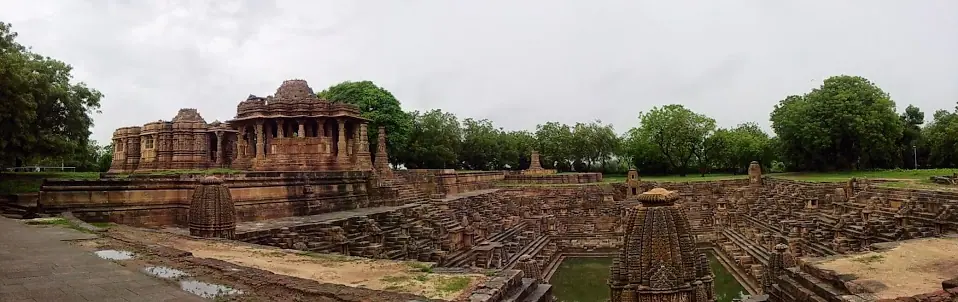
This ASI-protected temple to Surya was built under the Chaulukya (Solanki) king Bhima I, probably in 1026 to 1027 CE according to IGNCA. Three parts lie on one east-west axis: the shrine with its hall, a pillared assembly hall carved with Mahabharata scenes, and the Surya Kund, a stepped tank lined with small shrines. Its tower was destroyed in later centuries. In 2022 it was added to India's tentative list for UNESCO World Heritage status. The Uttarardh Mahotsav dance festival is held here in January after Uttarayan. Do not climb on or touch the carvings. Modhera Sun Temple page; see also our Sunday Surya worship guide.
Modheshwari Mata Temple, Modhera
Less than 2 km from the Sun Temple, this working shrine honours Modheshwari, described by Gujarat Tourism as a form of Parvati or Durga and worshipped as Matangi with eighteen arms bearing weapons. According to the temple's legend, she took this form to destroy a demon who harassed the sages of the region. She is the kuldevi of families who trace their roots to the Modhera area. Special pujas are held in Chaitra Navratri and on every Purnima, and the 2026 Sharad Navratri Mahotsav was listed for 11 to 19 October. Modheshwari Mata temple page; see also our Navratri 2026 Gujarat garba guide.
Valinath Mahadev Temple, Tarabh
At Tarabh village near Visnagar in Mehsana district, Shiva is worshipped as Valinath Mahadev, in the form of an image that tradition holds to be self-manifested, as Gujarat First reported. Divya Bhaskar reported that the new shrine was ready after about ten years of work, with the pran pratishtha on 22 February 2024 and a 1,100-kund havan. The Ahmedabad Mirror reported that Prime Minister Narendra Modi inaugurated it. Confirm darshan and the road route locally. Valinath Mahadev temple page.
Gabbar Tirth and the 51 Shaktipeeth Parikrama, Ambaji
Gabbar, a small hill about four kilometres west of Ambaji in Banaskantha district, holds the shrine regarded as the original abode of the goddess worshipped at Ambaji. It is believed to be where the heart of Sati fell, though Shakti Peetha lists differ between texts. At the summit an ever-burning lamp faces the Ambaji temple, and the goddess's footprints under a pipal tree are worshipped. The parikrama around the hill has replicas of the 51 Shakti Peethas, celebrated in a state-level mahotsav, usually in February. Pilgrims climb by steps or ropeway, which can close at short notice. Gabbar Tirth temple page; see also our Shakti Peethas guide.
Brahma Temple (Brahmaji Mandir), Khedbrahma
In the middle of Khedbrahma in Sabarkantha district, this east-facing temple is dedicated to Brahma. The Archaeological Survey of India's 1906 to 1907 report noted that temples to Brahma are few and far between. The sanctum image shows Brahma standing, three-faced and four-armed, with a goose on either side. Henry Cousens judged the carving on the old walls to be in twelfth-century style, while the hall and roof were rebuilt later. Local tradition links the site with a sacrifice by Brahma and the sage Bhrigu. No official timings were found. Brahma temple page.
The Dwarkadhish Temple at Dwarka and the main Ambaji temple are also major pilgrimage sites; they are not yet in our source-checked set.
Gujarat temples at a glance
| Temple | District/City | Deity | Known for |
|---|---|---|---|
| Somnath | Gir Somnath | Shiva | Jyotirlinga; 1951 rebuilding |
| Nageshwar | Devbhumi Dwarka | Shiva | Underground sanctum |
| Rukmini Devi | Dwarka | Rukmini | Water offering |
| Harsiddhi Mata | Devbhumi Dwarka | Harsiddhi | Hilltop; long aarti |
| Old temple at Gop | Jamnagar | Not established | Early stone shrine |
| Kashtabhanjan Dev | Botad | Hanuman | 54-foot statue |
| BAPS Sarangpur | Botad | Swaminarayan | Sadhu training |
| Ranchhodraiji, Dakor | Kheda | Krishna | Purnima walks; Holi |
| Vadtal Dham | Kheda | Lakshmi Narayan Dev | 1824 consecration |
| Hare Krishna Mandir | Ahmedabad | Radha Madhav | Janmashtami |
| Hutheesing Jain Temple | Ahmedabad | Dharmanatha (Jain) | Marble, 1848 |
| Modhera Sun Temple | Mehsana | Surya | Surya Kund |
| Modheshwari Mata | Mehsana | Modheshwari | Navratri |
| Valinath Mahadev | Mehsana | Shiva | 2024 consecration |
| Gabbar Tirth | Banaskantha | Amba | Shakti Peetha parikrama |
| Brahmaji Mandir | Sabarkantha | Brahma | Brahma shrine |
Pilgrimage circuits in Gujarat
- Dwarka and Somnath: Rukmini Devi, Nageshwar and Harsiddhi Mata in Devbhumi Dwarka district, then Somnath at Prabhas Patan. The Dwarkadhish Temple completes the classic Dwarka visit; it is not yet in our source-checked set.
- Botad pair: Kashtabhanjan Dev and the BAPS mandir in the same village.
- Kheda and Ahmedabad: Dakor and Vadtal, reached from Anand or Nadiad, with Bhadaj and Hutheesing in Ahmedabad.
- Mehsana: the Sun Temple and Modheshwari Mata at Modhera, with Valinath Mahadev at Tarabh.
- North Gujarat: Gabbar Tirth at Ambaji with the Brahma temple at Khedbrahma.
The records do not name a single best season for Gujarat's temples, apart from Gujarat Tourism's November to February suggestion for the Rukmini temple. Full-moon days and festivals are the most crowded; see our Dussehra 2026 in Gujarat guide.
Visiting from abroad
Ahmedabad, Vadodara, Jamnagar, Porbandar and Diu are the airports named in these records. Rest a day after a long flight before night festivals or the Gabbar climb, and book rooms and pujas only through official temple or government channels. Dress modestly and keep small cash for offerings and footwear counters. Our temple visit guide covers etiquette, our temple safety tips help in crowds, and our USA temples guide covers worship back home. See also the Hindu days of the week.
Frequently asked questions
Which Gujarat temples does this guide cover?
All 16 Gujarat temples and sacred sites in HinduTone's source-checked records, in four regions, each with its own section. The Hutheesing temple in Ahmedabad is a Jain temple, and the old temple at Gop is a ruined early shrine.
Is Nageshwar near Dwarka one of the twelve Jyotirlingas?
The Devbhumi Dwarka district administration describes it as one, and Dwarka's pilgrims treat it so. The identification is debated: Aundha Nagnath in Maharashtra is also venerated as Nageshwar.
Can I take my phone into Somnath Temple?
No. Shree Somnath Trust bans phones, cameras and other electronic devices inside and provides free lockers. Book rooms and pujas only through somnath.org, as the Trust has warned about fraud.
Can I book a room at Salangpur in advance?
No. The Kashtabhanjan Dev temple says rooms are allotted only after devotees arrive, with no advance or online booking through the temple or any agent.
When are Gujarat's temples most crowded?
The records name Maha Shivaratri at Somnath and Nageshwar, the Kartik Purnima fair at Somnath, full-moon days, Holi and Janmashtami at Dakor, and Navratri at Modheshwari. Confirm dates locally.
Is a visit to these temples a guaranteed remedy?
No. Devotees believe Kashtabhanjan Dev at Salangpur removes troubles of mind and body, and the records report that belief. It is a matter of faith, and no outcome is guaranteed.
Editor's note (20 October 2026)
Every temple fact in this guide comes from HinduTone's source-checked temple records, which were researched against district administrations, state tourism and endowment departments, newspapers and temple directories and checked on 11 October 2026. Claims resting on a single source and temples not yet verified are left out. Timings and seva rules change; please confirm them with the temple before travelling.
Related guides
- 12 Jyotirlingas of Lord Shiva: darshan guide
- Navratri 2026 Gujarat garba guide
- Kartik Purnima melas 2026, including Somnath
- Famous Krishna temples in India
- Famous temples in Maharashtra
- Famous temples in Karnataka
- Famous temples in Madhya Pradesh
- Lord Shiva hub
- Lord Krishna hub
- Goddess Durga hub
- Lord Hanuman hub
- Hindu temple visit guide
You might also like
Famous Temples in Maharashtra: A Source-Checked Guide to Ashtavinayak, Jyotirlingas, Pandharpur, Kolhapur and More
Famous Krishna Temples in India: 13 Source-Checked Temples from Guruvayur to Mathura, Vrindavan, Dakor and Pandharpur
Famous Temples in Uttarakhand: A Source-Checked Guide to Kedarnath, Badrinath, Tungnath, Haridwar, Almora and More