Famous Temples in Uttar Pradesh: A Source-Checked Guide to Kashi, Ayodhya, Mathura-Vrindavan, Gorakhpur and Kanpur
A region-by-region guide to 14 Uttar Pradesh temples, written only from HinduTone's source-checked temple records: Kashi Vishwanath and three more Varanasi shrines; Ram Janmabhoomi and Hanuman Garhi in Ayodhya with Hanuman Setu in Lucknow; the Krishna Janmasthan, Dwarkadhish, Radha Raman and Prem Mandir in Mathura-Vrindavan; and the JK Temple in Kanpur and Gorakhnath Temple in Gorakhpur. Each entry covers deity, recorded history, festivals and visitor notes, with a summary table, pilgrimage circuits, tips for visitors from abroad and FAQs.
A region-by-region guide to 14 Uttar Pradesh temples, written only from HinduTone's source-checked temple records: Kashi Vishwanath and three more Varanasi shrines; Ram Janmabhoomi and Hanuman Garhi in Ayodhya with Hanuman Setu in Lucknow; the Krishna Janmasthan, Dwarkadhish, Radha Raman and Prem Mandir in Mathura-Vrindavan; and the JK Temple in Kanpur and Gorakhnath Temple in Gorakhpur. Each entry covers deity, recorded history, festivals and visitor notes, with a summary table, pilgrimage circuits, tips for visitors from abroad and FAQs.
Quick answer: This guide covers all 14 Uttar Pradesh temples in HinduTone's source-checked records, in four groups: Varanasi (Kashi Vishwanath, the New Vishwanath Temple at BHU, the Nepali Mandir, Tulsi Manas Mandir), Ayodhya and Lucknow (Ram Janmabhoomi Mandir, Hanuman Garhi, Hanuman Setu), Mathura-Vrindavan (Krishna Janmasthan and its Garbh Griha, Dwarkadhish, Radha Raman, Prem Mandir) and Kanpur and Gorakhpur (JK Temple, Gorakhnath Temple).
Last updated: 20 October 2026. Built from HinduTone's source-checked temple records (checked on 11 October 2026). The records do not publish fixed darshan timings, so confirm timings, entry rules and seva arrangements with each temple before you travel.
Varanasi (Kashi): Shiva and Rama shrines by the Ganga
Kashi is a Shaiva city, and its temples suit Mondays and the month of Shravan; see our guide to the importance of Monday and Shiva worship.
Kashi Vishwanath Temple, Varanasi
In the old city near the western bank of the Ganga, Shiva is worshipped as Vishwanath or Vishweshwara, the Lord of the Universe. The temple is one of the twelve Jyotirlingas; the traditional Dvadasha Jyotirlinga lists name Vishvesha of Varanasi. According to tradition, the Kashi Khanda of the Skanda Purana praises Kashi as a place Shiva never leaves. According to the temple trust, the present temple was built in 1780 by Maharani Ahilyabai Holkar of Indore, and gold donated by Maharaja Ranjit Singh covers two of its domes. The Kashi Vishwanath Dham, inaugurated on 13 December 2021, links the precinct to the ghats. Maha Shivaratri, Rangbhari Ekadashi and Shravan bring heavy crowds. A boat to the Dham's riverfront entrance avoids the congested lanes. Kashi Vishwanath temple page and our 12 Jyotirlingas guide.
New Vishwanath Temple (Birla Temple), BHU
Near the centre of the Banaras Hindu University campus, this Shiva temple was planned by Madan Mohan Malaviya, the founder of BHU, to replicate the old Vishwanath temple, and was built with the support of the Birla family, according to BHU. A regional tourism guide says the foundation stone was laid in March 1931, construction took almost three decades, and the spire rises 252 feet. The Shiva shrine is on the ground floor, with Lakshmi Narayan and Durga temples on the first floor. Access arrangements on the campus may change; confirm them locally. New Vishwanath Temple page.
Nepali Mandir (Samrajeshwar Pashupatinath), Lalita Ghat
On Lalita Ghat, a short distance from Manikarnika Ghat, this Shiva temple was built in the 19th century by members of Nepal's royal family as a copy of the Pashupatinath Temple in Kathmandu. Live History India links its beginnings to Rana Bahadur Shah, a Nepali king who lived in Kashi as an ascetic. Built of wood and terracotta in the Nepali pagoda style with a two-tiered roof and gilded finial, it is called 'Mini Khajuraho' for its carvings and Kanthwala, 'wooden'. Pilgrims from Nepal visit regularly. Nepali Mandir temple page.
Tulsi Manas Mandir, Durgakund
In the Durgakund area near the Durga Temple, this white marble temple in shikhara style is dedicated to Rama, with Sita, Lakshmana and Hanuman. It is named after the poet-saint Goswami Tulsidas, and according to tradition stands where he lived and composed the Ramcharitmanas, whose verses are carved on its walls. It was built around 1964; sources differ on the builder. During Saawan the temple hosts handcrafted puppet shows on the story of Rama and Sita, and devotees consider a visit on Tulsi Vivah in Kartik auspicious. Tulsi Manas Mandir temple page.
Kashi's other shrines, such as the Kalabhairava temple, are not yet in our source-checked set; we have a separate Kalabhairava of Kashi article. For the city's lamp festival, see Dev Deepawali in Varanasi.
Ayodhya and Lucknow: Rama and Hanuman
Lucknow's Bada Mangal falls on Tuesdays; see our guide to the importance of Tuesday and Hanuman worship and the Lord Rama hub.
Shri Ram Janmabhoomi Mandir, Ayodhya
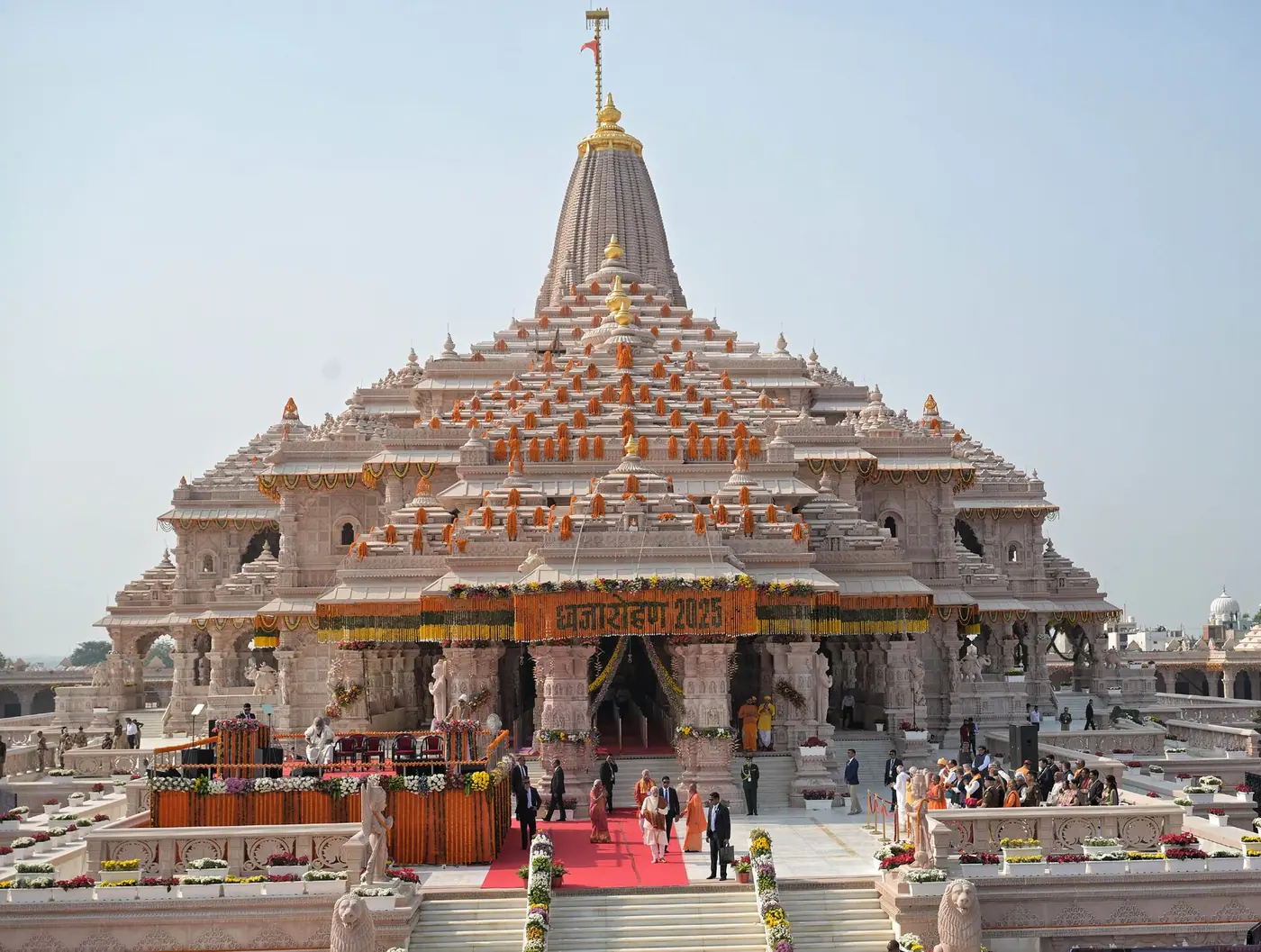
Built at the site Hindus revere as Rama's birthplace, the temple's ground-floor sanctum holds Ram Lalla, the child form of Rama, consecrated on 22 January 2024. Construction followed the Supreme Court's unanimous judgment of 9 November 2019 in the Ayodhya title dispute, which awarded the 2.77-acre site for a temple under a trust and directed that a separate five-acre plot be given for a mosque. The flag-hoisting on 25 November 2025 was described by the Government of India as marking completion. Rama Navami draws very large crowds. Entry rules are set by the Shri Ram Janmabhoomi Teerth Kshetra trust. Ram Janmabhoomi temple page.
Hanuman Garhi, Ayodhya
About 1 km from Ayodhya railway station, according to the district administration, Hanuman Garhi, 'Hanuman's fort', is built as a fortified complex reached by an entrance staircase. The image shows Bal Hanuman on the lap of his mother, Anjani. According to local tradition recorded by the district administration, Hanuman lived at this spot and guarded Ayodhya, so pilgrims to the town's Rama shrines also visit Hanuman Garhi. Sources differ on its origins: tradition credits Vikramaditya, while Livemint describes an 18th-century shrine built for the Ramanandi naga ascetics. Confirm queue rules before travelling. Hanuman Garhi temple page.
Hanuman Setu Mandir (Sankat Mochan Hanuman), Lucknow
Near Lucknow University, the shrine at Hanuman Setu is known as the Sankat Mochan Hanuman temple. It is linked with the saint Neem Karoli Baba, and Uttar Pradesh Tourism included it in the Neeb Karori Baba circuit announced in September 2026. The temple is decorated with flowers for Bada Mangal, the Tuesdays of Jyeshtha, when devotees crowd in, and long queues formed on Hanuman Jayanti in 2026. No official darshan timings were found; confirm with the temple management. Hanuman Setu temple page and our Hanuman temples guide.
For the festival season in the state, see Ayodhya Deepotsav 2026 and Dussehra 2026 in Uttar Pradesh.
Mathura-Vrindavan (Braj): Krishna's land
Braj temples follow a festival year of swings in Shravan, Janmashtami and Holi. Our famous Krishna temples guide and Thursday and Vishnu worship guide give wider context.
Shri Krishna Janmasthan Temple, Mathura
At Katra Keshavdeva in Mathura, this temple complex stands at the site revered by Hindus as the birthplace of Krishna; according to the trust, Krishna manifested himself here in the prison cell of King Kansa. According to local tradition recorded by the trust, the original temple here was built by Vajranabha, Krishna's great-grandson, and the trust cites a Sanskrit inscription recording a new temple in 1150 CE. The Shahi Idgah mosque stands adjacent, and the site has been the subject of long-running litigation, whose current status HinduTone could not confirm. Security rules on what visitors may carry can change. Krishna Janmasthan temple page.
Shri Krishna Janmasthan Garbh Griha
The Garbh Griha is the shrine at the heart of the Janmasthan complex, revered as Kansa's prison cell where Krishna was born to Devaki and Vasudeva. A temple of Ashtabhuja Maa Yogmaya stands beside the entrance of the cell. The Shri Krishna Janmasthan Seva Sansthan publishes Garbh Griha timings and streams live darshan on its website. On Janmashtami a night programme ends at midnight with the Prakatya darshan, an aarti and the Janmabhishek with panchamrit; Nandotsav follows in the Bhagavata Bhavan. Garbh Griha temple page and our Krishna Janmashtami 2026 guide.
Shri Dwarkadhish Temple, Mathura
On the bank of the Yamuna in the Chhatta Bazaar area of the old city, Krishna is worshipped as Dwarkadhish, the lord of Dwarka, in a black marble image called Dwarkanath beside a white marble Radharani. The present building was built in 1814 by Seth Gokul Das Parikh, treasurer of the Gwalior State under the Scindias, according to the district administration. The temple follows the Pushtimarg tradition, which shapes its darshan sessions and festivals: a newly decorated hindola each day of Sawan, a gold and silver swing on Raksha Bandhan, a Holi season that opens at Magh Purnima with rasiya songs, and a janm darshan near midnight on Janmashtami. Dwarkadhish temple page.
Sri Radha Raman Mandir, Vrindavan
This Vrindavan temple worships Krishna as Radha Raman, the beloved of Radha, in a shaligram deity devotees believe is self-manifested. The district administration counts it among the Sapta Devalaya, the seven Gaudiya temples of Vrindavan, and says it was built around 1542 at the request of Gopala Bhatta Goswami, one of the six Goswamis of Vrindavan. According to tradition, he brought twelve shaligram stones from the Gandaki river in Nepal, and one morning one had taken the form of Krishna. Prasad is prepared by the sevayat families following a calendar of seva turns, and outsiders are not allowed into the kitchen. The Prakatya Utsav on Vaishakh Shukla Purnima brings a mahabhishek with milk and panchamrit and large crowds. Radha Raman temple page.
Prem Mandir, Vrindavan
On the outskirts of Vrindavan in Mathura district, Prem Mandir is a white marble temple to Radha and Krishna, devoted to their divine love ('prem' means love). It was envisioned by Jagadguru Shri Kripalu Ji Maharaj, and its complex spreads over about 54 acres, according to the Times of India, and it is set within well-kept gardens. The temple was inaugurated on 17 February 2012 with Vedic hymns; a report ahead of the ceremony said construction took 11 years and used Italian marble. Opening hours and evening programmes can change; confirm before visiting. Prem Mandir temple page.
Kanpur and Gorakhpur
JK Temple (Shri Radhakrishna Temple), Kanpur
In Kanpur, the JK Temple, also called the Juggilal Kamlapat Temple, is popularly known as the Radhakrishna Temple. It was built by the JK Trust, which still pays for its major maintenance. It has five shrines: the central Radhakrishna shrine and shrines of Laxminarayan, Ardhanarishwar, Narmadeshwar and Hanuman. The district administration and the Ministry of Tourism describe its architecture as a blend of ancient and modern styles, with ventilated level roofs over the mandapas. Janmashtami brings coloured lights, a fair and a musical fountain show, a swing festival runs from Hariyali Teej to Raksha Bandhan, and Holi opens with a Rangotsav of flowers. JK Temple page.
Gorakhnath Temple, Gorakhpur
On Nepal Road, about 4 km from Gorakhpur Railway Station, this is the principal shrine of the yogi Gorakhnath and a temple of the Nath monastic tradition; devotees regard Guru Gorakhnath as a form of Shiva. Its head carries the title Gorakshpeethadhishwar, held by Mahant Yogi Adityanath. According to tradition, Gorakhnath came from the Jwala Devi shrine in Kangra seeking rice and lentils as alms, and his begging bowl never filled; devotees see the Makar Sankranti khichdi offering as continuing that story. Lakhs come from Uttar Pradesh, Bihar and Nepal, and a month-long Khichdi Mela starts on 14 January. The large campus holds an akhand jyoti and an akhand dhuna. Gorakhnath temple page and the Lord Shiva hub.
Uttar Pradesh temples at a glance
| Temple | District/City | Deity | Known for |
|---|---|---|---|
| Kashi Vishwanath | Varanasi | Shiva | Jyotirlinga; Kashi Vishwanath Dham |
| New Vishwanath (BHU) | Varanasi | Shiva | Campus temple; 252-ft spire |
| Nepali Mandir | Varanasi | Shiva (Pashupatinath) | Wooden pagoda on Lalita Ghat |
| Tulsi Manas Mandir | Varanasi | Rama | Ramcharitmanas verses on walls |
| Ram Janmabhoomi Mandir | Ayodhya | Rama (Ram Lalla) | Rama Navami; Nagara style |
| Hanuman Garhi | Ayodhya | Bal Hanuman | Fortified temple |
| Hanuman Setu | Lucknow | Sankat Mochan Hanuman | Bada Mangal |
| Krishna Janmasthan | Mathura | Krishna | Birthplace complex |
| Janmasthan Garbh Griha | Mathura | Krishna | Midnight Prakatya darshan |
| Dwarkadhish | Mathura | Krishna (Dwarkadhish) | Pushtimarg; Sawan hindola |
| Radha Raman | Vrindavan (Mathura) | Krishna (Radha Raman) | Shaligram deity; Prakatya Utsav |
| Prem Mandir | Vrindavan (Mathura) | Radha Krishna | White marble, 2012 |
| JK Temple | Kanpur Nagar | Radha Krishna | Five shrines; Janmashtami |
| Gorakhnath Temple | Gorakhpur | Guru Gorakhnath | Khichdi Mela |
Pilgrimage circuits in Uttar Pradesh
- Kashi circuit: Kashi Vishwanath and the Nepali Mandir on the riverfront, ideally reached by boat, then Tulsi Manas Mandir at Durgakund and the New Vishwanath Temple on the BHU campus.
- Ayodhya circuit: Ram Janmabhoomi Mandir and Hanuman Garhi, which pilgrims to Ayodhya's Rama shrines also visit, with Hanuman Setu in Lucknow.
- Mathura-Vrindavan circuit: the Krishna Janmasthan and its Garbh Griha, then Dwarkadhish in the old city, followed by Radha Raman and Prem Mandir in Vrindavan.
- Neeb Karori Baba circuit: Uttar Pradesh Tourism's packages start from Lucknow and include Hanuman Setu Mandir; check official tourism channels.
- Eastern and central UP: Gorakhnath Temple in Gorakhpur, and the JK Temple in Kanpur.
Other Braj and Kashi shrines, and the Sangam at Prayagraj, are also major pilgrimage sites; they are not yet in our source-checked set.
The records do not name a single best season for Uttar Pradesh's temples. Festival days such as Maha Shivaratri, Shravan, Rama Navami, Janmashtami, Holi and Makar Sankranti are the most crowded.
Visiting from abroad
Lal Bahadur Shastri International Airport at Varanasi, Maharishi Valmiki International Airport at Ayodhya, Lucknow, Gorakhpur, Prayagraj, Kanpur (Chakeri), Agra (Kheria) and Indira Gandhi International Airport in Delhi are the airports named in these records. Take a rest day after a long flight, and book darshan and services only through official temple or government channels such as the Kashi Vishwanath trust portal. Dress modestly, carry a copy of your passport, and keep small cash for offerings and footwear counters. Our temple visit guide covers darshan and etiquette, and our temple safety tips help in festival crowds. See also the Hindu days of the week.
Frequently asked questions
Which Uttar Pradesh temples does this guide cover?
All 14 Uttar Pradesh temples in HinduTone's source-checked records, grouped into Varanasi, Ayodhya and Lucknow, Mathura-Vrindavan, and Kanpur and Gorakhpur. Each has its own section.
Can I book darshan at Kashi Vishwanath online?
The record says darshan, aartis and paid services such as Sugam Darshan are run by the Shri Kashi Vishwanath Temple Trust and can be booked through its official portal. The trust suspends online bookings and VIP protocol darshan on peak days such as Maha Shivaratri, so check shrikashivishwanath.org before you plan.
What can I carry into the Ram Janmabhoomi Mandir in Ayodhya?
Rules on phones, bags and other items, along with entry passes and security screening, are set by the Shri Ram Janmabhoomi Teerth Kshetra trust and can change, especially on festival days. Confirm current rules with the trust before travelling.
When is Janmashtami celebrated at Mathura and Vrindavan temples?
Janmashtami falls in Bhadrapada (August to September). The records describe midnight darshans at the Krishna Janmasthan and Dwarkadhish and an abhishek at Radha Raman. Crowds are very heavy.
What is the Khichdi Mela at Gorakhnath Temple?
Around Makar Sankranti in January, devotees offer khichdi to Guru Gorakhnath, and a month-long mela begins on 14 January each year, according to the Gorakhpur district administration.
Is a visit to these temples a guaranteed remedy?
No. The records report beliefs such as liberation in Kashi and wish-fulfilment on Tulsi Vivah at Tulsi Manas Mandir. These are matters of faith, and no outcome is guaranteed.
Editor's note (20 October 2026)
Every temple fact in this guide comes from HinduTone's source-checked temple records, which were researched against district administrations, state tourism and endowment departments, newspapers and temple directories and checked on 11 October 2026. Claims resting on a single source and temples not yet verified are left out. Timings and seva rules change; please confirm them with the temple before travelling.
Related guides
- 12 Jyotirlingas: complete guide
- Famous Krishna temples in India
- Krishna Janmashtami 2026
- Ayodhya Deepotsav 2026
- Dev Deepawali in Varanasi
- Kalabhairava, guardian of Kashi
- Famous temples in Maharashtra
- Famous temples in Tamil Nadu
- Famous temples in Karnataka
- Famous temples in Uttarakhand
- Famous temples in Madhya Pradesh
- Lord Rama hub
- Lord Krishna hub
- Lord Hanuman hub
- Hindu temple visit guide: darshan, dress code and etiquette
You might also like
Famous Temples in Madhya Pradesh: A Source-Checked Guide to Mahakaleshwar, Omkareshwar, Khajuraho, Orchha and Datia
Famous Temples in Andhra Pradesh: A Source-Checked Guide from Tirumala and Simhachalam to Srikurmam, Lepakshi and Kanipakam
Famous Temples in Maharashtra: A Source-Checked Guide to Ashtavinayak, Jyotirlingas, Pandharpur, Kolhapur and More