Famous Temples in Odisha: A Source-Checked Guide to Puri, Bhubaneswar, Biraja, Tara Tarini and Western Odisha
A guide to 12 Odisha temples, written only from HinduTone's source-checked temple records: Jagannath at Puri and the Baladevjew temple at Ichhapur; Bhubaneswar's Lingaraj, Ananta Vasudeva, Kapilesvara, Mukteswar and Rajarani; the goddess shrines of Biraja at Jajpur and Tara Tarini in Ganjam; and Harishankar, Nrusinghanath and Hanuman Vatika in western Odisha. Each entry covers deity, recorded history, festivals and visitor notes, with a summary table, pilgrimage circuits, tips for visitors from abroad and FAQs.
A guide to 12 Odisha temples, written only from HinduTone's source-checked temple records: Jagannath at Puri and the Baladevjew temple at Ichhapur; Bhubaneswar's Lingaraj, Ananta Vasudeva, Kapilesvara, Mukteswar and Rajarani; the goddess shrines of Biraja at Jajpur and Tara Tarini in Ganjam; and Harishankar, Nrusinghanath and Hanuman Vatika in western Odisha. Each entry covers deity, recorded history, festivals and visitor notes, with a summary table, pilgrimage circuits, tips for visitors from abroad and FAQs.
Quick answer: This guide covers the 12 Odisha temples in HinduTone's source-checked records, in four groups: Puri and the Jagannath tradition (Jagannath Temple, Puri, and the Baladevjew Temple at Ichhapur), the old temples of Bhubaneswar (Lingaraj, Ananta Vasudeva, Kapilesvara, Mukteswar and Rajarani), the goddess shrines of Biraja at Jajpur and Tara Tarini in Ganjam, and western Odisha (Harishankar, Nrusinghanath and Hanuman Vatika in Rourkela).
Last updated: 20 October 2026. Every entry below is built from HinduTone's source-checked temple records, checked on 11 October 2026. Darshan hours, dress codes and festival dates change, so confirm timings with the temple or its administration before you travel.
Puri and the Jagannath tradition
Jagannath Temple, Puri
On the Odisha coast, the Shree Jagannath Temple enshrines Jagannath, a form of Vishnu, with Balabhadra, Subhadra and the Sudarshana chakra as carved wooden (daru) images on the Ratna Simhasana. The Puri district administration names Puri as one of the four dhams, with Dwarka, Badrinath and Rameswaram. According to the temple administration (SJTA), the present temple was built in the 12th century under Anantavarman Chodaganga Deva, and Anangabhima Deva III installed the deities in 1230 CE; tradition credits the original shrine to King Indradyumna. Food cooked in the temple kitchen is offered to Jagannath, sanctified at the Vimala shrine and shared as Mahaprasada at the Ananda Bazaar. In certain years the images are renewed in the Nabakalebara ceremony, most recently in 1996 and 2015.
The Ratha Yatra in Ashadha (June to July) takes the deities on the chariots Nandighosha, Taladhwaja and Darpadalana to the Gundicha temple, after the Gajapati king sweeps the chariots in the chhera pahanra ritual; the Bahuda Yatra brings them back. The Snana Yatra bathing festival is followed by about two weeks of anasara, when public darshan is not available. Entry is restricted to Hindus, a dress code has applied since January 2024, and the Lion Gate is the entry point. The nearest airport is Bhubaneswar, about 60 km away per the district administration. Jagannath Temple, Puri page, plus our Rath Yatra 2026 guide and Thursday guide.
Baladevjew Temple, Ichhapur (Tulasi Khetra)
In the centre of Ichhapur village, about 2 km south-west of Kendrapara town, this living temple is centred on Balabhadra, honoured as Baladevjew, the elder brother of Jagannath, with Jagannath and Subhadra worshipped alongside him. Devotees know the area as Tulasi Khetra. The IGNCA heritage survey dates the temple to the middle of the 18th century, during Maratha rule; accounts of the builder differ, and neither is confirmed. The annual Rath Yatra, on 16 July in 2026, takes the three deities on the 14-wheeled chariot Brahma Taladhwaja, reported as 65 to 67 feet tall, along a route of about 2 km to the Mausima temple. At Snana Purnima the sacred water is poured on the deities' feet rather than their heads. Police are deployed at festival crowds. Baladevjew Temple page.
Bhubaneswar: the temples of Ekamra Kshetra
Lingaraj Temple
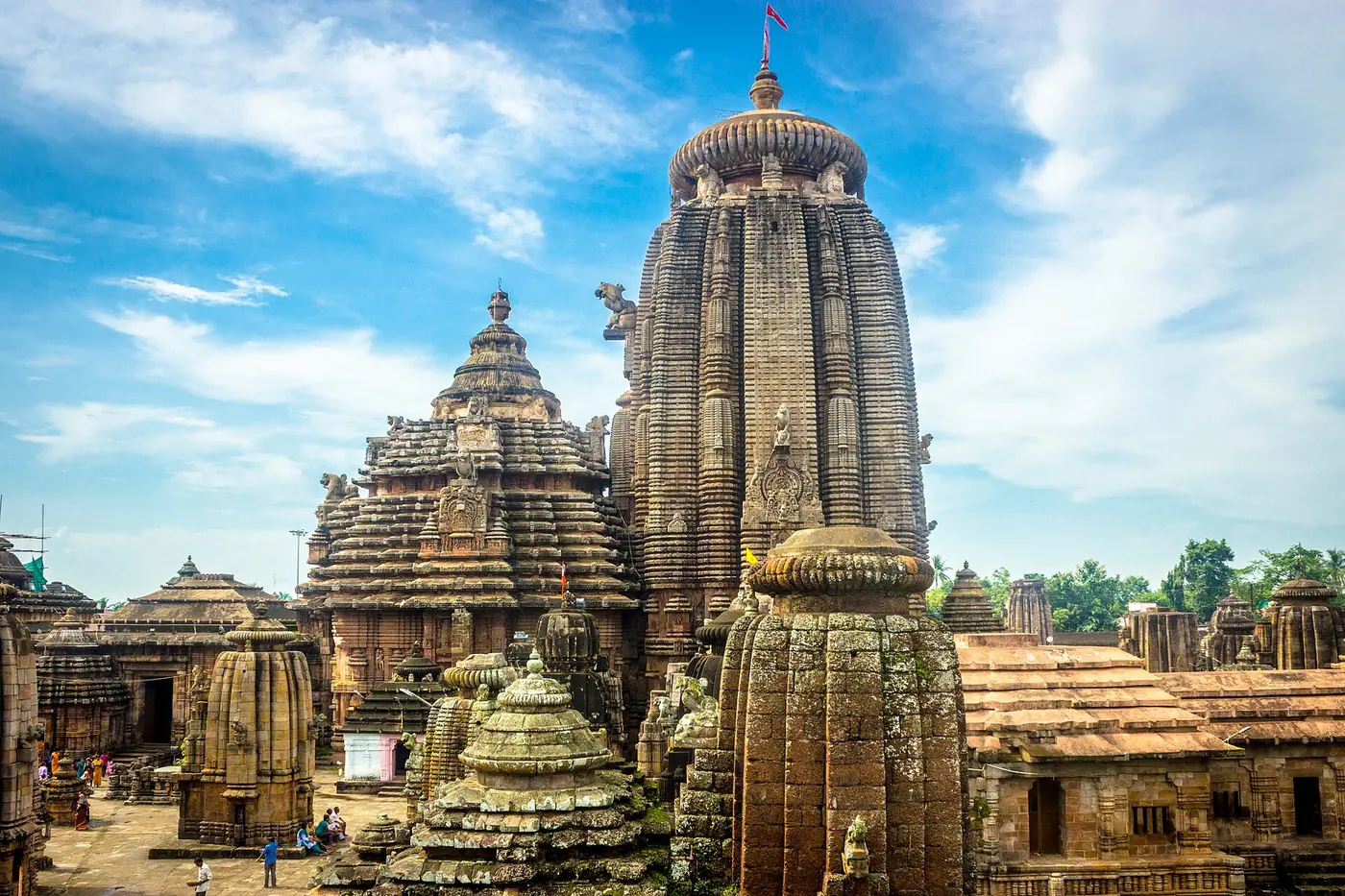
In Old Town Bhubaneswar, near the Bindusagar tank, the Lingaraj Temple enshrines a Swayambhu (self-manifested) linga known as Krittivasa. Odisha Tourism describes Shiva here as Harihara, a joint form of Shiva and Vishnu. According to the Orissa Review, medieval texts such as the Ekamra Purana place this temple at the centre of Ekamra Kshetra, and under the Eastern Ganga rulers Vaishnava elements entered worship: Jaya and Vijaya on the doorjambs, a Garuda pillar beside the Nandi, tulsi offered with bel leaves, and a temple flag fixed to a Pinaka bow. Odisha Tourism dates the present temple to the 11th century; its curved tower rises to about 55 metres. Shivaratri and the Rukuna Ratha Jatra (Ashokashtami car festival) are its main festivals. Entry is restricted to Hindus, with a viewing platform outside, and the temple closes for part of the afternoon. Lingaraj Temple page. See also our 12 Jyotirlingas guide and Monday guide.
Ananta Vasudeva Temple
About 0.2 km from the Lingaraj Temple, near Bindusagar, this Vaishnava temple enshrines Vishnu as Ananta (Balabhadra) and Vasudeva (Jagannatha), with the goddess Ekanamsa (Subhadra) between them, as described by Odisha Tourism. Odisha Tourism credits Queen Chandrika Devi of the Eastern Ganga dynasty with building it in the 13th century, and an Orissa Review chronology places this in 1278. The temple is known for its daily food offering: traditional Odia temple food served as abhada, a meal of rice, dal and vegetable curries, reflecting the belief that the Lord's food is shared by all devotees. It is on the ASI's list of centrally protected monuments. Ananta Vasudeva Temple page.
Kapilesvara Siva Temple, Kapileswar
At the end of Kapileswar Road, about a kilometre from the Lingaraj temple, this living Shiva temple enshrines a Sivalinga worshipped as Kapileshwar. An inscription in the temple ascribes it to Gajapati Kapilendradeva of the Suryavamsi dynasty, placing it in the 14th century per the IGNCA record, while other sources describe a 14th-century renovation of an older temple; the founding date is not settled. The temple stands on the northern bank of the Manikarnika tank. On Maha Shivaratri thousands of devotees come at night, keep Jagara with earthen lamps and take a ritual dip in the tank; Sitalasasthi is also observed. The Ministry of Culture moved in 2023 to make it a monument of national importance, and by August 2026 the ASI had begun phase-wise restoration. Kapilesvara Temple page.
Mukteswar Temple
Beside the road from Bhubaneswar towards Puri, this living Shiva temple enshrines a Sivalinga worshipped as Mukteswara, which the Ministry of Tourism renders as Lord of Spiritual Freedom. It is best known for its arched stone torana on sixteen-sided pillars. The temple carries no inscriptions; the IGNCA record assigns it to Somavamshi rule in the 10th century, and the Ministry of Tourism gives 875 to 904 CE under Yayati I, so these are scholarly estimates. Sivaratri, Kartika Purnima and Jalasaya are observed, and Odisha Tourism presents the Mukteswar Dance Festival of Odissi here. Confirm visiting hours with the ASI Bhubaneswar Circle. Mukteswar Temple page.
Rajarani Temple
On Tankapani Road in Old Town, Rajarani is no longer a place of worship: the heritage record describes it as a non-living temple whose presiding deity is missing, and it is classed as Shaiva. It is an ASI-protected monument, known for the carved figures on its outer walls, including Surya, Nataraja, Ardhanarishvara, Lakulisa, Harihara and Parvati, with celestial female figures and couples. The IGNCA record dates it to the end of the 10th or start of the 11th century, Somavamsi period. The grounds host the three-day Rajarani Music Festival of Hindustani and Carnatic music, organised by the state tourism department. No daily worship is held. Rajarani Temple page.
Goddess shrines: Biraja and Tara Tarini
Biraja Temple, Jajpur
At Jajpur, the goddess Biraja is shown in a rare two-armed form as Mahishamardini holding a trident. According to later Tantric tradition, the navel of Sati fell here, and Odisha Tourism lists the temple among the 18 Maha Shakti Pithas; the temple trust notes that the earlier Kurma and Matsya Puranas make no such link. Jajpur is also a pitri tirtha, and pilgrims offer pinda at the Nabhi Gaya well inside the compound. The IGNCA report dates the presiding image to about the Gupta period; the present temple was rebuilt in the 19th century after the earlier one was destroyed in 1568. During Dussehra the goddess rides the chariot Singhadhwaja through the town; Triveni Amavasya, Dola Purnima, Varuni Snana and Savitri Amavasya are also observed. Biraja Temple page, plus our Dussehra 2026 in Odisha guide.
Tara Tarini Temple, Ganjam
On Kumari hill, on the south bank of the Rushikulya river near Purushottampur, the twin goddesses Tara and Tarini are worshipped as two stones shaped as human faces and adorned with gold and silver, with brass processional heads between them. The Taratarini Development Board describes them as household goddesses of almost every family in south Odisha. According to Puranic tradition recorded by the board, the breasts of Sati fell here; lists of Shakti Pithas differ between texts. The board notes that no historical record fixes when worship began, and points to Ashoka's rock edict at Jaugada about 4 km away. The Chaitra Parba falls on every Tuesday of Chaitra, when many families have children's heads tonsured as a vow. Pilgrims climb 999 steps, drive up the back road or take the ropeway; Brahmapur station is about 32 km away. Tara Tarini Temple page. See also our Shakti Peethas guide and Friday guide.
Western Odisha: Gandhamardan hills and Rourkela
Harishankar Temple, Balangir
At the foot of the Gandhamardan hills in Balangir district, Harishankar is a living temple where the presiding deities are Hari (Krishna) and Hara, the latter a linga set in a circular base; the Orissa Post describes it as embodying the union of Shaiva and Vaishnava traditions. According to the IGNCA record, it was built in the 15th century by Durlabha Devi, a queen of the Chauhan dynasty. A local legend tells of a man digging for roots who found a stone above a spring, after which Shiva appeared in a dream. Shivaratri and Nrusimha Chaturdashi are its main occasions. Polythene and plastic are banned, soap and shampoo are not to be used at the waterfall, and the stream can flood in heavy rain. Harishankar Temple page.
Sri Nrusinghanath Temple, Paikmal
On the other side of the Gandhamardan hills, near Paikmal in Bargarh district, Vishnu is worshipped as Nrusinghanath, a form of Narasimha. According to the legend retold in the Orissa Review, Vishnu took the form of Marjara Keshari, a cat-lion, to destroy a rat demon. The temple trust dates the temple to the 15th century under King Baijal Dev of Patna. Pilgrims traditionally bathe in the Papaharini stream before entering, and the Bhimdhar and Chaldhar waterfalls lie upstream. Nrusingha Chaturdashi in April to May brings a grand abhisheka and the Baisakh Mela; Ratha Yatra and Nuakhai, when the first grain is offered, are also kept. The trust asks for traditional attire and bars photography inside. Raipur is the nearest airport on its list of routes. Nrusinghanath Temple page. See our Narasimha mantras collection.
Hanuman Vatika, Rourkela
Within Rourkela city in Sundargarh district, Hanuman Vatika is a garden temple complex set up by the Hanuman Vatika Trust around a standing statue of Hanuman about 75 feet tall. Around it stand shrines of Rama with Hanuman, Jagannath with Mahalakshmi, Sarala, Radha Krishna, Parvati and Santoshi, the twelve Jyotirlingas of Shiva, and a Ganesha temple at the entrance. Maha Shivaratri and Rath Yatra are among its annual events, and in January 2024 crowds gathered here on the day of the Ram Lalla consecration at Ayodhya. The site becomes very crowded on festival days, and redevelopment was planned in 2026, so confirm arrangements with the trust. Hanuman Vatika page, plus our Hanuman temples guide and Tuesday guide.
The Sun Temple at Konark is also a major heritage site; it is not yet in our source-checked set.
Odisha temples at a glance
| Temple | District/City | Deity | Known for |
|---|---|---|---|
| Jagannath Temple | Puri | Jagannath | Char dham; Ratha Yatra |
| Baladevjew Temple | Kendrapara | Balabhadra | Brahma Taladhwaja chariot |
| Lingaraj Temple | Bhubaneswar | Shiva (Harihara) | Ekamra Kshetra centre |
| Ananta Vasudeva | Bhubaneswar | Vishnu | Abhada food offering |
| Kapilesvara | Bhubaneswar | Shiva | Shivaratri Jagara |
| Mukteswar | Bhubaneswar | Shiva | Stone torana; dance festival |
| Rajarani | Bhubaneswar | None (monument) | Wall sculpture; music festival |
| Biraja | Jajpur | Biraja (Durga) | Shakti Pitha; Nabhi Gaya |
| Tara Tarini | Ganjam | Tara and Tarini | Chaitra Tuesdays; tonsuring |
| Harishankar | Balangir | Hari and Hara | Gandhamardan waterfall |
| Nrusinghanath | Bargarh | Narasimha | Cat-lion legend; Baisakh Mela |
| Hanuman Vatika | Rourkela | Hanuman | 75-foot statue |
Pilgrimage circuits in Odisha
- Puri and Bhubaneswar: Jagannath Temple at Puri with the Bhubaneswar group: Lingaraj and Ananta Vasudeva near Bindusagar, Mukteswar and Rajarani nearby, and Kapilesvara at the end of Kapileswar Road. Konark is not yet in our source-checked set.
- Jagannath tradition: Puri, then Ichhapur near Kendrapara for Balabhadra's own Rath Yatra and Snana Purnima, with Ananta Vasudeva in Bhubaneswar, where the same three deities are worshipped as Ananta, Vasudeva and Ekanamsa.
- North of Bhubaneswar: Biraja at Jajpur, reached by road via Cuttack, for the goddess and ancestral rites at Nabhi Gaya, combined with the Bhubaneswar temples.
- South Odisha: Tara Tarini on Kumari hill, reached from Brahmapur (Berhampur).
- Gandhamardan circuit: Odisha Tourism's western Odisha itinerary pairs Harishankar with the Nrusinghanath hill temple before continuing to Balangir; Hanuman Vatika in Rourkela suits a separate trip.
The records do not name a single best season for Odisha's temples, beyond noting that Nrusinghanath draws many visitors in the cool season. Festival days are crowded; see our Kartika month in Odisha guide for the current season.
Visiting from abroad
Biju Patnaik International Airport in Bhubaneswar is the airport named in most of these records, and Raipur in Chhattisgarh for Nrusinghanath. Take a rest day after a long flight before temple queues, hill climbs or festival crowds, and book any services only through official temple or government channels. Dress modestly in traditional clothing, carry a copy of your passport, and keep small cash for offerings and prasad; Puri provides free shoe and phone deposit stands. Our temple visit guide covers darshan and etiquette, and our temple safety tips help in festival crowds. See also the Hindu days of the week.
Frequently asked questions
Which Odisha temples does this guide cover?
All 12 Odisha temples in HinduTone's source-checked records: Jagannath at Puri and Baladevjew at Ichhapur; Lingaraj, Ananta Vasudeva, Kapilesvara, Mukteswar and Rajarani in Bhubaneswar; Biraja at Jajpur and Tara Tarini in Ganjam; and Harishankar, Nrusinghanath and Hanuman Vatika in western Odisha. Each has a full section.
Can non-Hindus enter the Jagannath and Lingaraj temples?
According to the Shree Jagannath Temple Administration, entry to the Puri temple is restricted to Hindus; visitors of other faiths can watch the Rath Yatra on the Grand Road. Odisha Tourism says the same restriction applies at Lingaraj, where a viewing platform outside the compound lets visitors see the architecture.
Is there a dress code at Puri?
Yes. Since 1 January 2024 the SJTA has barred shorts, half-pants, ripped jeans, skirts and sleeveless clothing. Footwear, leather items, phones and cameras are not allowed inside, and free deposit stands are provided near the Lion Gate.
Why can't devotees see Jagannath for about two weeks in June?
After the Snana Yatra bathing festival the deities withdraw into seclusion, called anasara, until the new moon of Ashadha. According to tradition they are unwell, and public darshan is not available during this time.
Is a visit to these temples a guaranteed remedy?
No. Devotees offer pinda for ancestors at Biraja, make tonsuring vows at Tara Tarini and bathe in Mukteswar's Marichi Kunda water hoping for children, and the records report those beliefs. They are matters of faith, and no outcome is guaranteed.
Editor's note (20 October 2026)
Every temple fact in this guide comes from HinduTone's source-checked temple records, which were researched against district administrations, state tourism and endowment departments, newspapers and temple directories and checked on 11 October 2026. Claims resting on a single source and temples not yet verified are left out. Timings and seva rules change; please confirm them with the temple before travelling.
Related guides
- Jagannath Rath Yatra 2026 guide
- Dussehra and Durga Puja 2026 in Odisha
- Kartika month in Odisha 2026
- 12 Jyotirlingas guide
- 108 Shakti Peethas guide
- Famous temples in Andhra Pradesh
- Famous temples in Tamil Nadu
- Famous temples in West Bengal
- Famous Krishna temples in India
- Lord Shiva hub
- Lord Vishnu hub
- Goddess Durga hub
- Lord Hanuman hub
- Hindu temple visit guide: darshan, dress code and etiquette
You might also like
Famous Temples in Maharashtra: A Source-Checked Guide to Ashtavinayak, Jyotirlingas, Pandharpur, Kolhapur and More
Famous Krishna Temples in India: 13 Source-Checked Temples from Guruvayur to Mathura, Vrindavan, Dakor and Pandharpur
Famous Temples in Uttarakhand: A Source-Checked Guide to Kedarnath, Badrinath, Tungnath, Haridwar, Almora and More